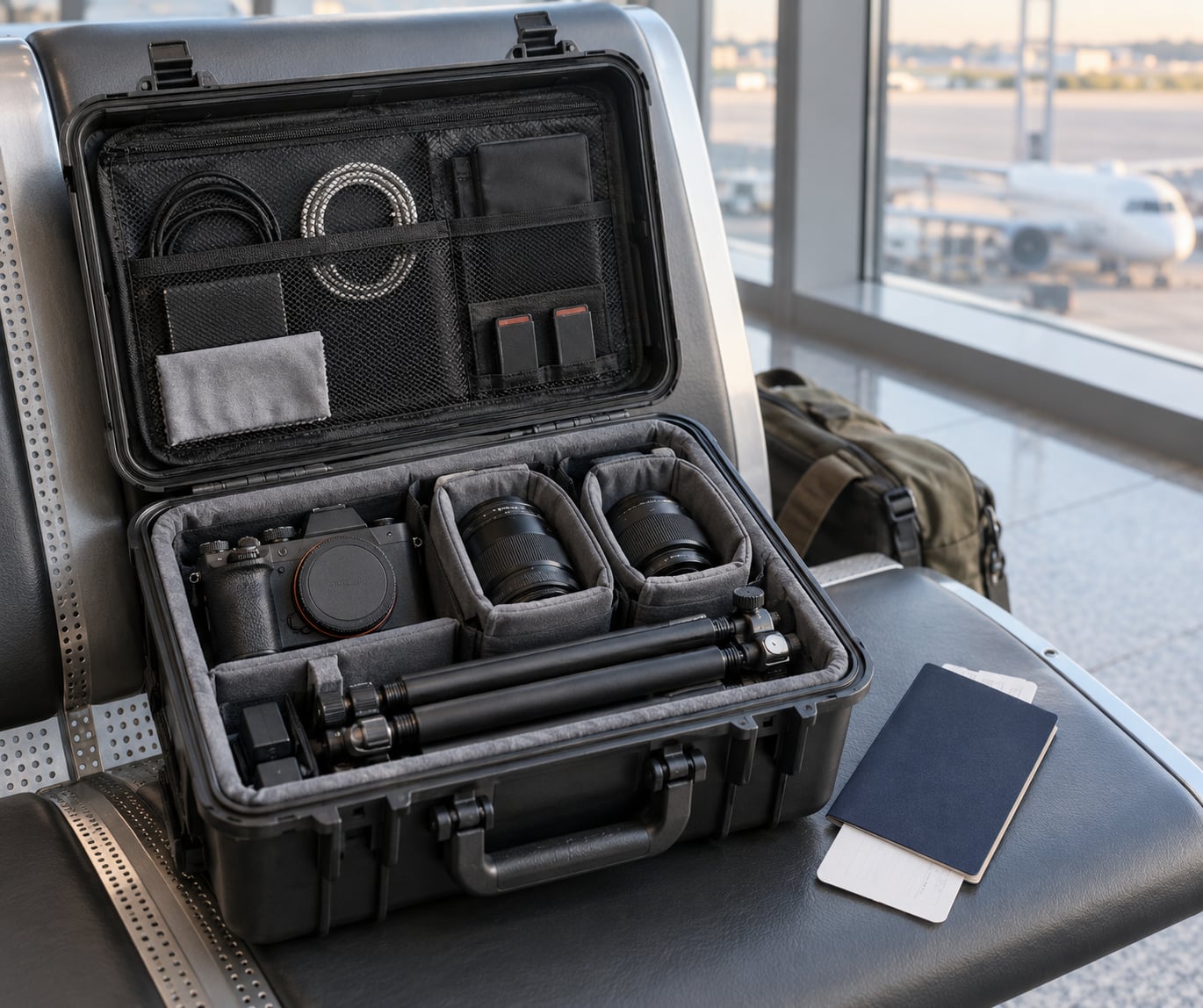
Learning how to travel with camera gear on a plane comes down to one rule: camera bodies, lenses, and every lithium battery ride in your carry-on or personal item, never in checked luggage. Everything else is detail — what to pack, how to pad it, and what to say if a gate agent reaches for your bag. Budget about 30 minutes the night before and the airport day stays uneventful.
I fly with a working kit most months, and the difference between a smooth trip and a bad one is decided at home, not at the gate. Bags get dropped, bins fill up, and rules differ on every carrier. Check them yourself, split your kit so nothing irreplaceable shares a fate with your socks, and photograph the serial numbers before you leave.
Below is the process I actually use, in order, with the numbers that matter (100 Wh, 160 Wh, 300 Wh) and the scripts that get you through a gate-check argument without raising your voice.
Table of Contents
- What You Need
- Trip-planning information
- Documents and records
- Packing and protective gear
- Step-by-Step: How to Travel with Camera Gear on a Plane
- 1. Check the airline’s rules for traveling with camera gear on a plane
- 2. Decide what travels with you and what is checked
- 3. Protect, document, and distribute your equipment
- 4. Pack the camera and accessories correctly
- 5. Get through airport security safely
- 6. Inspect and reassemble the kit after the flight
- Common Mistakes
- Frequently Asked Questions
- Does my camera bag count as a carry-on or a personal item?
- Can I bring a camera that has a lithium battery on a plane?
- Does a camera battery count as a lithium battery?
- Will TSA ruin my digital camera or memory cards?
- What happens if I pack a lithium battery in checked luggage by accident?
- What should I do if my gear is damaged or lost in transit?
- Conclusion
What You Need
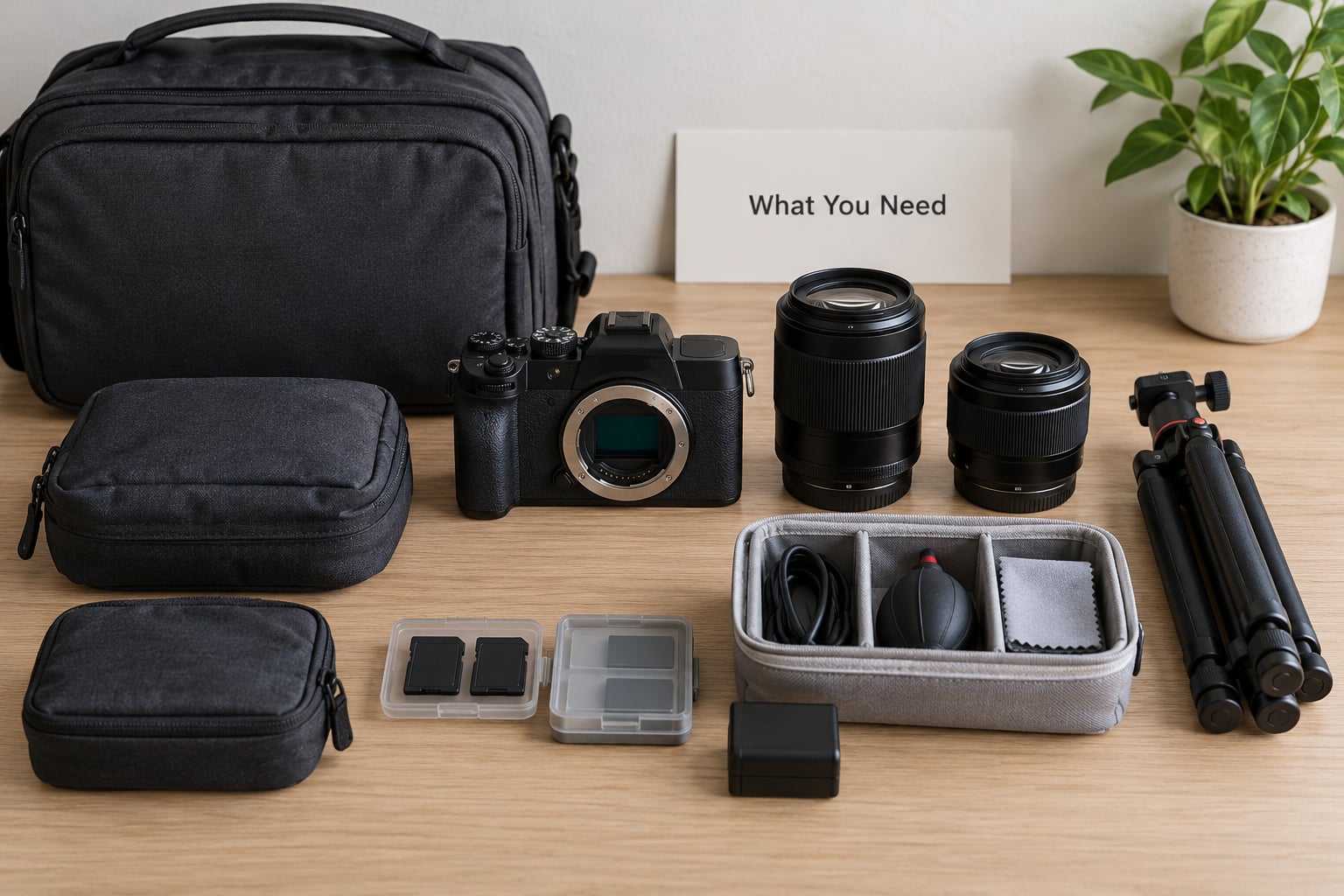
Start with information, not gear. The whole plan falls apart if the rules change and you find out at the counter.
Trip-planning information
- Airline baggage rules for every carrier and aircraft type on your itinerary, including connections. Carry-on weight and dimension limits vary more than most people expect, and codeshares use the operating carrier’s rules.
- Your boarding group. It decides your odds of an overhead bin.
- The lithium-battery rules published by the FAA PackSafe site, your national aviation authority, and IATA Dangerous Goods Regulations.
- PreCheck or Global Entry status, if you have it — the dedicated lane often has fewer people in it.
Documents and records
- Passport or ID, visa where needed, boarding pass, and any press or media credentials you hold.
- Gear receipts or a written inventory with model and serial number for every body, lens, flash, drone, and cinema battery.
- Your home insurance rider or travel insurance policy number, and the insurer’s 24-hour claims line saved in your phone.
Packing and protective gear
- A padded camera backpack that fits the smallest allowance on your itinerary, with lockable buckles or a TSA-approved lock.
- Padded dividers or a hard-shell case if anything in the kit is fragile or high value.
- A battery case or padded pouch that keeps terminals covered and batteries from touching each other.
- Lens cloths, a blower, and a small cleaning kit — bags pick up grit on the belt and in the hold.
- One or two rolls of tape or a strap for flagging a damaged bag, plus a phone charger and a multi-USB charger.
Step-by-Step: How to Travel with Camera Gear on a Plane
1. Check the airline’s rules for traveling with camera gear on a plane
Open the airline’s baggage page, not a forum thread. You are looking for four things: carry-on dimensions and weight, the personal-item allowance, checked-bag fees, and the prohibited-items list including batteries.
Then check each leg separately. A domestic hop on a major carrier can allow a 22 x 14 x 9 inch bag with no weight cap, while the same airline’s transatlantic service often publishes a 10 kg limit and enforces it at the gate with a bag sizer.
European and Asian low-cost carriers are stricter still, and photographers on those routes report routinely being asked to weigh a carry-on and then check it. If your kit will not fit the strictest allowance on the itinerary, you need to know that before you pack, not at 6 a.m.
Write the numbers down. A screenshot of the baggage policy in your phone is more useful than your memory at the gate.
2. Decide what travels with you and what is checked
Sort the kit into three piles: cabin-essential, cabin-optional, and checked-acceptable. Cabin-essential is the body you cannot replace before the shoot, the lenses you cannot work without, every battery, memory cards, and any film you have exposed.
Checking a complete camera kit is a calculated risk, not a shortcut. Hold luggage is stacked, thrown, and occasionally opened by hand; a body in a padded insert inside a roller can still come out with a cracked LCD or a bent mount.
Use your personal-item slot for the batteries and cards. They have to be in the cabin, and a small padded pouch takes almost no space, so it protects the allowance you would otherwise lose to a jacket.
3. Protect, document, and distribute your equipment
Photograph every serial number — bodies, lenses, flashes, drones, battery serials — and save the images to your phone and to a cloud folder before you leave the house. That list is what an insurer asks for first after a loss.
Keep a copy of the inventory and receipts at home, or with someone you trust, so you are not relying on a phone that might also be damaged or stolen.
Use locks on hard cases and a strap or tamper tape on soft bags, so a broken seal tells you something opened it in transit rather than at security.
4. Pack the camera and accessories correctly
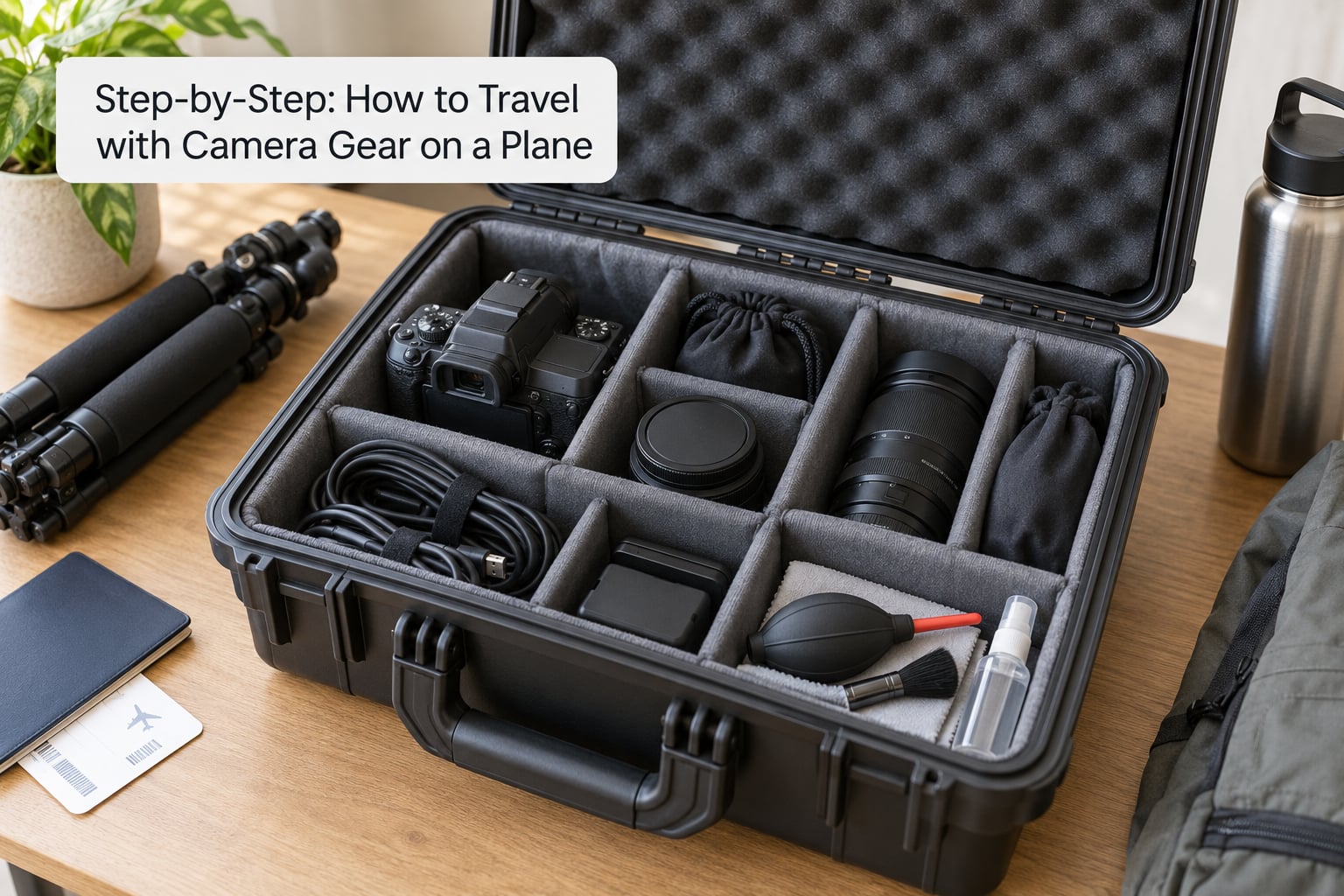
Pack bodies and lenses separately, each in a padded compartment or wrap, with nothing resting on the mount or the front element. Remove the lens before you close the case so a lens is not carrying the weight of everything above it.
Wrap clothing — socks, a base layer — around the bodies and fill the gaps so nothing shifts when the bag is tipped onto its side by a baggage belt. Padding around the body beats padding in an empty space.
Store batteries in their own pouch with terminals covered or taped, and never loose in a pocket where a key can bridge the contacts. Keep memory cards in a small case in your cabin bag, not in the roller.
Collapsed tripods, monopods, and gimbals travel in the cabin if they fit; many carriers treat long protruding legs as a dimensional problem, and inspectors can object to spiked feet. If a support has to be checked, put the spikes in your cabin bag instead.
Drones follow their own rule: the aircraft and controller may travel in the hold, but drone and controller batteries always fly in the cabin.
5. Get through airport security safely
Present your bag early, before the line builds behind you. Ask for a hand check of anything fragile; photographers report that officers usually accommodate a request made politely at the front of the line.
Modern scanners will not harm a digital sensor or a memory card. Undeveloped film is the exception, because x-rays affect it — ask for a hand inspection, keep the film in a clear bag so it is easy to show, and expect a possible wait.
Have your laptop, power banks, and large electronics out and ready, and keep them with you rather than in a bag you will not open again until you land.
If a bin comes back flagged, do not empty the whole bag onto the counter. Take the case, the lens, and the batteries out one at a time so the officer can see what they are looking at.
6. Inspect and reassemble the kit after the flight
Before you leave the baggage hall, open the hard case or the padded insert and look at every body and lens. Damage found in the hall is far easier to claim than damage discovered at the hotel.
Take a first safe stop — the arrivals area or your hotel room — to reassemble the kit, insert batteries, and check that the bodies fire and the cards read.
If a bag is delayed, file the report at the airline’s baggage desk before you leave the airport and get a file reference number. Photograph the bag as it comes off the belt, damage included, and keep the tag.
Common Mistakes
Leaving the batteries in a checked bag. Spare lithium batteries are not permitted in the hold. The rationale is fire risk — a damaged battery that shorts in an unpressurized cargo compartment is exactly the scenario the rule exists for. Devices with batteries installed have their own treatment, and airlines differ, so the safest move is to carry every battery you can legally carry and never argue the point at the belt.
Treating the camera bag as a free extra. A padded backpack is a bag like any other. If the allowance is one item, the backpack is the item — unless it fits the personal-item dimensions, in which case it can be the second item.
Overpacking one bag. A camera bag stuffed past its structure deforms on the belt and crushes the corner of a body. Spread the weight, keep the cabin bag light enough to lift into the bin yourself, and move heavy lenses or a battery into a jacket pocket at the gate on strict European routes.
Skipping the documentation. Undocumented gear is hard to claim. Serial-number photos, a written inventory, and receipts take ten minutes and settle most disputes before they start.
Putting memory cards or film in checked luggage. Cards can be replaced, but the footage on them cannot. Keep every card in the cabin and copy each one to a laptop or a drive as you go.
Waiting to inspect at the destination. Damage discovered three days later, after the bag has been moved and the paperwork has faded, is much harder to pursue than a claim opened the same hour.
Boarding late into a full bin. Board early when you can. Padded backpacks draw less attention at the gate than a hard roller case, and a bag lifted into the bin by you is a bag you control.
Prevention is simple: verify the rules, split the kit so nothing irreplaceable is checked, document it all, and inspect it the moment you land.
Frequently Asked Questions
Does my camera bag count as a carry-on or a personal item?
It depends on its size, not on what is inside it. If your backpack meets the airline’s published personal-item dimensions and fits under the seat, it counts as your second item. If it matches the carry-on dimensions, it is your carry-on. A camera bag is never free extra, so measure it against the strictest allowance on your itinerary before packing.
Can I bring a camera that has a lithium battery on a plane?
Yes, and that is exactly where it belongs. Devices with lithium-ion batteries installed should travel in the cabin, not the hold. Spare batteries travel in the cabin too, protected from damage and short circuit with terminals covered or insulated. The size limit that matters is watt-hours: 100 Wh is allowed without approval, 101 to 160 Wh needs airline sign-off, and up to 300 Wh applies to some larger batteries.
Does a camera battery count as a lithium battery?
Yes. Every modern rechargeable camera and video battery is a lithium-ion pack, and so are power banks, drone packs, and V-mount cinema batteries. The watt-hour figure printed on the label decides what you may do with it, and you calculate it as volts times amp-hours. If you cannot find the rating, treat the pack as spare and keep it in the cabin.
Will TSA ruin my digital camera or memory cards?
No. Digital sensors, processors, and SD or CFexpress cards are not affected by airport x-ray or CT scanners. Film is different: repeated or strong exposure can fog or damage undeveloped film, so ask for a hand inspection and keep it in a clear bag. Older film bodies with visible gears and springs also attract more secondary screening, though the gear is not damaged by the process itself.
What happens if I pack a lithium battery in checked luggage by accident?
Tell the airline before you hand the bag over, not after. Many carriers will let you pull the battery out and carry it in the cabin if you raise it at the counter, and reporting it yourself keeps you on the right side of the rules. If the bag is accepted with a battery inside it and something goes wrong, coverage for the damage becomes a genuine fight rather than a claim.
What should I do if my gear is damaged or lost in transit?
Report it at the airline’s baggage desk before you leave the airport and get a file reference number. Photograph the case and the tag, and keep your serial-number list, receipts, and insurance details together. Airline liability for checked baggage is limited by international convention, which is one more reason to keep irreplaceable gear in the cabin and to check your gear-in-transit coverage before the trip.
Conclusion
Confirm the carry-on allowance and battery rules for every leg of the trip, and keep bodies, lenses, batteries, and memory cards in the cabin. Protect the kit with a padded backpack or a hard case, photograph every serial number before you leave, and inspect the bag the moment you land. Do those five things and the airport becomes a waiting room instead of a problem.