To choose a focal length for portraits, start with the framing you want and work backwards: 35mm for context, 50mm for a conversational waist-up frame, 85mm for the classic head-and-shoulders look. Then adjust for your camera format and how much room you have to stand back. It takes about five minutes of decisions, not a shopping trip.
Here is the part that trips up most beginners. Focal length is not perspective. Perspective comes from where the camera sits relative to your subject’s face, and every lens can produce the same perspective if you move your feet. What focal length actually changes is how much you can include, how far away you end up standing, how much background you compress, and how shallow the depth of field gets at a given framing.
Get those two separated and the rest of the decision gets much easier. Here is the process I use when someone asks me to help them pick a lens.
Table of Contents
- What You Need
- Step-by-Step: How to Choose a Focal Length for Portraits
- 1. Start with the amount of environment you want in the frame
- 2. Check how your camera format changes the field of view
- 3. Decide how much perspective you want
- 4. Balance subject comfort and working distance
- 5. Consider the background and depth of field
- 6. Test before the important session
- Common Mistakes
- Frequently Asked Questions
- What is the most flattering focal length for portraits?
- Is 85mm or 50mm better for portraits?
- Is a 24mm or 50mm lens better for portraits?
- Is 85mm or 70-200mm better for portraits?
- What focal length works in a small room?
- Is f/2.8 or f/4 better for portrait photography?
What You Need
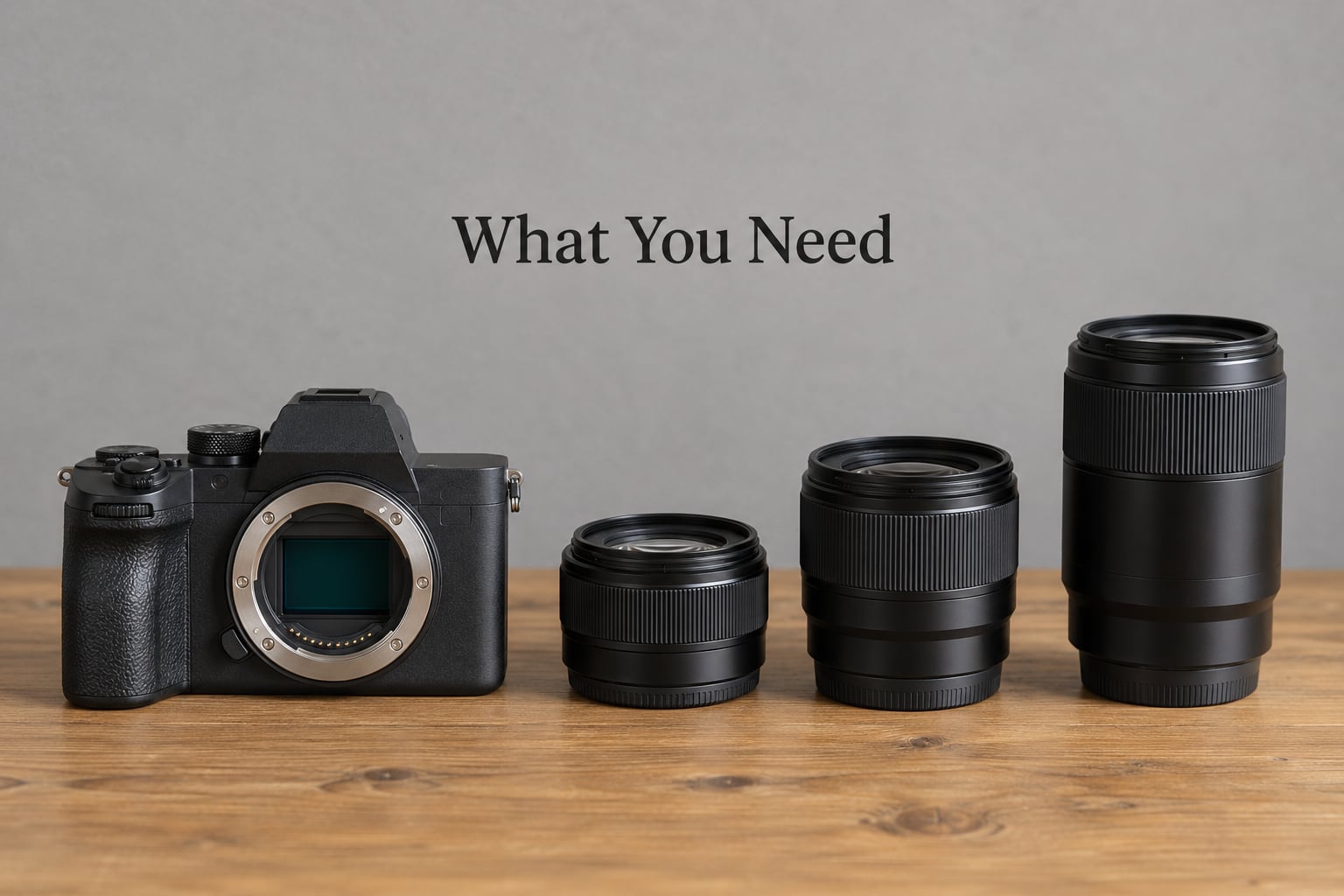
You need very little. A camera with a lens you can change, a subject who will sit still for a few minutes, and enough space to move around the room. That is genuinely it. Everything else in this guide is judgement you apply on top of those three things.
Before you choose a focal length, settle two background facts. First, what sensor are you shooting on? Full frame, APS-C and Micro Four Thirds produce different fields of view from the same lens, which is why a 50mm feels wide on one body and normal on another. Second, what framing do you need for this particular job: a tight headshot for a portfolio, a waist-up frame for a website, a full-body frame for a dancer in motion?
One more clarification worth making early, because it saves arguments later. Aperture does not decide perspective. Your maximum aperture affects how much light you gather, how shallow the depth of field is and how out-of-focus the background falls. Perspective is entirely a function of camera position. A 35mm shot from one metre exaggerates the nose and the near cheek far more than an 85mm shot from three metres, even though both can frame the same head.
Step-by-Step: How to Choose a Focal Length for Portraits
1. Start with the amount of environment you want in the frame
The fastest way to narrow the field is to name your framing. An environmental portrait puts the person in their kitchen, workshop or office, so you need room around them, which means 24-35mm on full frame. A full-body frame needs enough vertical coverage for head to feet, which sits comfortably around 35-50mm. Waist-up conversation shots land near 50mm, and a tight head-and-shoulders or headshot frame sits in the 85-105mm range.
Those are full-frame numbers. If you work out your answer here and then translate it for your body using the table in step 2, you are done in five minutes. If you try to reason about it in isolation, you will end up comparing a 50mm full-frame photo with a 50mm APS-C photo and wondering why they look nothing alike.
2. Check how your camera format changes the field of view
Crop factor is a multiplier, nothing more. Multiply the lens focal length by it and you get the full-frame equivalent field of view. It has no effect on perspective, compression or depth of field in absolute terms, and it does not change what your lens sees in the physical world. It only tells you how tightly the frame is cropped.
| Lens focal length | Full frame | APS-C (1.5x) | Canon APS-C (1.6x) | Micro Four Thirds (2x) |
|---|---|---|---|---|
| 24mm | 24mm | 36mm | 38mm | 48mm |
| 28mm | 28mm | 42mm | 45mm | 56mm |
| 35mm | 35mm | 53mm | 56mm | 70mm |
| 50mm | 50mm | 75mm | 80mm | 100mm |
| 85mm | 85mm | 128mm | 136mm | 170mm |
| 105mm | 105mm | 158mm | 168mm | 210mm |
| 135mm | 135mm | 203mm | 216mm | 270mm |
Read that table as a translation tool, not a ranking. A 50mm on APS-C with a 1.5x crop gives you the same framing as a 75mm lens on full frame, and on a 1.6x Canon body it matches an 80mm. That is why so many APS-C shooters buy a cheap 50mm and end up with something close to the classic portrait look. It is still a 50mm lens, and nothing about its perspective has changed.
3. Decide how much perspective you want
Perspective describes how near and far parts of your subject relate to each other. Shoot from close with a wide lens and the nose, the near cheek and the shoulders all enlarge at different rates, so the face looks stretched down the middle of the frame. Shoot from further back with a longer lens and those differences flatten out, so ears, eyes and jawline read evenly.
To choose a focal length for portraits and control perspective properly, keep the face the same size in every test frame and walk backwards as you zoom. Whatever looks best at that identical framing is your answer, because you have removed framing from the equation entirely. This is the single most useful thing I can tell anyone who has been confused by this: change one variable at a time.
A longer lens does compress, and people describe that compression as flattering. It is partly real: at the same framing, a longer focal length from further back stacks the background closer to your subject, so walls look closer and clutter behind them gets compressed into less space. What it does not do is change the geometry of the face. That is entirely camera position.
4. Balance subject comfort and working distance
Working distance is the practical constraint that forum arguments usually miss. People ask whether 85mm is too long, and the honest answer is that indoors it usually is, because a head-and-shoulders frame at 85mm on full frame means standing roughly 2.5 to 3 metres back. On a DX body the same lens gives you a three to four metre working distance, which is a lot of room to find in a living room.
| Portrait type | Full frame | APS-C (1.5x) | Micro Four Thirds (2x) | Approximate distance on full frame |
|---|---|---|---|---|
| Tight headshot | 85-135mm | 55-90mm | 43-70mm | 3 to 5 m |
| Head and shoulders | 85-105mm | 55-70mm | 43-53mm | 2.5 to 3.5 m |
| Waist-up | 50-85mm | 33-55mm | 25-43mm | 1.5 to 2.5 m |
| Full body | 35-50mm | 23-33mm | 18-25mm | 3 to 4 m |
| Environmental | 24-35mm | 16-23mm | 12-18mm | 1.5 to 2.5 m |
| Group of three or four | 35-50mm | 23-33mm | 18-25mm | 3 to 4 m |
Distance is not just about back wall space. It changes how people behave. At two metres a subject will hold a conversation with you and move naturally. At five metres you have to raise your voice and the moment starts to feel posed, which is exactly the opposite of what a good portrait needs. Plenty of working photographers pick a 100-105mm precisely so they can stand back and let their kids play while they frame the shot.
Minimum focus distance matters here too, and nobody talks about it enough. A 50mm prime typically focuses from around 45 centimetres, so if you want a tight frame on a head in a small room, a 50mm can physically get closer than you want. An 85mm or 105mm hits its close limit further out, which is why longer lenses feel more polite in tight indoor spaces even before you consider the flatter look.
5. Consider the background and depth of field
Background separation comes from three things together: distance from the subject, the focal length you need to frame at that distance, and the aperture. Doubling any one of them roughly doubles the blur. That is why a 200mm at f/4 can throw a softer background than a 50mm at f/1.8, even though the aperture number is higher.
The trap is assuming the longest lens always wins. In a small room with a plain wall two metres behind your subject, an 85mm produces a grey wall. A 35mm puts a person, a plant and a window frame in the shot, and that context often reads as a better portrait than blur. If the background has nothing in it, more blur does not rescue the frame.
One more thing that comes up constantly: flat light undoes the benefit of compression. An on-camera flash pointed straight at a face removes the modelling that makes a long lens look flattering, and you are left with a flat, compressed face that looks worse than the wide-angle version would have. Side light or a large soft source placed off to one side keeps the shading that longer focal lengths depend on.
6. Test before the important session
Before you commit, test. Rent a 24-70mm or a 70-200mm, shoot the same person in the same spot at five or six focal lengths, and note where your hand naturally stops zooming. That is your answer, and it is worth more than any chart, because it accounts for your eye, your room and your subject. It is the advice I give everyone who asks.
Keep the test repeatable. Same subject, same lighting, same clothing, same camera height. Change only the focal length and step back to hold the framing constant. Take the shots at the aperture you would actually use and compare them at full size, not on the camera screen, because the rear display flatters almost everything.
If you rent nothing, reframe by moving. With the lens you already own, walk forward and back while keeping the subject the same size in frame. That walk tells you which focal length you would rather own, and it costs nothing but ten minutes and a bit of floor space.
Common Mistakes
Believing the lens distorts the face. Perspective distortion is created by the camera being close to the subject, not by the lens being wide. The fix is to step back and zoom in; the face proportions change and the framing stays the same.
Treating compression as a magic flattering effect. Compression is real, but it only reads as flattering when the light still models the face. Under flat frontal light, heavy compression makes a face look wide and flat. The fix is a soft source placed roughly 45 degrees to one side and slightly above.
Comparing focal lengths across different sensors. A 50mm photo on full frame and a 50mm photo on APS-C are different framings, so comparing them tells you nothing useful. The fix is to convert to full-frame equivalent first, using the table in step 2.
Assuming a longer lens always blurs the background more. Blur depends on framing distance and aperture as much as focal length, and in a small room you may not be able to back up far enough to use the long lens. The fix is to put something in the background and use the focal length your room allows.
Choosing the shortest possible working distance. Sticking the camera 60 centimetres from someone’s face is the surest way to make them uncomfortable and to exaggerate their nose. The fix is to pick the longest focal length your space allows, which also gives you more room to step back.
One rule worth remembering: choose the framing first, then the lens, then the distance. Focal length is the last decision in that chain, not the first.
Frequently Asked Questions
What is the most flattering focal length for portraits?
Around 85mm on full frame is the classic answer, because it flattens facial proportions and keeps you far enough back for the subject to relax. On APS-C that same framing comes from a 50mm, and on Micro Four Thirds from a 43mm. The number matters less than matching the framing and keeping a comfortable distance between camera and subject.
Is 85mm or 50mm better for portraits?
Both work, and the right one depends on your room and your framing. An 85mm gives the flatter, more classic look but needs roughly 2.5 to 3 metres for a head-and-shoulders frame, which fails in a small indoor space. A 50mm fits anywhere, frames waist-up naturally, and stays conversational. On APS-C, the 50mm delivers the same field of view as a 75mm on full frame.
Is a 24mm or 50mm lens better for portraits?
Use the 50mm for headshots, head-and-shoulders frames and anything where the face is the point. Use the 24mm for environmental portraits where the person and their surroundings both matter, and where you need to be close because the room is small. Shoot the 24mm carefully and keep edges away from the frame’s corners, where wide lenses stretch most.
Is 85mm or 70-200mm better for portraits?
The 85mm wins on rendering: primes this size usually hold sharpness wide open and give smoother, rounder out-of-focus highlights than a zoom set at the same focal length. The 70-200mm wins on reach and on one lens that covers headshots, waist-up frames and full body without swapping. If you can only afford one, most working portrait shooters pick the zoom and stop worrying about it.
What focal length works in a small room?
In a small room, favour shorter focal lengths and back-wall distance over flattering compression. A 24-35mm on full frame lets you stand far enough away to fit the subject into the frame, which matters more than the look the lens produces. If your subject is against a bare wall two metres back, move the subject toward the window instead of reaching for a longer lens.
Is f/2.8 or f/4 better for portrait photography?
Neither is universally better, so choose based on light and depth of field. Use f/2.8 or wider when you need a fast shutter for movement, when the light is dim, or when you want strong background separation. Use f/4 when light is plentiful, when you want the eyes and ears both sharp, or when you are shooting a group and everyone needs to be in focus.
Do this first: pick one real job you need to shoot, write down its framing, and translate that framing into a focal length for your camera using the tables above. Then rent the closest lens to that number and test it before you buy. Most people discover their favourite portrait focal length within one session of actually shooting, and it is rarely the one they expected.