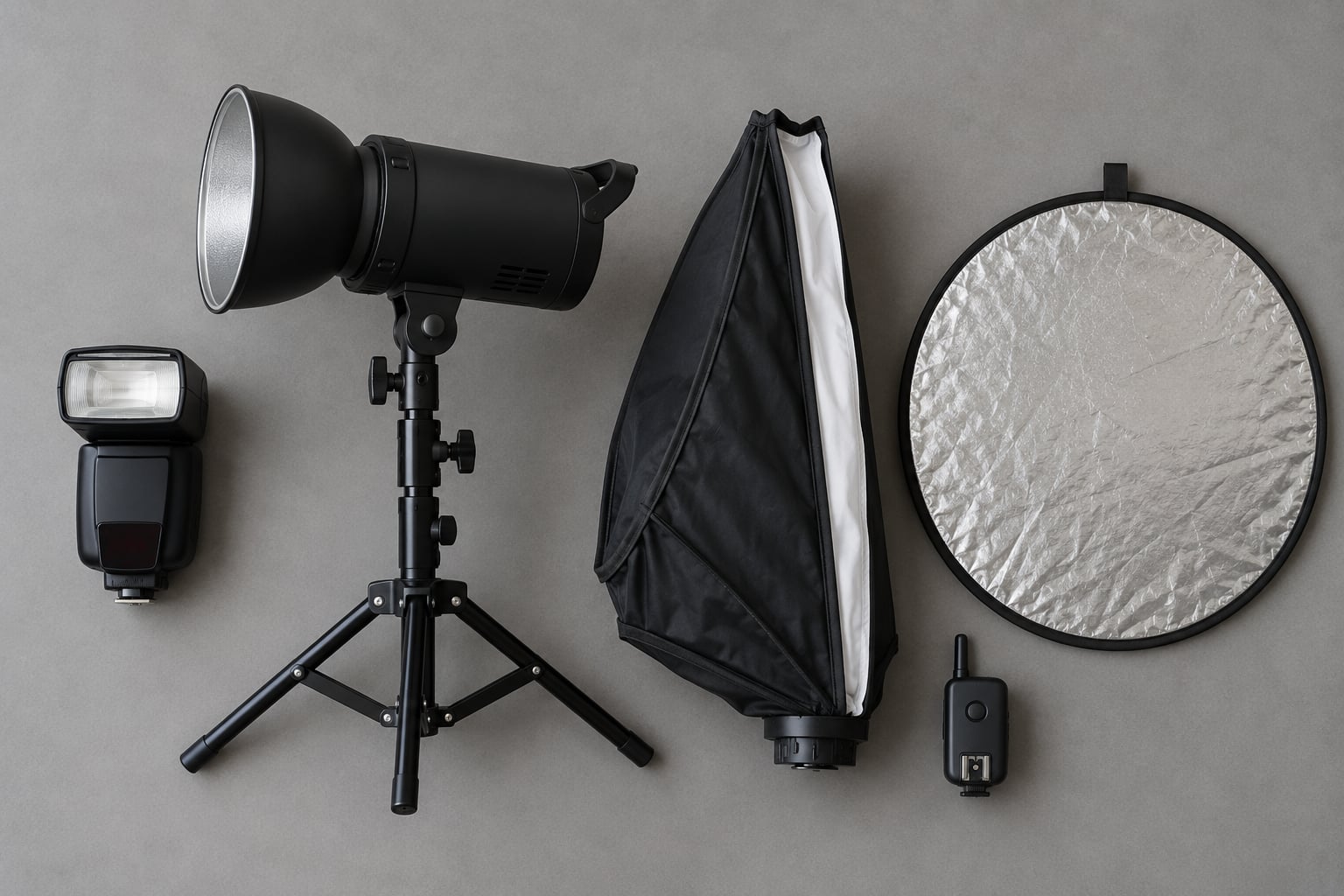
If you are trying to work out how to choose between speedlights and studio strobes, the short version is this: a speedlight is a small battery-powered flash that clips to your camera’s hot shoe and puts out roughly 50 to 100 Ws, while a studio strobe is a much larger flash that lives on a light stand, runs on mains power or a battery pack, and delivers several times that power. Pick the speedlight if you shoot on location without power outlets. Pick the strobe if you need big soft modifiers, fast recycling, or daylight-punching power.
There is a third option most guides gloss over, and it is where a lot of working photographers end up: the battery-powered monolight. It sits between the two, giving you strobe-class output in something you can still load into a car. This guide breaks the choice down by power, portability, modifiers, cost and scaling, so the decision comes down to your actual shooting conditions rather than a brand name.
By 2026, the boundary between these categories is thinner than most buying advice suggests. The comparison below is the one I keep coming back to.
Table of Contents
- How to Choose Between Speedlights and Studio Strobes at a Glance
- Speedlights vs. Studio Strobes: How Each Light Works
- Modelling light behaviour is where people get surprised
- How each system gets triggered
- Power and Light Output
- Watt-seconds and why brands are not comparable
- Where extra power actually changes the picture
- Battery consistency, recycling and heat
- Portability and Setup Time
- Where speedlights win outright
- Where studio strobes win outright
- What the middle ground actually feels like
- Light Control and Modifiers
- Modifier compatibility
- How far a speedlight stretches
- Colour consistency and control
- Continuous light as the third column
- Cost, Accessories, and Scalability
- Buying used without buying a problem
- Which Should You Choose?
- Frequently Asked Questions
- Are speedlights or studio strobes better for portrait photography?
- Can speedlights produce studio-quality lighting?
- What is the main difference between a speedlight and a studio strobe?
- Do studio strobes need a battery or generator?
- Which is cheaper: speedlights or studio strobes?
- Can I use speedlights for large commercial portrait sessions?
- Conclusion
How to Choose Between Speedlights and Studio Strobes at a Glance
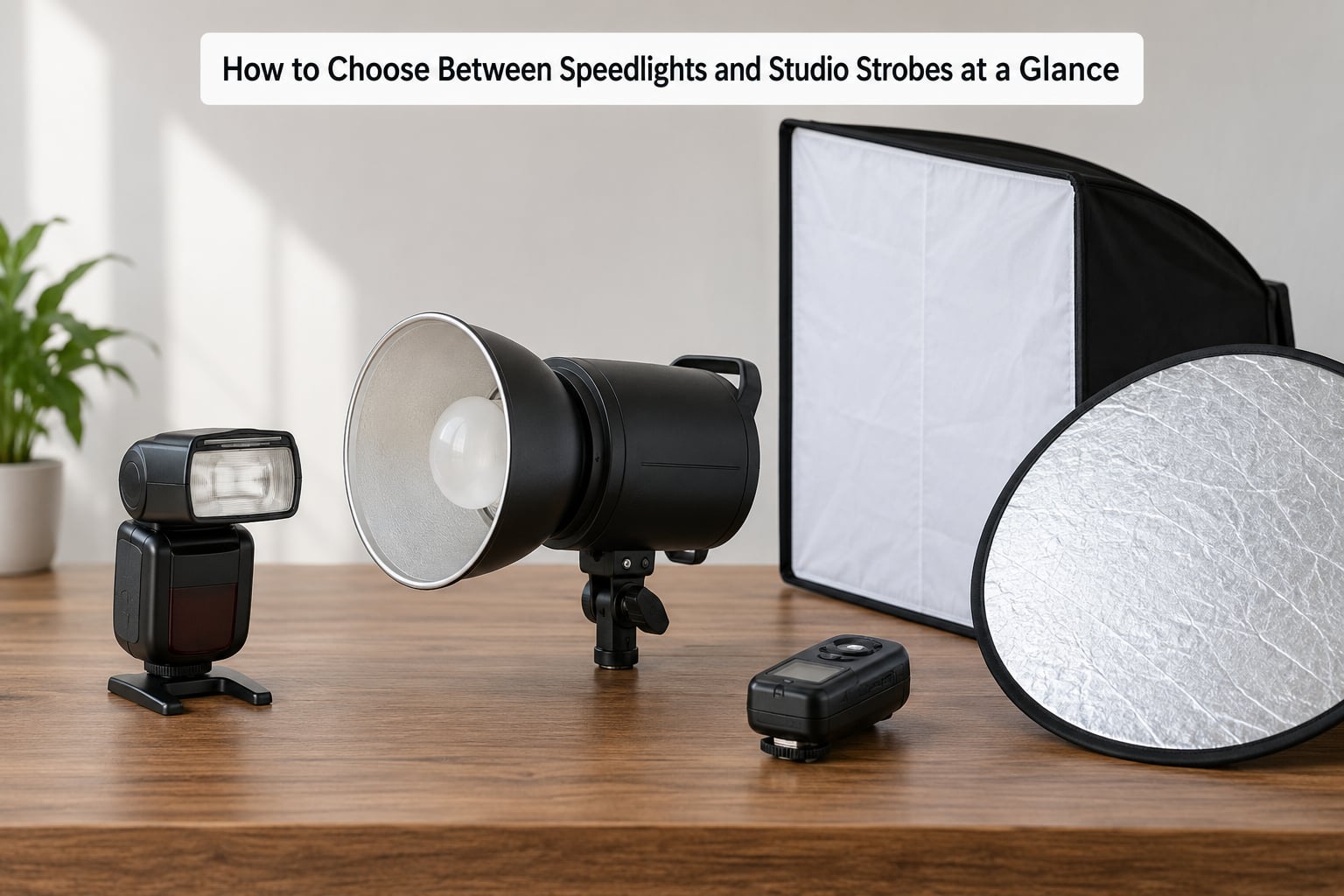
Three columns, because the middle column is the one people under-rate. Read down the rows for the situation you shoot in most, and the answer usually makes itself obvious.
| Factor | Speedlight | Battery monolight | Mains studio strobe |
|---|---|---|---|
| Typical output | 50-100 Ws | 200-600 Ws | 300-1000+ Ws |
| Power source | AA, lithium or small rechargeable pack | Lithium-ion battery pack | AC mains, often with a power pack for location work |
| Where it lives | Camera bag pocket or on a stand | On a stand or a light stand arm | Locked to a stand in a fixed studio |
| Setup time | Under a minute, sometimes seconds | A few minutes | Longest: stands, cables, sandbags, modifier assembly |
| Largest usable modifier | Small softbox, 60-90 cm umbrella at best | Standard softboxes and umbrellas with ease | Large octaboxes, 130 cm umbrellas, big scrims |
| Recycle time at full power | Around 1-2 seconds with NiMH, faster with lithium | Typically 0.5-1.5 seconds | Sub-second on most packs |
| Best daylight performance | Shaded locations, small subjects | Bright sun, full-body portraits | Harsh sun at long throw distances |
| Control features | TTL, HSS, modelling light, zoom or bounce head | TTL, HSS, fan cooling, Bowens mount | Modelling lamps, fan cooling, Bowens mount, bare-bulb options |
| Scale it up cheaply | Add a second or third flash on the same trigger | Add a second monolight on the same trigger | Cheap add-ons are mains-only, so scaling costs real money |
| Noise | Silent | Silent unless the fan spins up at high power | Fan noise in the quiet moments, some packs fan constantly |
| Best fit | Events, travel, weddings, small rooms, beginners | Location portraits, headshots on location, content and brand work | Fixed studio, product, fashion, high-key, video-adjacent setups |
Speedlights vs. Studio Strobes: How Each Light Works
Both lights fire a brief, intense burst of light and both are triggered from your camera. The difference is in where the energy comes from and what it takes to move it.
A speedlight runs on its own battery and drives a small xenon or LED flash tube through a capacitor. The charge builds between shots, which is what the recycle time actually measures. Mains-powered studio strobes take power straight from a wall, so the capacitor refills as fast as the circuit allows, which is why they feel instant.
Battery monolights split the difference. They charge a capacitor from a lithium-ion pack, so you still get the speed of a modern cell without needing a cable. That is the entire reason they became the default location light.
Modelling light behaviour is where people get surprised
Speedlights usually have a small modelling lamp that lights continuously so you can check the framing before the flash fires. It is dim, and on many models it cuts out as soon as you fire, which is correct behaviour but catches beginners out.
Studio strobes with mains power run their modelling lamp continuously at full brightness across the whole power range, which makes shaping light with flags and nets far easier. You can set the strobe to a low output, leave the lamp lit, and judge exactly what the light is doing. Battery packs and monolights vary here: many of them dim or cut the lamp when the light is fired, and some only offer a narrow power range with the lamp on.
How each system gets triggered
Speedlights normally trigger through the camera’s hot shoe or a radio trigger that slides onto it. Stands and softboxes for speedlights need a bracket and a small stand, because the light is not built to hang off a light stand on its own.
Studio strobes use the same radio system but with a receiver built in, and they can also be fired from a laptop or a phone through software on some brands. If you buy the strobe ecosystem first and add speedlights later on the same trigger system, both categories mix freely. Do it the other way round and you are often stuck with two radios.
Power and Light Output
Power is the first thing to get your head around, because watt-seconds tell you less than people expect. What you are really buying is the ability to put light through a modifier and still have some left over after it arrives at the subject.
Watt-seconds and why brands are not comparable
A speedlight puts out roughly 50 to 100 Ws. A mains studio strobe starts around 200 Ws and runs past 1000 Ws for the big packs. That is the headline, and it is useful.
The trouble is that watt-second ratings are measured differently across manufacturers. One brand may quote peak output and the useful portion of the flash, another quotes the full capacitor charge. The realistic output of the flash burst is what actually matters, and t0.5 flash duration is the number that tells you how much of that burst lands where you need it.
Guide number has the same problem, multiplied by the distance unit. A guide number of 60 at 10 metres is nothing like a guide number of 60 at 3 metres. Treat any published guide number as a within-brand ranking tool, not a cross-brand comparison. If you want a real cross-brand figure, look for measured output at t0.5 in an independent test.
Where extra power actually changes the picture
Extra power stops being a spec-sheet luxury in a handful of specific situations:
- Filling a large modifier. A 130 cm deep umbrella or a 120 cm softbox needs a lot of light before any of it reaches your subject. This is the single most common question I see about speedlights, and the answer is that one speedlight will not do it properly. Two will not reliably do it either at full modifier size.
- Working at distance. Outdoor portraits on a beach or a wall mean the light travels far. Throw is what forces the jump from a monolight to a full pack.
- Defeating the sun. Direct sunlight at midday needs roughly a monolight minimum, and a full pack for a full-body subject.
- Adding light to existing daylight. Balancing strobe output with a bright ambient scene uses power just to compete with the exposure.
If none of those describe your work, the power difference between classes matters far less than the modifiers and the setup time. A speedlight at moderate output through a small softbox can produce a beautiful portrait that a 1000 Ws pack cannot improve on.
Battery consistency, recycling and heat
Speedlight output drops as NiMH cells drain, which is why high-speed sync and low-power flashes seem less consistent than the specification suggests. Lithium packs hold voltage flat and recycle faster, and they are the single biggest practical upgrade for anyone shooting events on speedlights.
Battery monolights recycle in well under two seconds at most power settings and hold their output until the cell is nearly flat. Mains strobes do both perfectly, which is why a studio never has a recycle problem. The trade at the top end is heat and fan noise: powerful packs run hot, and a fan that spins up during a quiet portrait can ruin the take.
Portability and Setup Time
Portability is not a minor feature. For a lot of photographers it decides the question on its own, because a light you cannot get into the car is a light you will not use.
Where speedlights win outright
A speedlight weighs very little, runs for a full event on a set of AA cells, and goes from bag to stand in seconds. That combination is why so many working photographers use them as their default and only reach for something bigger when they have to.
It also handles small rooms better. A speedlight bounced off a low ceiling or a white wall fills a space without needing to place a stand at all. In a hotel room or a small home studio, that bounce capability plus a single stand is often the entire lighting kit you need.
Where studio strobes win outright
Once a setup is more than two or three lights, stands start to multiply. Mains strobes stay put, which is the entire point of a fixed studio. You set the background, the key, a fill and a hair light once, then spend the day changing the subject rather than rebuilding the rig.
Multi-light arrangements also lean heavily on modelling lamps and on being able to disable individual heads to see what each one contributes. That is much easier with strobes than with bracketed speedlights.
What the middle ground actually feels like
A single battery monolight plus a rolling stand is the setup most on-location portrait photographers converge on. It is heavier than a speedlight and lighter than a mains kit, needs no cable, and handles a 90 cm softbox without argument. If your work is mostly location portraits, this is the honest answer to the speedlights vs studio strobes question, and most reading frames skip past it.
Light Control and Modifiers
Light quality comes from the size of the light relative to the subject, and a bigger source can be softer. Modifiers are how you make a small flash behave like a large one, and they are also where the two categories diverge most sharply.
Modifier compatibility
Studio strobes use a Bowens-type mount, the same ring you find on softboxes, beauty dishes, reflectors and grids across brands. Anything with that mount fits anything else with that mount, regardless of price. Mains packs often also offer a bare-bulb mode with no reflector at all.
Speedlights need a bracket and speedring adapter before most modifiers will attach, and the extra pieces are cheap but they are another thing to lose in a bag. Speedlights do have one modifier advantage: the swivel and bounce head lets you aim a bare flash at a ceiling for a large apparent source with no extra gear at all.
How far a speedlight stretches
Here is the useful rule of thumb: treat one speedlight as enough to fill a modifier up to about 60 cm, and up to roughly 90 cm if you accept it running hot and slowing your recycle rate.
Beyond that the light is visibly hotter in the middle of the modifier than at the edges, so you get a bright hotspot rather than an even wash. A 130 cm deep or silver umbrella needs a monolight or better, and that is where budget shooters get caught out. Two cheap speedlights bailed into a large modifier are not equivalent to one good monolight in the same modifier.
Colour consistency and control
Flash output sits around 5500 to 5600 K, which sits between daylight and tungsten and needs only minor correction. Higher-end strobes hold that colour temperature more consistently across the power range, and cheaper monolights shift as they dim. For mixed work with video or for large print jobs where skin tones must match across a whole series, that consistency matters more than most buyers expect.
Continuous light as the third column
If any part of your work is video, a strobe with a strong modelling lamp or a dedicated continuous light changes the conversation. You can see what you are getting before you shoot, you can record a take without a separate light, and moving a panel or a softbox is faster than resetting a stand. It costs more power for the same result, and it is still the right call for hybrids.
Cost, Accessories, and Scalability
The honest comparison is total system cost, not the price of the light. Every option needs a trigger, a stand and something to shape the light.
On raw outlay, a speedlight setup is the cheapest way in. The cost lands in accessories: brackets, speedrings, extra batteries, a second light and a decent trigger with enough range for location work. Budget third-party speedlights cover the fundamentals well, and the community consensus leans strongly toward one brand family for price and reliability.
On the other end, a mains strobe kit only looks expensive until you count the stands, the cables and the sandbags. A single pack plus one softbox and one stand is a small fraction of what a three-head studio costs. The expensive part is scaling, because mains-only heads cannot be added cheaply, so every additional light is a full new purchase.
Battery monolights and battery packs sit in the middle and scale best, because a second head on the same trigger ecosystem adds a key or a rim light without new radios. This is the argument for buying into one ecosystem and growing inside it rather than assembling from mixed brands.
Buying used without buying a problem
- Avoid untested gear with no return window. Flash tubes and trigger units fail in ways that only show up under load.
- Skip models with no repair path or firmware updates. A discontinued line means no fixes and no new features.
- Check the recycle time and power output yourself if you can, and test the trigger before you commit.
- Buy branded units over untested clones, even when the clone looks like a bargain.
For those still weighing it, the pattern that shows up again and again in photographer forums is simple: use speedlights whenever you can reasonably get away with it, and move up when the light can no longer do the job. Many photographers add a monolight to their speedlight kit later rather than replacing everything, keeping the speedlights as fill and rim lights, which is exactly what weaker lights are good at.
Which Should You Choose?
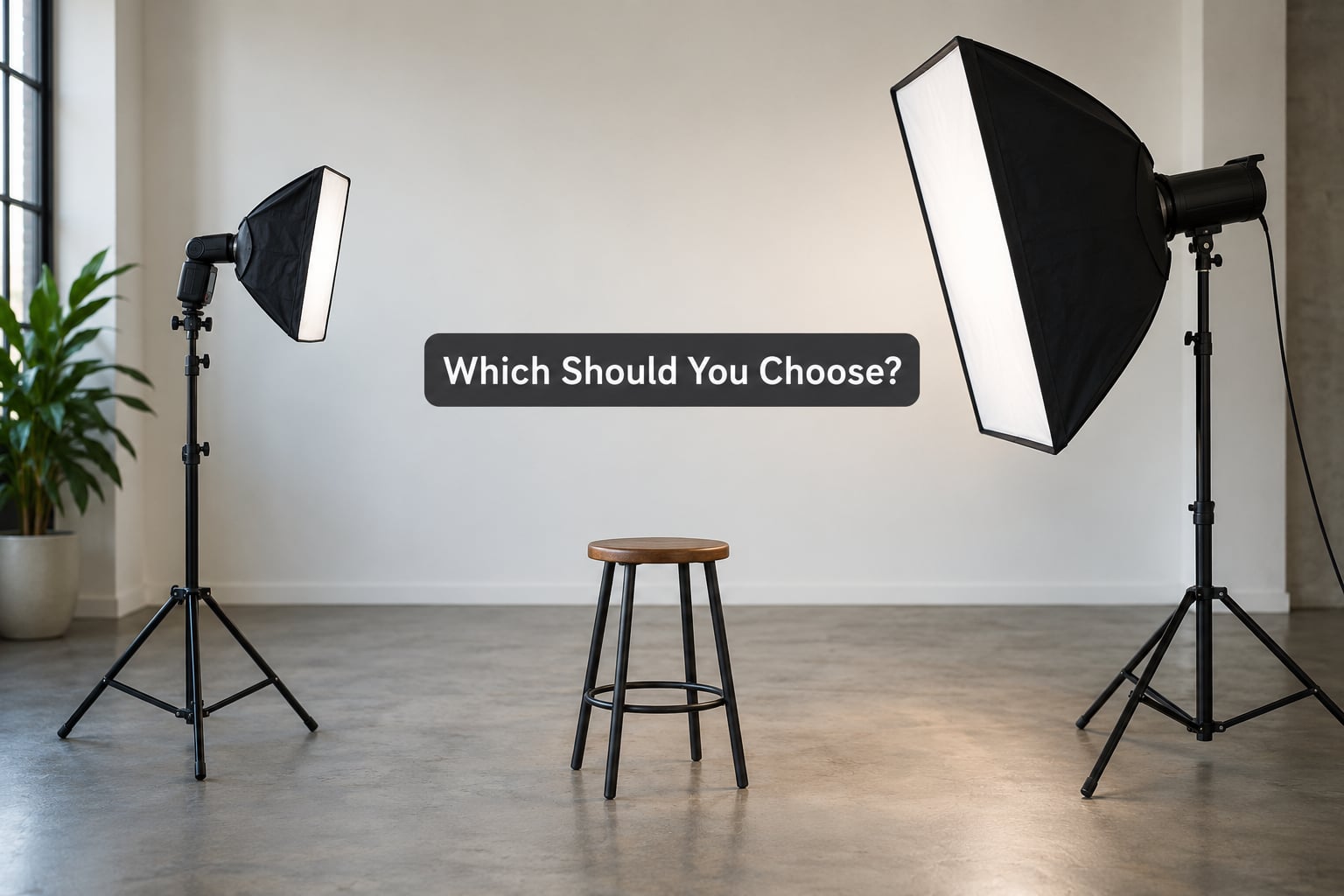
Match the light to the job, not the other way round. Here is how the decision usually lands by use case.
Headshots in a small room. A speedlight bounced or through a small softbox, placed about a metre from the subject. You need very little power for this, and a monolight only gets in the way of moving the light between subjects quickly.
Events and weddings. Speedlights for the reception and ambient work, a monolight or two for groups and for the couple portraits shot during the day. Strobe-class recycling is what matters here, because the light is firing at full tilt for hours.
On-location portraits. A battery monolight with a 90 cm softbox as the key, a second one or a speedlight for fill and rim. This is the case where neither pure answer is right.
Commercial and fashion work. Studio strobes, or monolights in a controlled space, because you are using large modifiers and you are judging the light with your eyes before the flash fires.
High-key and product work. Studio strobes, with the modelling lamps on, so you can shape the light with flags and nets and see the falloff as you build it.
Beginners. A speedlight with TTL, and one bounce. It teaches exposure and placement faster than any other setup, because you can move it in a second and watch what changes.
Large spaces and harsh sun. Full packs. Nothing else competes with a 1000 Ws head when the light has to travel across a courtyard.
Photo and video work. Continuous light, or a strobe with a usable modelling lamp. Buying flash-only gear means buying a second lighting kit later.
Frequently Asked Questions
Are speedlights or studio strobes better for portrait photography?
Speedlights suit small rooms, quick changes and on-location work where the light never has to travel far. Studio strobes suit larger modifiers, brighter ambient conditions and any setup where you want big, even sources or visible modelling lamps. For most location portraits, a battery monolight between the two is the strongest single choice.
Can speedlights produce studio-quality lighting?
Yes, on a small subject with good modifiers. A speedlight through a 60 cm softbox or bounced off a ceiling gives soft, flattering portrait light that stands up to print. It falls short when the modifier is large or the subject is full-body in bright conditions, where the light cannot keep up and the middle of the frame goes hotter than the edges.
What is the main difference between a speedlight and a studio strobe?
Size, power and power source. A speedlight is a battery-powered hot-shoe flash putting out roughly 50 to 100 Ws. A studio strobe is a larger stand-mounted flash running from about 200 to over 1000 Ws, powered by mains or a battery pack. The strobe drives much bigger modifiers and recycles far faster, and needs stands, cables and more setup time.
Do studio strobes need a battery or generator?
Most mains-powered strobes need a wall outlet, and that is the biggest reason location photographers now choose battery-powered strobes or monolights instead. Packs and monolights run from lithium-ion batteries and need no cable or generator, at the cost of recycling slightly slower at full power and having output that drops as the cell empties.
Which is cheaper: speedlights or studio strobes?
A speedlight plus a trigger is the cheapest way to start, though brackets, extra batteries and a second light add up quickly. A single mains strobe head with a softbox and stand costs more than one speedlight but less than a full multi-head studio kit. Compare total system cost, including stands, modifiers, triggers and batteries, not the light on its own.
Can I use speedlights for large commercial portrait sessions?
For head-and-shoulders work in controlled rooms, yes. For full-body commercial work with large modifiers, bright locations or long throw distances, speedlights run out of power and the modifiers show hot centres. Use a battery monolight or strobe for the key and keep speedlights as fill, rim and background lights, which is a role they handle very well.
Conclusion
Work through five questions in order: where are you shooting, how big is the subject, which modifiers do you need, how much total power does the situation require, and what can you realistically carry and afford. The answers point at one category almost every time.
Small room, moving subject, no power access, tight budget: speedlight. Large modifier, long throw, harsh sun, fixed studio: studio strobe. Location portraits that need both: battery monolight, with speedlights kept in the bag as fill and rim lights.