To photograph a family of five, stop trying to line everyone up in a straight row. Build the pose in layers, put the light where it reaches the back row, and shoot in short bursts until you have a blink-free frame. Budget 45 to 60 minutes and treat the first ten as the only time everyone will fully cooperate.
Five is where family photography gets awkward. Four people can share a single plane of focus and still read as separate shapes. The fifth forces you to stagger heights, split faces across different distances, and hold three autofocus points at once. It also means the youngest kid’s patience runs out long before the adults think the photos are done.
The workflow below handles all three problems in order: choose the light, set the camera so nobody comes out soft, then add people in a sequence that spends your attention while the energy is highest.
Table of Contents
- What You Need
- Step-by-Step: How to Photograph a Family of Five
- Choose a Location and Visual Direction
- Set Up the Shot and Camera Settings
- Pose the Family in Manageable Groups
- Direct Expressions and Movement
- Capture a Variety of Compositions
- Review and Deliver the Best Images
- Common Mistakes
- Frequently Asked Questions
- How long should a family photo session be?
- How many photos should I take of a group of five?
- What aperture and shutter speed do I need so nobody in the back row is blurry?
- How do I pose a family of five with a toddler and teenagers?
- Do I need flash for outdoor family photos?
- Conclusion
What You Need
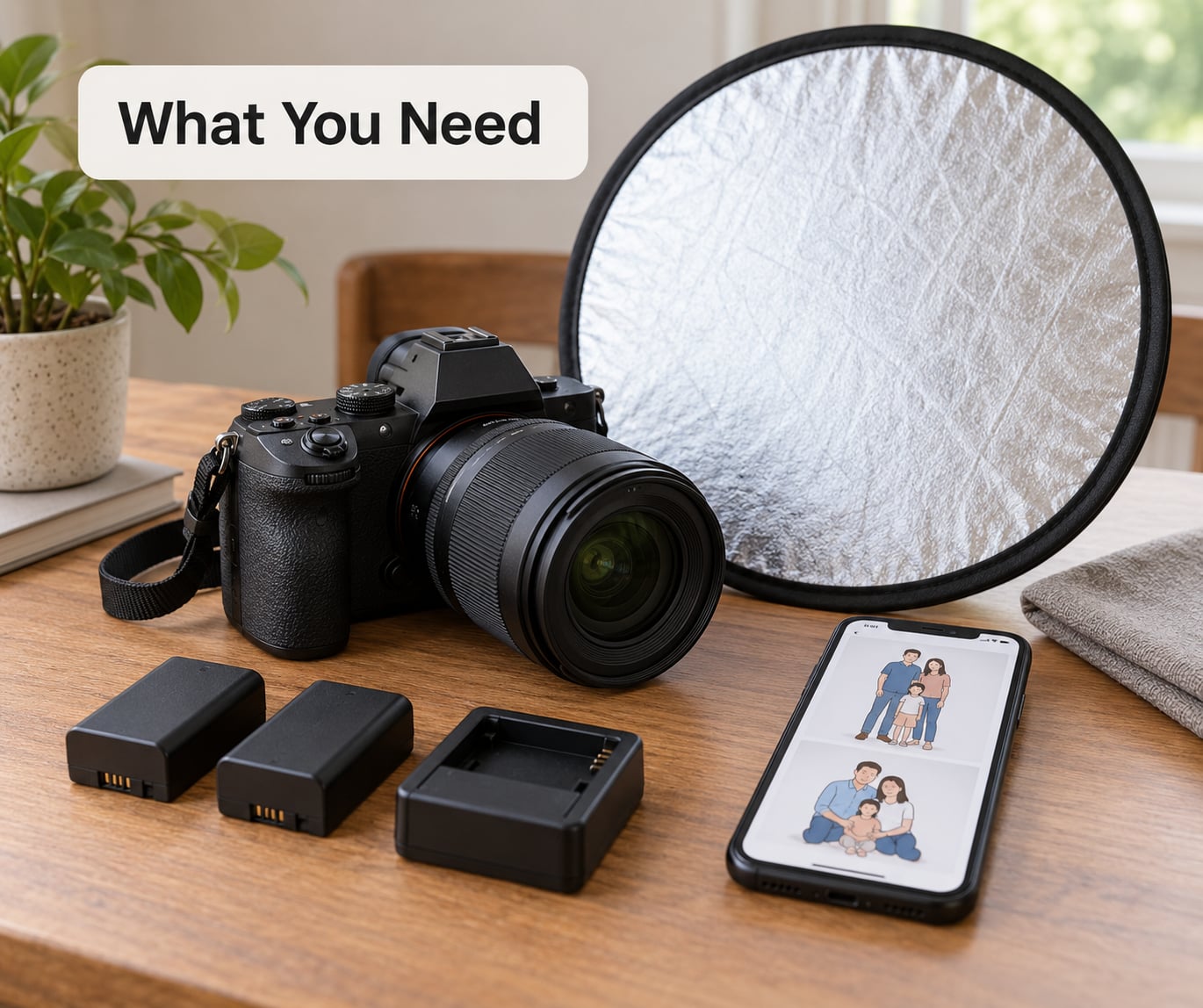
You do not need a second body or a lighting rig to shoot a family of five well. You need one camera that shoots faster than your subjects move, a lens wide enough to hold five people without stretching them at the edges, and light soft enough that nobody squints.
- A camera with reliable continuous autofocus. Subject-detection eye AF holds a face, but with five people competing it still hunts. Back-button focus on a single moving child and a small focus zone is often more dependable than wide-area AF.
- A lens in the 35mm to 50mm range on full frame, or roughly 24mm to 35mm on a crop sensor. That is wide enough for five adults shoulder to shoulder without the edge-stretching a 24mm lens gives on full frame, and long enough to separate faces.
- A burst-capable shutter. Any camera that fires three frames per second is fine. Ten per second costs you nothing but memory here.
- A reflector or a white bedsheet. This is your fill. Without it, anyone standing behind the front row falls into shadow.
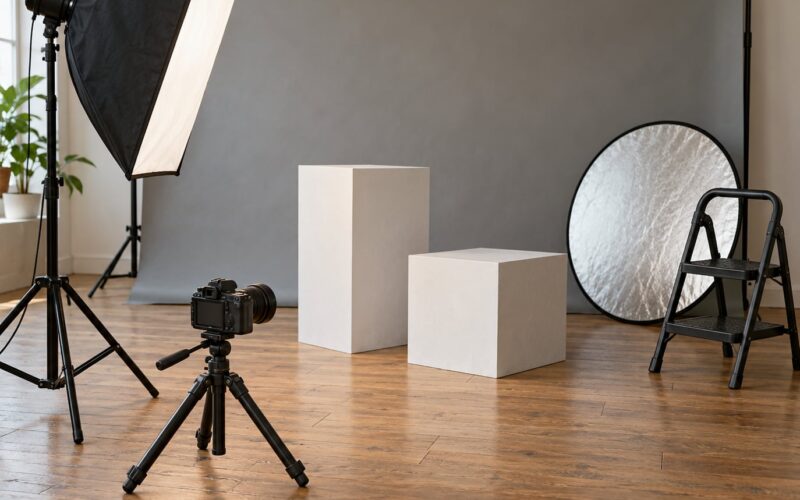
- Two or three height props. Wooden apple boxes, a bench, a low log, a wide step. These are what stop a two-year-old from becoming a head under everyone else’s chin.
- Spare batteries and a formatted card. A family session drains a battery in an hour and fills a card fast when you shoot bursts.
- One adult in the family who can run the show. Appoint them as the handler before you arrive. When you are directing five people, someone has to physically move a toddler.
Three setups cover almost every situation. A phone on a tripod with a Bluetooth or watch remote works if you place the family carefully and shoot bursts, and it costs almost nothing. A mirrorless or DSLR body with a 35mm to 50mm lens and a reflector covers open shade and overcast light. Two wireless flashes on stands at forty-five degrees to the group handle harsh sun, and they are the only setup that reliably freezes a running child while keeping the look of daylight.
Two preparation items matter more than any gear choice. Plan outfits around one colour plus neutrals, and skip large logos, busy patterns and pure white, which blows out against sky or grass. And write the shot list before you shoot, not after: whole group, parent with kids, kids only, parents only, and one or two individual children.
Step-by-Step: How to Photograph a Family of Five
A five-person session runs about 45 to 60 minutes. Here is the minute-by-minute version I work from.
| Minutes | What happens | Who is in frame |
|---|---|---|
| 0 to 5 | Arrive, let kids run loose, check the light and the background | Nobody, candid only |
| 5 to 12 | Full group, straight on and then 45 degrees | All five |
| 12 to 22 | Whole group with movement and prompts | All five |
| 22 to 32 | Parent with kids, then the other parent with kids | Breakout of three |
| 32 to 42 | Kids only, plus individual headshots of the youngest | One to three |
| 42 to 50 | Parents alone and a final full group | Two, then five |
| 50 to 60 | Play, movement and free-running candid moments | Whatever happens |
Choose a Location and Visual Direction
Pick a spot with enough width to hold five people shoulder to shoulder plus a metre of air on each side, and with a background that stays quiet behind them. Open shade under a large tree, a covered porch or the open side of a building gives you soft, even light with no hard shadows cutting across faces.
Check the light before you unpack. Walk to where the family will stand and turn around: if the sun is anywhere near their eyeline, they will squint and shade their own eyes. Bright sky behind their heads puts you into backlight, which means you either expose for the faces and lose the sky, or fill with flash.
Scout for two things kids can use. A path, bench or patch of grass gives them something to walk or sit on, and a wide open area means nobody has to stand near a road or a drop. If the forecast is bad, identify an indoor backup with big windows before you leave the house.
Set Up the Shot and Camera Settings
For five people, the settings exist to solve two problems: freezing movement and getting everyone inside the depth of field. Set shutter speed first, then aperture, and leave ISO on auto with a sensible ceiling.
| Light | Shutter | Aperture | ISO | Lens |
|---|---|---|---|---|
| Open shade or overcast | 1/500 sec | f/5.6 to f/8 | Auto, up to 3200 | 35 to 50mm |
| Golden hour backlight | 1/500 sec | f/4 to f/5.6 | Auto, up to 3200 | 50 to 85mm |
| Harsh sun with fill flash | 1/200 sec | f/8 | Auto, up to 800 | 35mm |
| Indoor window light | 1/250 sec | f/4 | Auto, up to 6400 | 35 to 50mm |
Switch to continuous autofocus, put the drive mode in burst, and shoot RAW so you have room to lift shadows later. Set a minimum shutter speed of 1/250 sec if you are letting the camera choose ISO, otherwise a running toddler will smear even in decent light.
Frame a little wider than you think you need. Five people plus elbow room fits awkwardly at any focal length, and cropping a tight frame to fix it later loses resolution you cannot get back. Aim for the tallest person’s eyes, then check the other four faces before you press the shutter.
Pose the Family in Manageable Groups
How to photograph a family of five without a crowded frame comes down to depth and connection. Never put five people in a straight horizontal line: shoulders merge, heads line up, and the frame flattens. Break the line instead.
- Staggered row. Five across, but alternating a step forward and back and a half-shoulder offset. The small step separates overlapping arms.
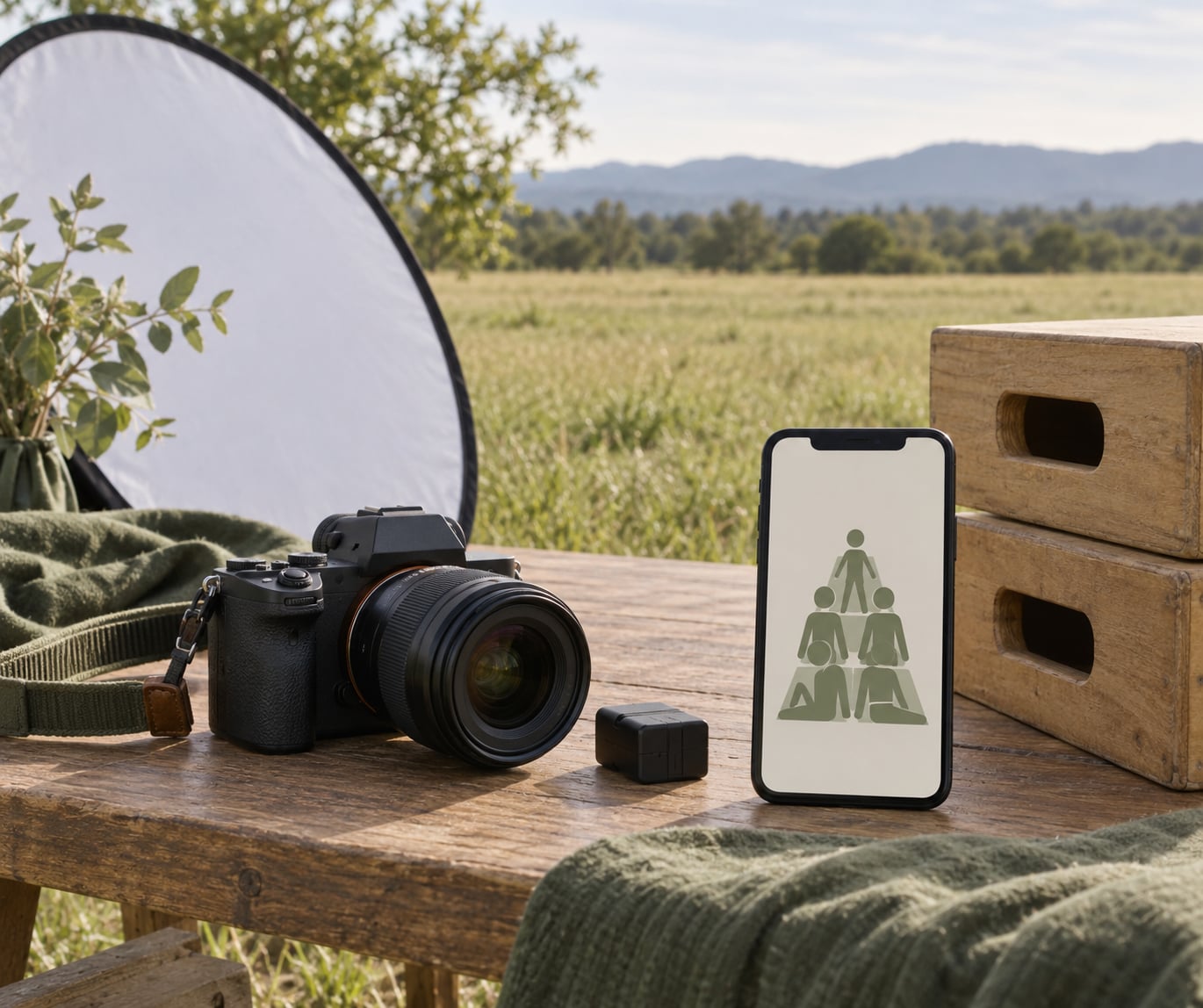
- Triangle formation. The two parents form the base, the three children sit or stand around them at different heights, and the tallest child anchors the third corner of the triangle. This is the most forgiving pattern for a wide age spread.
- Layered depth. Two parents and the youngest in front, older children a step or two behind, so all five heads sit at different heights in the frame. Keep everyone within a couple of metres of each other so depth of field still covers them.
- Held hands and walking. Everyone holds hands and walks slowly toward the camera. It gives you a natural, moving frame and sidesteps the frozen-smile problem entirely.
- The pile. All five on the ground, lying or leaning on each other. It works because nobody has to think about posture, and it is where the genuine laughing frames usually come from.
For a toddler-to-teen age spread, put the smallest child on a prop so their head lands between shoulder and eye level of the adults, then let the teen stand at full height at the edge. Anyone taller than the rest should sit or lean rather than tower, and keep heads from tilting the same direction, which reads as a slump.
Direct Expressions and Movement
Give one instruction at a time and say it as an action, not a description. “Look at each other and whisper something” beats “look happy”. Throw something small just before the burst, or ask the youngest child to show the others something in their hands.
Other prompts that reliably move people: hug from behind without turning to camera, walk toward me and stop on my count, tell a joke and wait for the laugh, and everyone hold hands and squeeze once on three. Silly faces work best as the second burst, never the first.
Direct attention to the person standing farthest from the lens, not the one nearest you. Kids look at whoever just spoke, so position the loudest voice where you want the eyes to land.
Capture a Variety of Compositions
A gallery of twenty near-identical frames of the same straight line is worse than eight different ones. After the main group frames, change the camera height instead of inventing new poses: shoot from slightly below for height, level with the children’s faces for warmth, and from behind the parents’ shoulders looking out at the kids.
Add one detail frame per person, hands, feet, a kid’s hands around a parent’s hand. Those small images break up the gallery and they are the ones parents end up framing.
On frame count, the rule of thumb repeated on photography forums is one picture per person for a group of five or fewer, so plan at least five usable frames per pose. In practice, shoot five-frame bursts and expect roughly one in five to have every eye open and every face in focus. Coming home with three usable shots from forty frames is almost always under-shooting, not bad posing.
Review and Deliver the Best Images
Cull on the big screen, not on the camera back. Zoom to 100 percent and check four things per frame: eyes open on all five, faces sharp, no hands cut off by the frame edge, and no bright distraction in the background pulling attention.
Keep the frames where nobody is blinking first, then judge expression, then composition. Editing in that order saves time because you never colour-correct a shot you are about to delete.
Export one grade across the whole set so skin tones match, then give the family a small curated folder of ten to fifteen prints alongside the full gallery. Families almost always pick a smaller grouping for display, so make sure each parent-and-kids and kids-only frame is sharp enough to print on its own.
Common Mistakes
Most disappointing group photos of five fail for one of a handful of repeatable reasons, and every one has a straight fix.
- One person blinks. Shoot five-frame bursts instead of single frames, and tell the group you are taking several shots so nobody tries to hold a smile.
- The back row is soft. Five people cannot all be on one plane once they stagger. Stop down to f/8 and keep the group within about two metres of depth.
- Everyone is squinting. Harsh overhead sun is the cause. Move into open shade or put the sun behind the group and add fill.
- The frame is crowded. Step back and use a slightly longer lens. Five people in a tight frame has no breathing room.
- Arms merge into neighbouring bodies. Offset each person by half a shoulder and ask everyone to bend the nearest elbow to create a visible gap.
- Background lines cut through heads. Walk the group a metre forward, or change your own position by a step, until the lines fall between shoulders rather than through them.
- The toddler falls apart mid-session. Move to smaller groupings earlier rather than later, and stop trying to win them back with the full group. Put the handler in charge of the reset.
- The energy runs out before the group shot. Shoot the full group in the first ten minutes while everyone is still willing, then spend the rest of the session on breakouts.
A few habits help more than any gear change. Arrive early and let the kids see the camera before it comes up. Pick a location with something for children to do nearby. And decide in advance which frames have to happen, so a mid-session bathroom trip costs you one pose instead of the whole session.
Frequently Asked Questions
How long should a family photo session be?
Plan 45 to 60 minutes for a family of five, and shoot the full group within the first ten while everyone is still cooperative. The rest of the session goes to breakouts: parent with kids, kids only, parents alone, and one or two individual children. A younger group can lose attention sooner, so move the small groupings earlier rather than saving them for the end.
How many photos should I take of a group of five?
The common rule of thumb is one picture per person for groups of five or fewer, so aim for five usable frames per pose and shoot five-frame bursts to get them. Expect only one burst in five to have every eye open and every face sharp. Coming home with three usable shots from forty frames is nearly always a case of under-shooting.
What aperture and shutter speed do I need so nobody in the back row is blurry?
Start at 1/500 sec and f/5.6, moving to f/8 when the group is spread out more than about two metres in depth. Those two settings together freeze a running child and keep five faces inside the depth of field. Leave ISO on auto with a ceiling around 3200 and check the face you framed second, since back-row sharpness fails first.
How do I pose a family of five with a toddler and teenagers?
Build a triangle with the parents at the base and the three children at different heights around them. Put the toddler on a wooden box, bench or step so their head lands between shoulder and eye level of the adults, and let the tallest teenager stand at the outer edge. Stagger each person by half a shoulder so overlapping arms create a visible gap.
Do I need flash for outdoor family photos?
Not in open shade or overcast light, where even sky light at 1/500 sec and f/5.6 gives clean, soft results. You do need it in harsh sun or when the sun is behind the group. Two flashes on stands at about forty-five degrees, fired at 1/200 sec or faster, keep the daylight look while freezing movement and filling the shadows under brows and chins.
Conclusion
Photographing a family of five comes down to three decisions before the family arrives: where the light comes from, what the camera is set to, and how the five bodies are arranged. Get the sun behind a cloud or behind the group, set 1/500 sec at f/5.6 or f/8 with burst and continuous autofocus, and build a triangle rather than a line.
From there it is volume and variety. Full group first, breakouts next, movement and candid moments at the end. Shoot five-frame bursts, cull hard on the eyes, and the gallery will hold up on a wall and on a card.