Getting your first photography client comes down to three things: a small portfolio aimed at one specific type of work, a clear offer you can explain in a sentence, and repeated direct outreach to people who already know you or already need photos. Most beginners stall because they wait for a website to bring in work on its own, and websites do not do that.
The good news is that the first booking is a pipeline problem, not a talent problem. Someone who has never been paid for a shoot is not competing on reputation, only on preparation and follow-through. That is something you control.
Most first photography clients arrive through referrals and direct, repeated contact rather than social media reach. That means you can start before you feel ready.
Table of Contents
- What You Need
- Step-by-Step: How to Get Your First Photography Client
- Step 1: Choose a Photography Niche and Ideal Client
- Step 2: Build a Small Portfolio That Proves Your Style
- Step 3: Create a Simple Photography Service Offer
- Step 4: Identify and Research Real Prospective Clients
- Step 5: Send Personalized Outreach That Offers Value
- Step 6: Hold a Simple Discovery Call and Proposal
- Step 7: Close the Booking and Turn It Into Proof
- Common Mistakes
- Frequently Asked Questions
- How much should a new photographer charge for a first client?
- Do I need a professional portfolio before getting photography clients?
- Should I photograph friends and family for free to build a portfolio?
- How do I get my first photography client without experience?
- When should I follow up if a potential client does not respond?
- Conclusion
What You Need
You need less than most people assume. Before you contact anyone, get these six things in place.
One clearly defined photography niche. Families, product brands, real estate agents, headshots, small events. Pick the one you would happily shoot for a decade, because every other decision follows from it.
A camera and a lighting setup you trust. One body, one or two lenses, and a light you can use indoors without thinking. A borrowed camera for the first year is fine; gear is the last thing to fix, not the first.
A small but credible portfolio. Five to ten images, all in the same style, all relevant to the niche you picked. Ten weak shots spread across four styles are worse than five consistent ones.
A simple service menu. What the shoot covers, how long it runs, what the client receives, when they receive it, and what it costs. One page is enough.
Professional contact details. A domain-based email address you own, a business number that rings, and a reply address you check twice a day. Free email on a public domain reads as unfinished.
A contract or intake form, plus a pricing floor. A one-page agreement and a short questionnaire stop you from agreeing to anything on a phone call. Know your cost floor, the number below which the job stops making sense, before anyone quotes you.
Step-by-Step: How to Get Your First Photography Client
Work through these seven steps in order. Finish each one before moving to aggressive outreach, because each step removes a reason a prospect can say no.
Step 1: Choose a Photography Niche and Ideal Client
Narrow your offer to one audience and one use case. “Photographer” is not a niche; “headshots for nurses and doctors in a metro area” is. When someone can tell in five seconds whether you shoot their kind of work, you stop being one of thousands and start being a specific choice.
Write down what that audience actually wants solved. A parent booking a family session wants prints on the wall by their anniversary, not a pose list. A cafe owner wants images of the new seasonal menu by Thursday morning for an Instagram post.
Then create three sample project ideas that show you understand that job. Write them as one-line briefs: what was photographed, for whom, and what the images were used for. These three lines shape everything you show a prospect later.
Specialization also makes prospecting faster. A defined niche means you can find prospects by searching one thing, and you can skip everyone who does not fit.
Step 2: Build a Small Portfolio That Proves Your Style
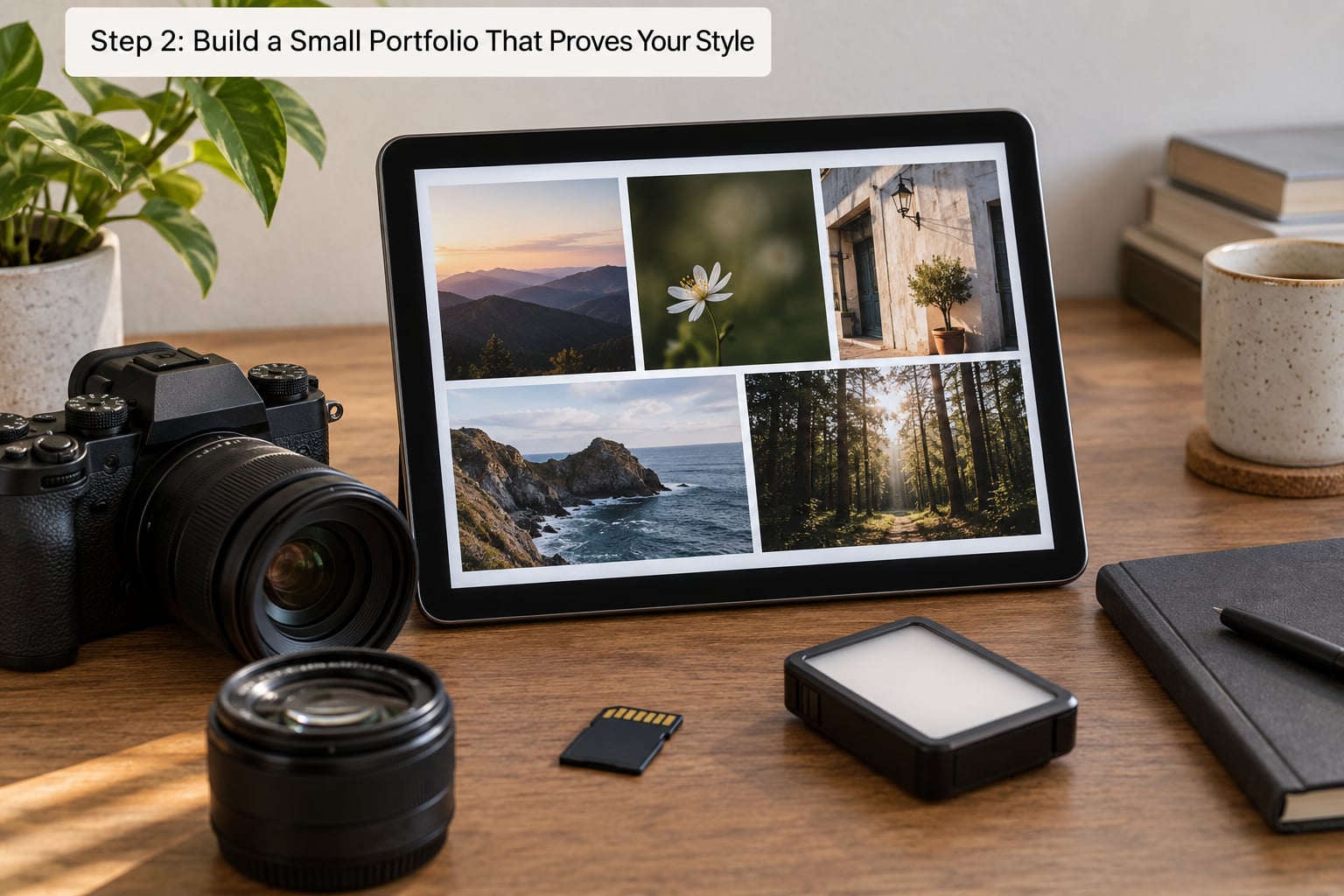
Aim for five to ten purposeful images. Shoot friends, family, classmates, or people you find through model-release swaps, and treat each session like a paid job: same lighting plan, same shot list, same edit.
Show a consistent visual style instead of showing everything you have shot. Pick a look and repeat it until it reads as yours. Mixed daylight and flash, mixed colour temperatures, five different editing moods, and no client will picture themselves in your work.
Check technical quality honestly before publishing. Sharpen what needs it, fix the tilted horizon, correct the blown window behind the subject. Nobody notices a subtle flaw, but everyone notices a blown highlight.
Organise the images around your niche. If you shoot families, your portfolio page shows families, not landscapes from a holiday.
Step 3: Create a Simple Photography Service Offer
Turn your niche into one package with defined boundaries. Specify session length, location, number of delivered images, revision limits, delivery timeline, usage, and your starting price. Fixed boundaries are what turn a favour into a business service.
A portrait package might cover a 45-minute session at one location, 30 edited images delivered in a private gallery within two weeks, one round of minor retouching on the selected images, and personal printing rights. Anything beyond that is a separate quote.
Product work looks different: a set number of items photographed on a neutral background, files delivered in the formats the client needs for their shop or catalogue, and a stated number of rounds on each image.
Events need their own boundaries around hours, travel, and second shooters. When your scope is written down, a client can say yes or no without a negotiation.
Step 4: Identify and Research Real Prospective Clients
Build a list of 20 to 30 people who plausibly need your work this month. Local business directories are the fastest starting point: search your niche plus your town, then work through the results one by one.
Networking groups, chamber-of-commerce events, and local Facebook groups put you in a room with business owners who already talk about a problem you can solve. Trade associations and meetups work the same way, with better-fit attendees.
On social media, use geotags and local hashtags rather than large generic ones. When you want models for portfolio work, search your city tag and your niche tag and message people one at a time.
For each prospect, record four things: what they currently post, what is missing or weak about it, how to reach them, and the one specific reason you are contacting them. If you cannot write that fourth item, they go on the list for later.
A spreadsheet is enough to track this, and it beats a vague intention to market more.
Step 5: Send Personalized Outreach That Offers Value
Generic pitches get ignored because they read as sent to two thousand people. Write one message per prospect, mention something real about their work, connect it to a need, and propose a specific next step.
A short message to a business owner reads like this:
I noticed your summer menu post is doing well, though the new sandwich is hard to see against the plate in the second photo. I shoot food and drink locally and I’m putting together a small portfolio. I could shoot four dishes for you this week and send you edited images you can use straight away, at no cost. If they work out, I’d love to talk about a regular session. Would Thursday afternoon work?
An email version follows the same shape: one line about them, one line about you, one concrete offer, one question that is easy to answer. Keep it under 150 words and put the ask in the first three lines.
Send between eight and fifteen personalised messages a week and expect replies from a small fraction of them. In photographer forums, the most repeated lesson from working professionals is that the first clients come from direct, repeated human contact, not from posting into the void.
Step 6: Hold a Simple Discovery Call and Proposal
When someone replies, move to a short call. Ten minutes is plenty. Your job is to qualify and to understand, not to talk about yourself.
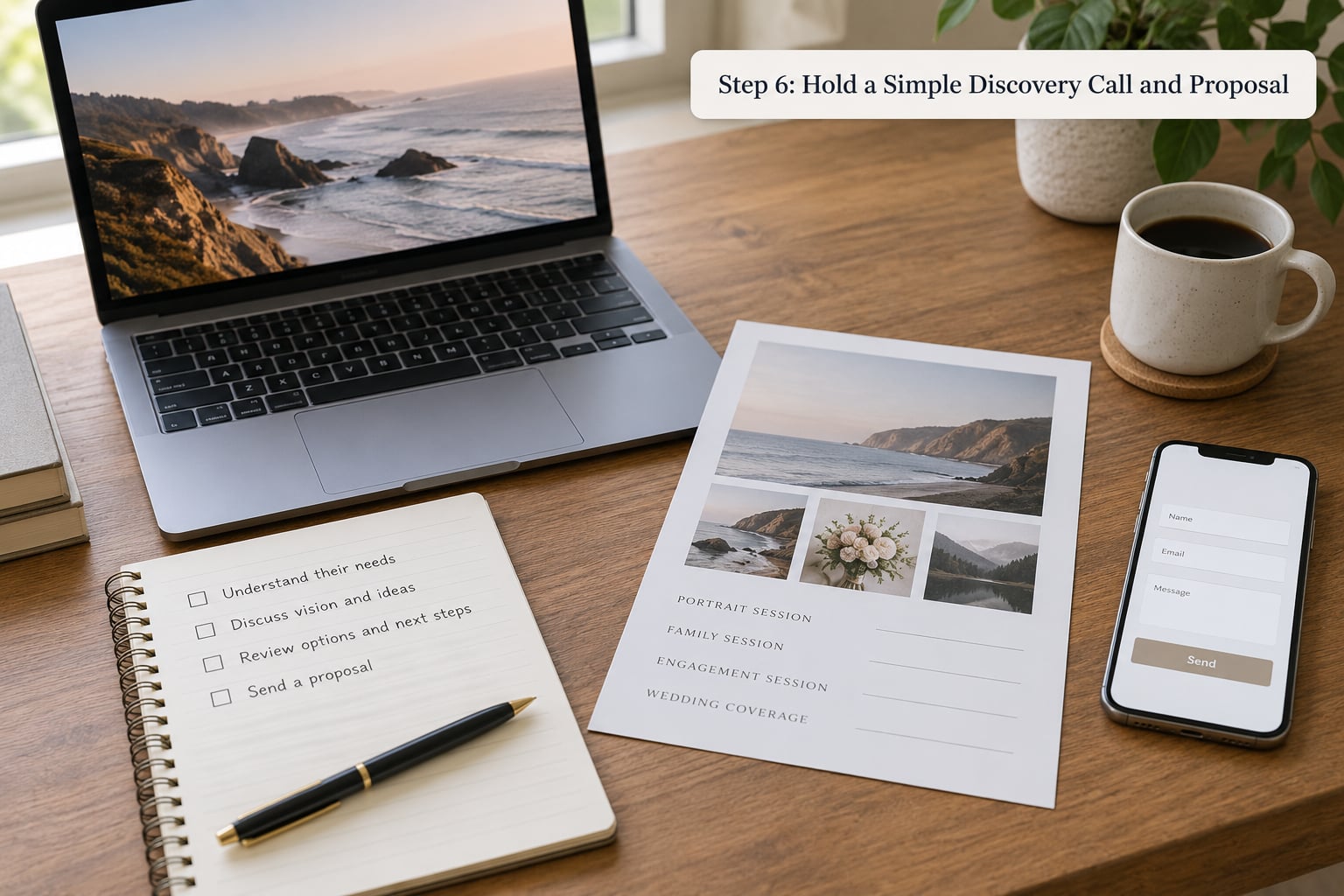
Ask what they use photos for now, where those images fall short, who makes the final decision, what a deadline looks like, and what has gone wrong with a photographer before. Then recommend one package rather than presenting three.
A simple call checklist: purpose of the images, date and deadline, location, who will be in front of the camera, deliverables needed, usage the client has in mind, budget range, and who signs off.
A proposal then covers scope, schedule, fees, usage, and expectations in writing. Deliver it the same day, ideally as a PDF with an acceptance line. Clients move fast when the next step is obvious.
Follow up once if they go quiet after three or four days. Not more than that, and never with a second message begging for an answer.
Step 7: Close the Booking and Turn It Into Proof
Close it properly. Take a deposit before the shoot, get the agreement signed, confirm the schedule in writing, and send a short pre-session note with what to wear, where to meet, and how long it will take.
Deliver images through a proper gallery rather than a pile of email attachments. Name every file descriptively, keep a backup in two places, and tell the client the exact deadline for any reshoots.
Then ask for the three things that make client number one do most of your marketing for you: permission to publish the work, a written review, and an introduction to one person who might need the same thing.
Make those asks easy. A specific message that asks for a review, asks to share the gallery, and asks for one referral beats a vague “let me know how I did”. Add the finished images to your portfolio the week you deliver them, then refine your offer based on what the client actually asked for.
Common Mistakes
Contacting everyone. Fix: work a named list of 20 to 30 prospects who fit your niche. Relevance beats volume every time.
Waiting for a large portfolio. Fix: five consistent images in one style are enough to start. Grow the set with paid work instead of with free shoots that repeat themselves.
Undercharging out of fear. Fix: set a cost floor from gear, editing time, travel and unpaid hours. Quote from that floor, and treat a quote below it as a reason to walk away.
Sending mass messages. Fix: personalise the first two lines for every recipient. If you could paste the message unchanged into ten inboxes, it will not work.
Offering unlimited revisions. Fix: state the number of rounds in the agreement, and define what counts as a round.
Failing to define image usage. Fix: write down what the client can do with the images, whether that is their website only or their paid advertising, and add a fee when usage extends.
Delivering files without a contract. Fix: no deposit, no date, no shoot. Scope it in writing before anything else happens.
Offering free work with no terms. Fix: even when a shoot is free, agree in writing what happens to the images, how they can be used, and whether you may publish them.
Frequently Asked Questions
How much should a new photographer charge for a first client?
Price from your cost floor rather than from another beginner’s rate. Add gear, travel, editing hours, delivery time and any paid expenses, then add the margin you want to keep. For your first booking, a modest introductory rate on a tightly defined package is reasonable, as long as the scope, deliverables and usage are written down. Raise it for every client after that, and never quote without a deposit.
Do I need a professional portfolio before getting photography clients?
You need proof, not polish. Five to ten images in a consistent style, all in the niche you want to be hired for, are enough for most first enquiries. What matters is that the work looks intentional and relevant. A free domain site is fine at the start; your problem is usually a list of prospects who have not heard from you, not the quality of your hosting.
Should I photograph friends and family for free to build a portfolio?
Yes, once, and with terms. Treat the shoot like paid work so it is bookable, and agree in writing that you keep full rights to publish the images and that nobody will post them elsewhere without asking. Free shoots work best when they fill a specific gap, such as missing lighting conditions or a location type. Then stop free shooting and use the time for outreach instead.
How do I get my first photography client without experience?
Lead with what you can show, not with your years of experience. Pick one niche, produce a small relevant portfolio, then approach people who already know you and local businesses whose photos you can improve. Many beginners in photography forums report that their earliest paid work came through friends, family, community networks or a business that needed regular content.
When should I follow up if a potential client does not respond?
Follow up once, three to four days after your first message, and keep it short. Say something useful, such as a sample image in their style or a fixed idea for their next post, and add a single clear question. If there is still no reply after that, move on and keep going. Two messages is generous; more usually reads as pressure.
Conclusion
Do one thing today: pick your niche, put three relevant images on a single page, and send five researched messages to people who already need what you shoot. That sequence, repeated weekly, lands a first photography client far more often than waiting to be found.