A model release is a one-page permission slip, and getting it signed takes less than two minutes if you set it up properly. The trick is deciding who actually needs to sign, choosing the right form before the shoot day, and presenting it as routine paperwork instead of a legal ambush. Get that sequence right and the signature stops being the awkward part of the session.
Most refusal I hear about comes down to how the form arrives, not what it says. A subject handed a dense page of legalese with no explanation assumes the worst, and honestly, they are not entirely wrong to. Show up with a short form, explain it in one sentence, and hand over a pen, and people sign without blinking.
This guide covers the whole chain: form selection, sending paperwork ahead of time, the on-set conversation, checking what was signed, giving copies, storing originals, and the moment when you need to go back and ask again. It is general information, not legal advice. Rules around likeness, privacy and minors differ by state, by country and by how you plan to use the images, so check with a local attorney for anything specific to your situation.
Table of Contents
- What You Need
- How to Get Model Releases Signed Step by Step
- 1. Determine Whether Everyone in the Photo Needs a Release
- 2. Choose the Right Release for the Shoot
- 3. Send the Form Before the Appointment
- 4. How to Get Model Releases Signed Without Delaying the Shoot
- 5. Check the Signature and Release Details
- 6. Give Everyone a Copy and Save the Original
- 7. Reconfirm Permission for Significant or Later Uses
- Common Mistakes and How to Fix Them
- Final Pre-Shoot and Post-Shoot Checklist
- Frequently Asked Questions
- Can a photographer use photos of someone who did not sign a model release?
- Are electronic model releases valid, and what should an electronic signature contain?
- Can a model withdraw permission after signing a release?
- At what age can a minor sign a photography release?
- Do photographers need a witness or notarization for a model release?
- How long should a photographer keep signed model releases?
- Conclusion
What You Need
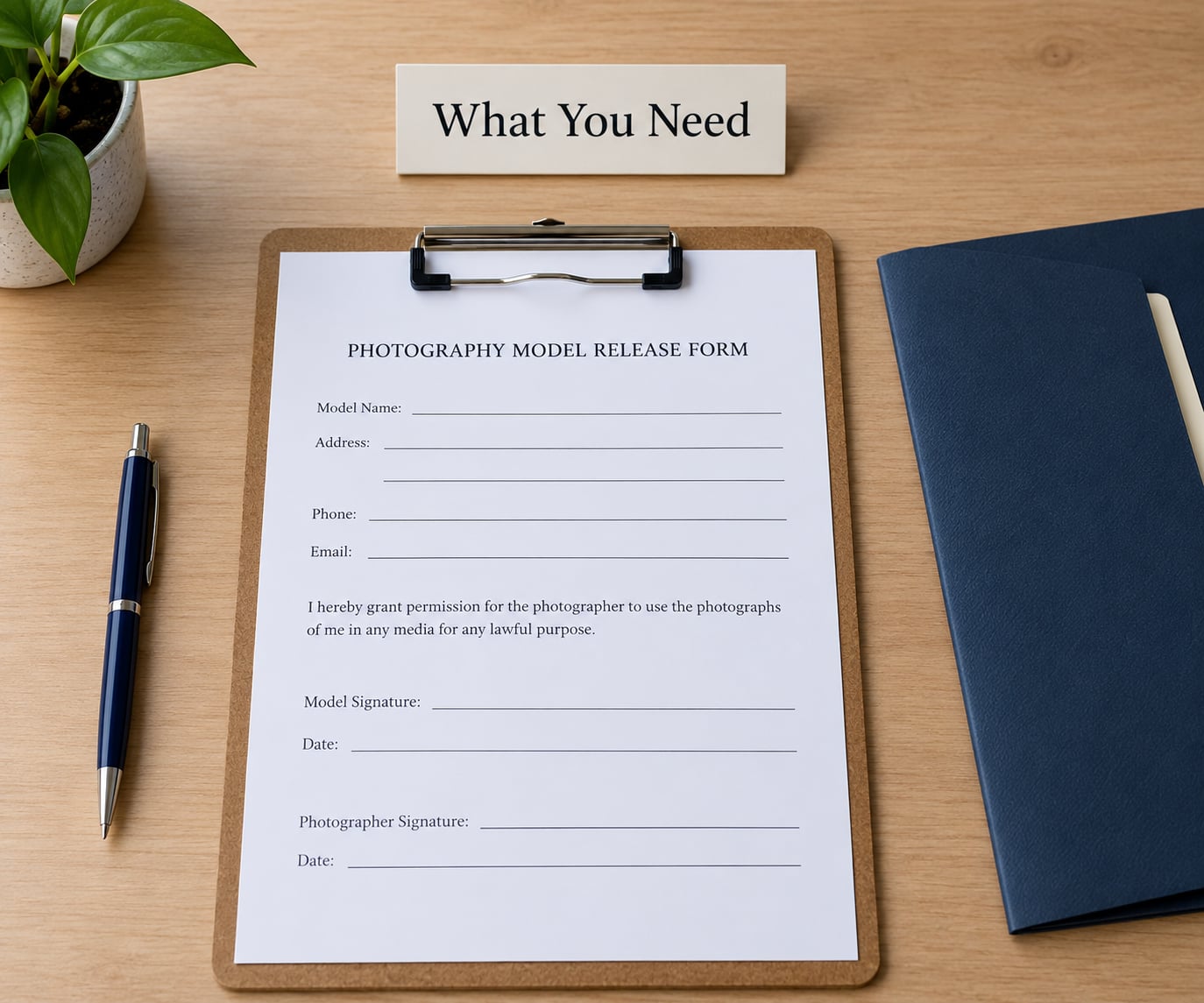
You need four things: a release form matched to the use, something to write with, a way to confirm who is signing, and a storage plan for the signed original. That is genuinely it. Everything else is detail.
- A model release form. Use a short, plain-language version for friends, TFP sessions and portfolio work, and a longer commercial version for advertising, brand work or images you intend to license to a third party. Do not build your own from scratch. Start from a template that has been reviewed for common states, then adjust.
- An identification check. The person signing needs to be the person in the photos. A quick look at a driver licence or ID is enough, and if you are working with a minor, confirm you are dealing with an actual parent or legal guardian.
- A pen that works. Cheap pens skip on cheap paper and a signature that has dropped out of a box can be rejected later. Keep two on hand.
- A storage method decided in advance. A named folder in your archive, a scan tied to the session, whatever you will still be able to find in five years. Decide this before the shoot, not after.
- Guardian or property release, where it applies. For anyone under 18 you need a parent or legal guardian signature, and ideally a separate line for the child if they are old enough to understand. For shoots involving trademarked products, private interiors or recognisable art, add a property release.
One honest note about form length: longer is not always safer. A wall of text gets skimmed, and clauses nobody reads are clauses nobody truly agreed to. What matters is that the use, the term and the parties are unambiguous.
How to Get Model Releases Signed Step by Step
1. Determine Whether Everyone in the Photo Needs a Release
A release is needed for anyone whose face or identity a viewer could reasonably pick out of the frame. That is a lower bar than most beginners assume. It covers a background customer identifiable by a uniform or a shop, a person in a sharp silhouette, and anyone whose tattoos, car, or location make them recognisable to their friends.
Ask three questions about each shoot: is the image going to be used commercially, is the person clearly identifiable, and is the setting somewhere the public has no expectation of privacy? Two out of three points to a release. If the answer is no across the board, you can probably shoot without one and keep the frame for private use.
Write down briefly why you decided a release was required, and keep that note with the session file. If a client ever questions you three years later, a one-line note beats a guess.
2. Choose the Right Release for the Shoot
Pick the form that matches the actual use, and trim it to what you genuinely plan to do. A short form should name the photographer, the subject, the date, the specific photographs or session, the uses you are requesting, the term, and whether you may sub-license those images to a stock agency or a client.
A longer commercial form adds consideration, an indemnity clause where appropriate, a prohibition on using the images in a way that implies endorsement, and a revocation or expiry provision. Add a separate minor clause rather than trying to shoehorn a child into a form written for adults.
Watch the term. A release phrased as unlimited and perpetual is a strong ask for a friend posing for a practice shot. An expiring term of a few years is a far easier sell and often perfectly adequate. It also protects the relationship, which matters if you plan to work with the same people again.
3. Send the Form Before the Appointment
Sending the release at booking does most of the work for you. By the time the session starts, the awkwardness has already happened over email, where people are more willing to read and less likely to feel cornered.
Keep the note short: what the form is, why you need it, and an invitation to ask questions or request changes. Something like: “I attach a short model release for the shoot on the 14th. It covers using your images in my portfolio and on my website. Have a read beforehand and let me know if anything needs adjusting.” That last sentence does more work than the form itself, because it signals that a conversation is welcome.
Do not chase. If they have read it and not returned it, bring a printed copy on the day anyway.
4. How to Get Model Releases Signed Without Delaying the Shoot
Keep the on-set conversation under two minutes and treat it as part of the session, not a separate negotiation. A sequence that works: explain, hand over, answer, sign, copy.
- Explain it in one sentence. “This is a standard release so I can use your photos in my portfolio and on my site. It does not give away the copyright.”
- Hand over the form and a pen together. Do not make them ask for a pen.
- Offer time to read. Two silent minutes while you set up lights reads as respect. Hovering reads as pressure.
- Answer questions honestly. If they ask whether they can be removed later, tell them what your form actually says. Do not overpromise to smooth things over; a promise you cannot keep is worse than a clause they read.
- Confirm the right person signs. The signer must be the subject, or a parent or legal guardian for a minor.
- Watch the signature happen. Blank signature boxes filled in later are a real problem if the document is ever examined.
- Date it. A signature with no date weakens the record of when consent was given.
Give something of value where it is natural. Copies of the finished images, prints, a credit line, or payment in a TFP arrangement all count as consideration, and consideration is part of what makes a release enforceable. It is also simply good manners.
5. Check the Signature and Release Details
Before the model leaves, read the document back. Check the legal name against the ID you saw, confirm the date, confirm the session or images are described, and confirm the term and the uses are the ones you actually intend.
Check that optional fields are filled in properly rather than left ambiguous. If there is a restriction box, a withdrawal clause, or a credit-line line for a professional name, the person should fill it in themselves, not have you guess what they wanted.
For a minor, confirm the guardian’s relationship to the child is stated and that the guardian is the one signing. For a witness field, see the FAQ below, because whether you need one depends on where you are shooting.
6. Give Everyone a Copy and Save the Original
Hand each person a copy before they go, and keep the original signed document yourself. That single habit prevents the most common dispute later, which is not about the law at all but about someone claiming they never agreed to anything.
Scan the signed original the same day and name the file so it is findable: date, subject, project, and a short version of the use. Keep the paper original in a folder organised the same way. A signed release is only as useful as your ability to produce it when an agency, a client or a court asks, and a release you cannot locate is functionally the same as no release at all.
Link the release to the session folder rather than to a memory. When a client requests commercial licensing eighteen months later, the last thing you want to do is reverse-engineer which of 4,000 frames came from which afternoon.
7. Reconfirm Permission for Significant or Later Uses
Go back for fresh consent when the use goes beyond what the release clearly covers. Turning a headshot into a full-page print campaign, using a photo in an advertisement for a product the subject did not know about, or licensing a portrait to a third party under terms the subject never saw are all cases where a short additional note or a new form is worth the five minutes it takes.
The same applies to sensitive context. Some people are relaxed about a fitness photo and not relaxed about it appearing in an advertisement, or comfortable with a magazine and unhappy with a billboard, even though the two uses are technically both commercial. Offering the narrower option costs you nothing and avoids an argument.
Keep a record of any restriction the subject wrote on the form and honour it. A photographer who respects the limits written on a release is a photographer who gets referred by other subjects.
Common Mistakes and How to Fix Them
Most problems with releases are administrative rather than legal. The fix is usually a small change to how you prepare before the shoot.
- Blank or incomplete forms. A release missing the date, the term, or the description of the images gives you very little to rely on. Fix: use a checklist before you file each one, and reject incomplete documents back to the signing conversation rather than accepting them.
- Missing guardian consent. A child cannot sign for themselves, and a sibling or friend who is not the legal guardian cannot sign either. Fix: confirm the guardian’s relationship in writing on the form, and keep their contact details with the session.
- Vague usage language. “I may use these images for any purpose” reads as a red flag to a careful reader. Fix: name the uses. Portfolio, website, print, licensing to a named client, and so on.
- Unsigned digital copies. A scan with an empty signature line proves nothing. Fix: either sign on paper and scan it, or use a proper electronic signature workflow that records who signed, when, and under what terms.
- Lost originals. Fix: scan the day of the shoot, name the file consistently, and keep two copies in different places.
- Verbal permission only. “She said it was fine” is very hard to rely on if the images later end up somewhere unwelcome. Fix: put it in writing, even if the writing is one paragraph.
- Assuming the release transfers copyright. It does not. You keep copyright as the author. A release grants permission to use a person’s likeness; that is a separate thing from ownership of the image, and confusing the two is a common source of awkward client conversations.
Final Pre-Shoot and Post-Shoot Checklist
Before: right form selected for the intended use, signer eligibility confirmed, guardian identified where the subject is a minor, printed copies and working pens packed, storage folder created and named.
After: signature present and witnessed by you, date filled in, legal name matching identification, guardian signature present if applicable, restrictions recorded, copy handed to the subject, original scanned and filed, release linked to the session folder and the deliverable image set.
Frequently Asked Questions
Can a photographer use photos of someone who did not sign a model release?
Sometimes, yes. Photographs taken in a genuinely public place, from a public viewpoint, are often usable for editorial, documentary and even commercial contexts, and courts tend to protect the photographer in those cases. The risk climbs sharply when the setting implies privacy, the person is clearly identifiable, and you had an opportunity to ask. If any one of those applies, treat the image as not cleared for commercial use and keep it internal until you have a signed form.
Are electronic model releases valid, and what should an electronic signature contain?
Generally yes. Electronic signatures and electronic records are widely recognised for agreements of this type, including under frameworks such as the US ESIGN Act, provided the signer intends to sign and the record is retained intact. A defensible electronic record identifies the signer, records the date and time, shows the document that was signed, and lets the signer access a copy afterwards. Plain typed names in an email are the weakest version and are harder to rely on later.
Can a model withdraw permission after signing a release?
It depends on what the form says. A release described as irrevocable is very difficult to withdraw, which is why you should only ask for that term when the use genuinely justifies it. Releases with an expiry date, a revocation clause, or a narrower statement of permitted use are easier to change, and a court may still weigh publicity and privacy rights against the wording. If the subject asks to be removed, put the request in writing and respond to it properly rather than quietly hoping nobody notices.
At what age can a minor sign a photography release?
The age of majority is 18 in most US states, though it differs in a few and is generally 18 to 19 elsewhere. Below that age, a parent or legal guardian normally has to sign, and many practitioners also collect a signature or mark from the child when they are old enough to understand what is being agreed. Do not rely on a signature from an adult who is not the legal guardian, and do not accept a friend’s signature for someone else’s child.
Do photographers need a witness or notarization for a model release?
Usually not. Most model releases are simple permission agreements that do not require notarization, and a witness is generally only needed where local law, a particular client’s legal team, or an agency’s terms call for one. That said, requirements vary by state and by jurisdiction, and shoots with commercial or insurance implications are often better protected with a witness line on the form. If your client or agency hands you their own form, use theirs and follow its instructions exactly.
How long should a photographer keep signed model releases?
Keep them indefinitely, and treat the signed original as permanent. A release is only useful to you if you can produce it when a client, agency, publisher or court asks, and the plausible time between the shoot and that request can be many years. Store the paper original in a fire-safe place, keep a scan in cloud storage or a backed-up drive, and confirm the naming convention still works when you look for it again rather than trusting that you will remember.
Conclusion
The short version of how to get model releases signed: start with the frames, not the form. Work out who in the photograph is recognisable, pick the release that matches how you actually intend to use those images, and collect the signatures before the first frame is shot. Explain the document in one sentence, hand over a pen, hand back a copy, and file the original somewhere you can find it again. The law differs by state and by country and it keeps changing, so treat this as sound practice rather than legal advice, and ask an attorney when your situation is anything other than straightforward.