How to submit work to photography magazines comes down to five things: a finished project, a list of titles that actually publish that kind of work, their current guidelines, a short specific pitch, and the patience to wait. Here is the workflow I would hand a photographer sending their first submission this 2026.
Unsolicited submissions are slow. Assume weeks, sometimes months, before you hear anything back, and assume most of them end in silence rather than a rejection email. That is normal and not a verdict on your work.
What follows is the order that saves the most wasted effort: define the project, research titles, read the guidelines, build the edit, prepare files, write the pitch, then submit and track. Rules change without notice, so re-check each publication’s page before every send. Everything below is current as of October 2026.
Table of Contents
- What You Need
- How to Submit Work to Photography Magazines: Step-by-Step
- Step 1: Define the Project You Want to Publish
- Step 2: Research Publications That Fit Your Work
- Step 3: Check Each Magazine’s Submission Guidelines
- Step 4: Select and Sequence a Cohesive Portfolio
- Step 5: Prepare Publication-Ready Files
- Step 6: Write a Specific Pitch to the Editor
- Step 7: Submit, Follow Up, and Track Results
- Common Mistakes
- Frequently Asked Questions
- Can you submit the same photographs to multiple photography magazines?
- How long do photography magazines take to respond to submissions?
- Should I watermark images when submitting to a magazine?
- Can I submit work to print and online publications at the same time?
- What does exclusive submission mean for a photography project?
- Conclusion
What You Need
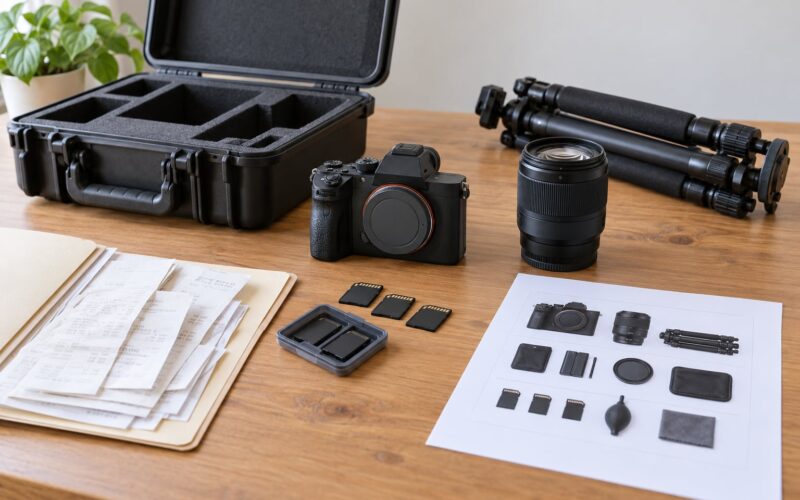
Most rejections are administrative before they are artistic. A submission fails on missing captions, an unlisted credit line, a file the editor cannot open. Gather this material once and every later submission gets faster.
- A defined project. One subject, one visual approach, 8 to 20 images that belong together. Not a folder of your best work from the last four years.
- Your image files at full quality. The originals, not the files you upload to Instagram.
- Captions and credits for every frame. Subject, location, date shot, camera and lens if relevant, and the exact name the editor should print.
- Rights paperwork. Model releases for identifiable people, including a parent or guardian release for anyone under 18, and proof you own the copyright or hold written permission to submit.
- A short bio, 75 words or fewer. Where you shoot, what you shoot, anything already published.
- A submission log. A spreadsheet with the magazine, contact, date sent, follow-up date, and reply. This is the single habit that separates people who get published from people who send and forget.
- Tearsheets from past publications. Once you are published, build a PDF or print sheet showing the page, issue name and date. Tearsheets are portfolio proof: they carry more weight than any self-description.
How to Submit Work to Photography Magazines: Step-by-Step
Step 1: Define the Project You Want to Publish
Before you look at a single magazine, write three sentences about what you are submitting: what it is about, how you photographed it, and why it matters to someone other than you. If those three sentences are hard to write, the edit is not ready.
Editors read hundreds of these. The frame that reads as a collection, not an accident, is the one that gets considered. Decide your audience too: a nature monthly, a travel title and a fashion book reward completely different pictures from the same shoot.
A useful test: name the ten images that must appear. If you cannot get to ten without padding, you have a portfolio, not a project. Keep the rest for later.
Step 2: Research Publications That Fit Your Work
Editorial fit is the number one reason a good photographer gets nothing back, and no competitor guide says it plainly enough: editors are not rejecting your skill, they are rejecting the mismatch. Spend real time on the last four issues.
Look at the pictures, not the table of contents. Are they quiet or loud? Documentary or staged? Do they run in a single image or a spread? If your series needs four pages and the last four issues have never given anyone four pages, look elsewhere.
Also note what the publication does not publish. Some titles are strictly analog processes only. Some cover a single region or a single community. Some are photography-only, some barely use photography at all, and that “barely” is your answer.
Then check the commercial shape of the submission route:
| Publication type | What you get | Typical submission route |
|---|---|---|
| Print magazine | A physical page, strongest credibility with commercial clients | Guidelines page or picture editor email, usually unpaid unless commissioned |
| Digital or online-only magazine | A named link to share, faster turnaround | Online submission form or portal, frequently a themed open call |
| Independent zine or small press | A credit and a tangible object in your hands | Direct email, often with no formal guidelines at all |
| Stock and wire libraries | Licensing income rather than an editorial credit | Separate sign-up; not a magazine submission |
Finally, read the exclusions. Most titles require exclusivity for a period after publication, and some restrict how many other places the same images can run. Know the rule before you send, not after you have an offer.
Step 3: Check Each Magazine’s Submission Guidelines
Guidelines usually live in one of four places: a “Submit” or “Contributors” page on the site, the issue masthead, an open-call page, or a submission portal the magazine links to. If none of those exist, write to the picture editor and ask. Asking is not a cold pitch, and it is far better than guessing.
Check these specific points every time:
- Image count allowed, and whether series count differently from single images.
- Accepted file format, maximum file size and maximum pixel dimensions.
- Color space required, and whether they need a working file or only a flattened one.
- Whether watermarks are permitted, expected or forbidden.
- Caption format: embedded text, a separate document, or typed into a form.
- Whether metadata must be stripped, and any filename convention.
- Whether the magazine has a themed open call with a deadline, or accepts rolling submissions.
- Whether the first contact is expected to be an email, a form, or nothing at all unless invited.
Guidelines exist as a professionalism filter. Editors use them to triage, so a submission that breaks three stated rules is usually triaged straight out.
Step 4: Select and Sequence a Cohesive Portfolio
Curation is the skill, and it is the hardest part to teach yourself. Start with everything from the project, then cut. Cut the near-duplicates, the image that repeats another idea, and the technically weaker frame that says the same thing better one shot later.
Then order for flow. Open with the image that establishes place or mood, build through the middle, and close on the frame that leaves a question rather than an answer. Reading the sequence as a contact sheet should feel like a sentence with grammar.
Write captions while you sequence, not after. Include the details a reader needs and nothing that slows the page: subject, place, date, and your name as the credit. Vague captions are the most common thing editors have to send back.
Never mix unrelated work into one submission to make it look bigger. An editor who spots three unrelated stories in one email stops reading the rest of it.
Step 5: Prepare Publication-Ready Files
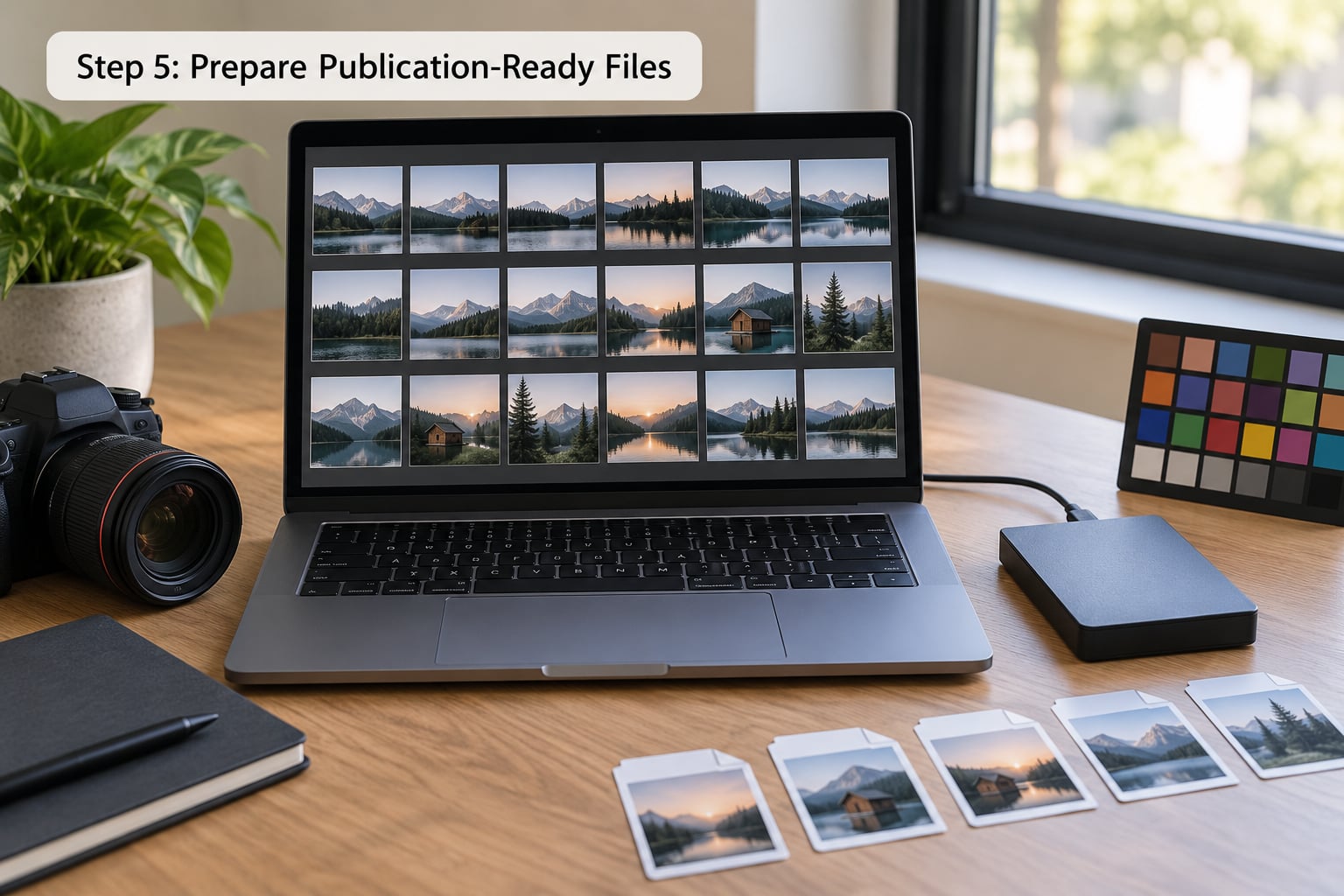
Technical specs are where a good edit dies. A print title that needs full-page spreads will reject a phone-screen crop, no matter how strong the picture. Here are the generalized specifications most magazines fall inside, so you can prepare once and adapt.
| Specification | Typical requirement | Notes |
|---|---|---|
| Image count | 5 to 12 per single-image submission; 8 to 20 for a series | Some titles cap at 10 per issue; check before you curate |
| File format | JPG, fully retouched and flattened | Keep layered working files backed up separately |
| Minimum resolution | 300 dpi at final print size | Portrait full page roughly 2550 by 3300 px; landscape spread roughly 5100 by 3300 px |
| Color profile | sRGB | Adobe RGB and ProPhoto files look wrong after conversion |
| Compression | High quality, roughly 90 to 100 | Visible artifacts on heavy screens and coarse newsprint |
| Orientation | Landscape preferred for digital features; both accepted for print | Leave room around the subject for cropping |
| Filename | Photographer_Project_001.jpg | No spaces, no dates in odd formats, no spaces after underscores either |
| Captions | Typed into a form or supplied as a separate text file | Name, place, date, subject in one line each |
| Watermarks | Usually forbidden unless requested | Most titles want unwatermarked files with credit promised in the caption |
| Contact sheet | Often requested as a single preview image | Numbered in sequence order, small enough to email |
Two more practical points. Export a proof set and check every image at full screen size on your own monitor before sending, because your laptop screen will hide problems. And keep at least two copies of the originals, always. If you submit work for someone else, get written permission first; paying for images does not transfer the rights to publish them.
Step 6: Write a Specific Pitch to the Editor
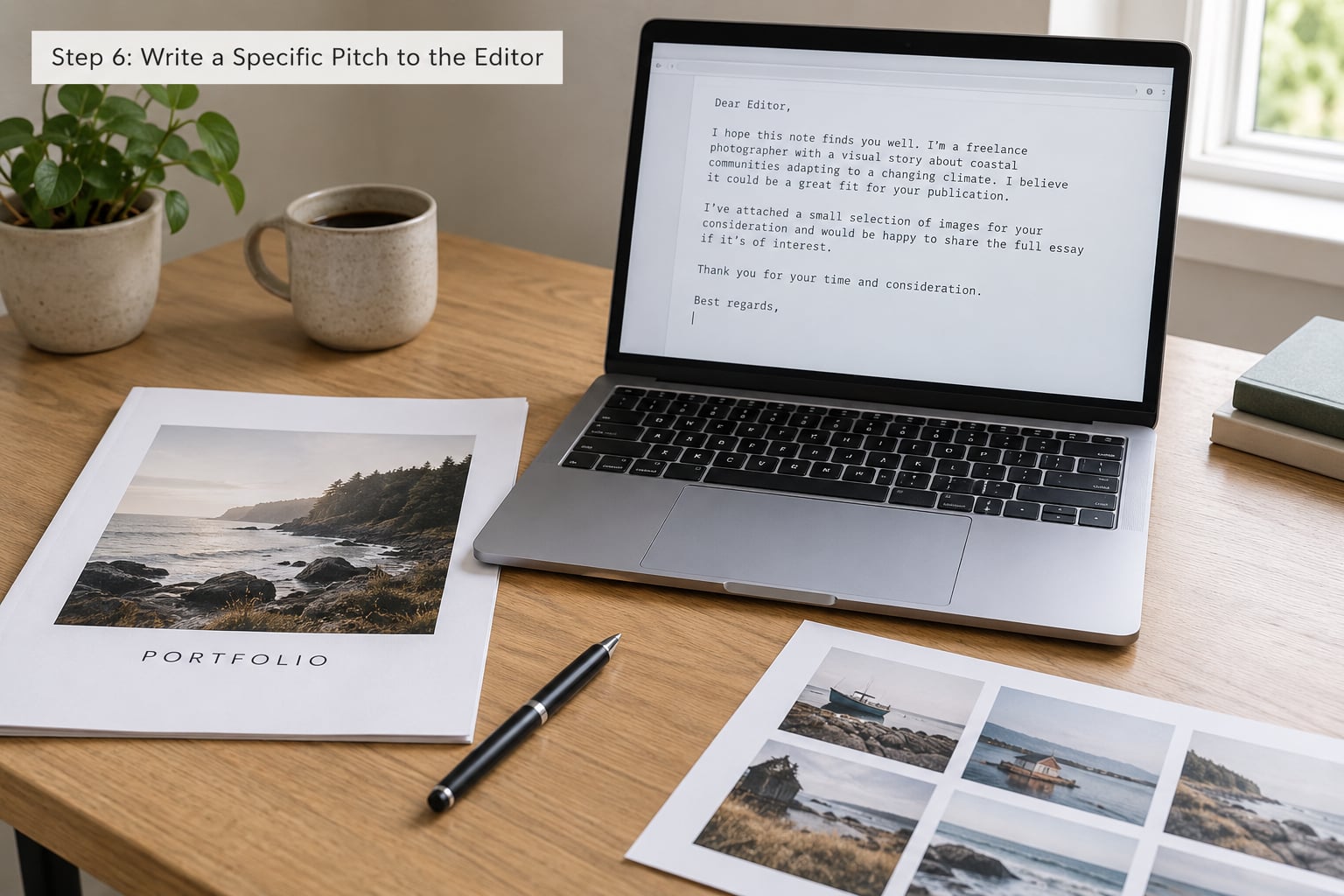
Most photographers write cover letters that could go to any magazine on earth. The picture editor can tell within one line, because it says nothing about the work in front of them.
Your email needs to do four things in under 200 words: prove you looked at this magazine, name the project in one line, explain why it fits this reader, and state publication status plainly. Address the picture editor by title when you can. Attach only what was asked for; twenty unsolicited files read as pressure.
Here is a template you can copy and fill in:
Subject: Photo submission for [issue or theme] - [project name]

Dear [Picture Editor name],

I am submitting [project name], a [number]-image series about [subject in one line], photographed in [place] in [month and year].

I have been a reader for [number] years, and this series follows the [specific feature or theme] your current issue covers. The work is documentary, [one sentence on your approach and what you want the reader to notice].

All [number] images are unpublished and exclusive to you for [period stated in your guidelines]. No work in this series has appeared in print elsewhere.

Also available, if useful:
- [second project, one line]
- [third project, one line]

Files: [number] JPGs, sRGB, [dimensions], [file size range]. Captions and credits attached.

Thank you for your time.

[Your name]
[Website]
[Email]
[Phone, if you want commissions]
Do not ask for money in an unsolicited submission. Unsolicited work is nearly always unpaid, and the money question gets answered differently: once an editor knows you, a commissioned assignment is where the fee lives. If you need payment for a specific project, say so up front and expect it to narrow your options.
Step 7: Submit, Follow Up, and Track Results
Read the email out loud once. Check the editor’s name, the project title in every place it appears, the attachment list, and the publication status line. Then send through the channel the guidelines specified, not the one that is fastest for you.
Log it the same day: publication, contact, date, follow-up date. Set the follow-up date from their stated timeline, or from six weeks if they give none. That date is the earliest you write, not the ideal one.
On a follow-up, keep it to two or three sentences, reference the project by name, add nothing new, and ask whether they would like the remaining files. One follow-up, then stop.
Three outcomes are normal. An acceptance may come with a request for revisions, different crops, more captions or a smaller image count; treat those as editing notes and deliver them fast. A rejection may or may not come with feedback; if you get specific notes, save them, because they describe the market better than any article. Silence is the most common outcome and needs no action beyond logging it.
Editors describe a real triage rhythm: one submission considered at a time, quick rejections, and a waiting period afterwards. Treat that as good news. It means an individual editor is not judging your work. If your work has real fit, submit to the next title and keep the count moving.
Common Mistakes
These are the errors that recur, and most have a simple fix.
- Sending without reading the guidelines. Wrong image count, wrong format, wrong contact. Fix: screenshot the requirements and tick them off before sending.
- Submitting files that are too small for print. A web-sized image stretched to a page looks broken on paper. Fix: check pixel dimensions against the required print size at 300 dpi.
- A generic cover letter. If your first paragraph would work for any editor, delete and rewrite it.
- Claiming publication you cannot prove. “Published in” on an unpaid blog link that never ran, or a portfolio piece you hosted yourself, is worse than saying nothing.
- Breaking exclusivity. Sending the same series to five titles, or to a title that runs it while it sits in your portfolio. Fix: one live offer at a time, and withdraw the others.
- Chasing editors. Repeated emails, messages after a rejection, submissions to every title you can find. Fix: one follow-up after the stated window, then move on.
- Submitting other people’s work. Buying a photo does not grant the right to submit it. Fix: written permission from the photographer and anyone identifiable in the frame.
- Ignoring what your social posts already did. If the series is on a public feed, say so honestly in the pitch and check whether the title treats published-online work as unpublished.
One red flag deserves its own warning because it is common and it is a scam: any offer that charges a submission or processing fee in exchange for a placement, a page, or a feature. A fee buys consideration of your submission, never a guaranteed run. Titles that sell advertising space do not sell editorial coverage, and a listing advertising guaranteed magazine placement for a fee is not a magazine.
Quick habits that pay off: one project per submission, ten images maximum unless told otherwise, sRGB everywhere, every caption written by hand, and a spreadsheet row for every send. Those five things catch most rejections before an editor ever opens the files.
Frequently Asked Questions
Can you submit the same photographs to multiple photography magazines?
Usually not at the same time. Most titles require exclusivity from the moment of submission until they decide, and many extend it for months after publication. Read each title’s terms before sending. A workable pattern is to submit one live offer at a time, keep the rest of the project on hold, and withdraw it elsewhere if you receive an acceptance.
How long do photography magazines take to respond to submissions?
Expect several weeks to a few months, and assume silence is the most common answer. Larger titles and themed open calls take longest; small zines and indie titles often reply within a week. Use the timeline printed in the guidelines, or six weeks if none is given, as the earliest reasonable moment for one short follow-up.
Should I watermark images when submitting to a magazine?
Rarely. Most titles ask for unwatermarked files and print the credit line you provide in the caption instead, because a watermark sits on top of the photograph. Only add a subtle mark when the guidelines explicitly ask for a proof, and keep a low-resolution marked version for any online portfolio link you send.
Can I submit work to print and online publications at the same time?
Only if each publication’s exclusivity terms allow it, and many do not, since online and print editions of the same company often count as one. Send one title per project, read the terms, and if you want both, sequence the submissions instead of running them in parallel. Photographically, prepare one master edit at full resolution and derive print and online versions from it.
What does exclusive submission mean for a photography project?
It means you promise that a specific editor is the only one considering the work during a stated window, usually running from submission until a decision and often for months after publication. Some titles only require exclusivity once they accept. Publishing the same images on your site or social feed during the window can breach it, so check the wording and state your public usage honestly in the pitch.
Conclusion
Submitting to photography magazines is a research problem before it is a photography problem. Define one project, find three publications whose recent issues and stated guidelines genuinely match it, prepare one master edit at publication resolution, and send one specific pitch per title.
Track every send in a spreadsheet, follow up once, and expect silence more often than yes. When a credit does land, save the tearsheet and use it on every future pitch. That is the whole process, and it works better run patiently than run hard.