Burst shooting for expression changes means switching your camera to a continuous drive mode and firing a short group of frames, usually three to five, while your subject’s face is moving. You then cull the group and keep the single frame that catches the micro-expression. It works because the best part of an expression lasts a fraction of a second.
A single frame almost never lands on that peak. A smile arrives as a squint, passes through half-closed eyelids and a held breath, then settles into something relaxed. Hold the shutter for a couple of seconds of frames and you are guaranteed to hit the window somewhere in the group.
The hard part is not the button. It is knowing when to fire, how many frames to take, and how to stop your subject performing for the shutter noise. Get those three right and any camera with a continuous drive mode will do the job. As of 2026, every major brand still keeps those controls in roughly the same place, so none of this depends on a recent model.
Table of Contents
- What You Need to Shoot Bursts for Expression Changes
- Step-by-Step
- 1. Choose a Burst Mode That Fits the Moment
- 2. Set the Camera for Reliable Expression Frames
- 3. Compose the Frame Before the Expression Changes
- 4. Anticipate the Change: How to Shoot Bursts for Expression Changes
- 5. Check the First Burst and Adjust
- 6. Capture Several Expression Phases in One Session
- 7. Cull for Expression, Sharpness, and Timing
- Common Mistakes
- Quick Tips for Better Bursts
- Frequently Asked Questions
- What shutter speed should I use when shooting bursts for expression changes?
- Is high-speed burst mode better for capturing facial expressions?
- Should I use continuous autofocus or single autofocus for burst portraits?
- How many frames should I capture during one expression change?
- Why do my burst images look soft even when the camera fires quickly?
- How do I choose the best frame from a burst sequence?
- Conclusion
What You Need to Shoot Bursts for Expression Changes
The gear list is short. Everything below is nice to have; the only genuine requirement is a drive mode that fires more than one frame per press.
- A camera with continuous shooting. Every mirrorless and DSLR made in the last decade has Low, Mid and High continuous. Frame rates vary by body, so read your manual for the actual numbers.
- A normal or short telephoto lens. An 85mm on full frame gives flattering compression and separates the face from the background. A 35mm or 50mm gets closer to the working distance in a small room.
- Light that does not fight you. Window light or a single soft source is enough. Hard overhead light makes people squint, and a squint is a facial expression you did not ask for.
- A fast card. A card that cannot keep up will stall the buffer mid-burst, and a stalled buffer loses exactly the frames you fired at the peak.
- A subject who knows what is coming. Tell them how many frames you are about to take. A subject who expects the burst relaxes into it instead of bracing.
A fast shutter speed matters because it stops a moving head turning into a smear, and a smear cannot be rescued in the edit. But shutter speed does not decide when an expression changes. Only timing does, which is why a body with a modest 6 fps can beat a faster one when the photographer is watching properly.
My own starting point on any body is 1/250 second, the widest aperture the light allows without pushing ISO past something I would print, and continuous autofocus with eye detection. Everything after that is subject work.
Step-by-Step
Below is the workflow I use on every portrait, family and headshot session. It takes about ten minutes to set up and the rest of it is attention.
1. Choose a Burst Mode That Fits the Moment
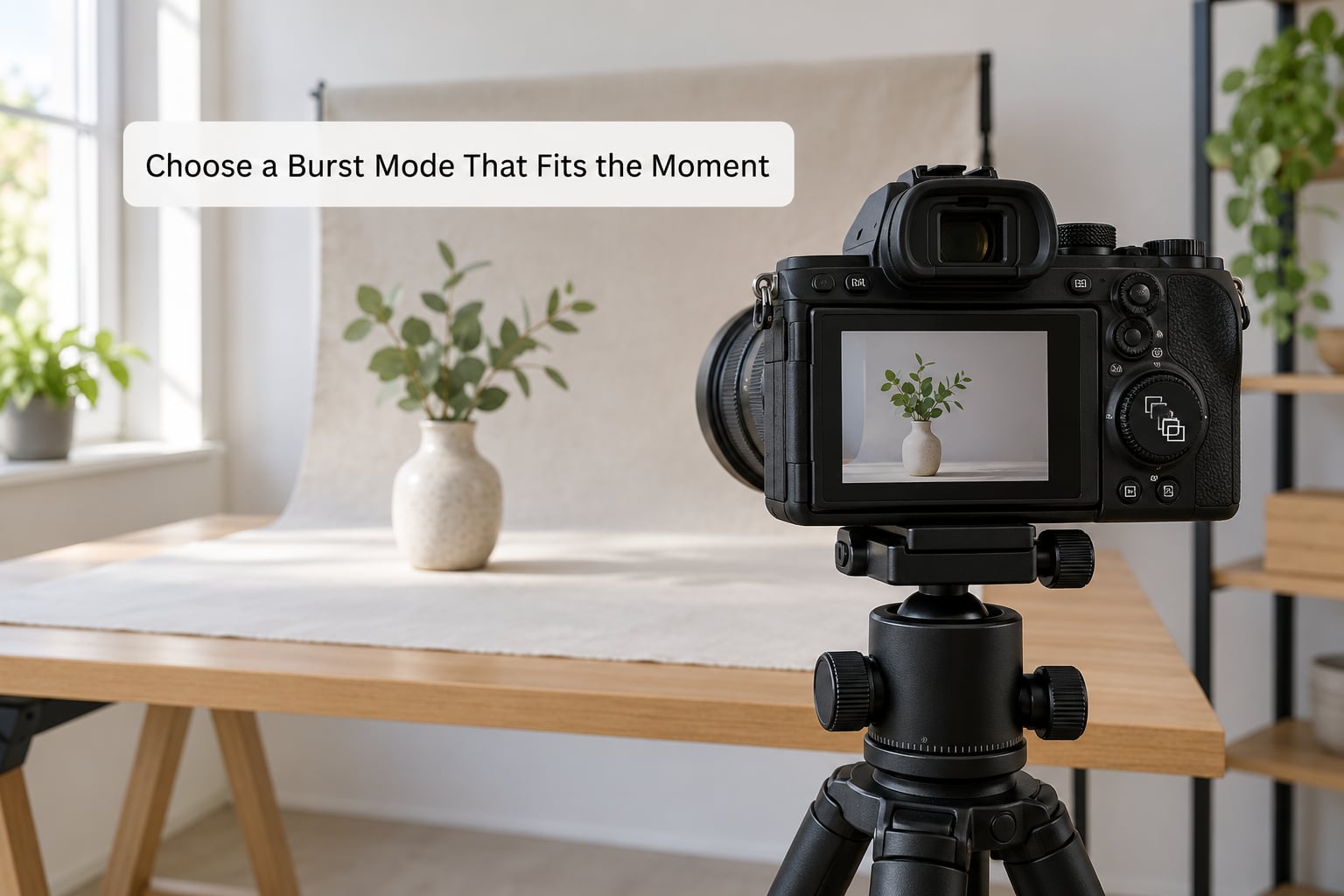
You are choosing between four drive modes, and only one of them is the default you should be shooting portraits in.
| Drive mode | What it does | Buffer cost | Use it for |
|---|---|---|---|
| Single shot | One frame per press | None | Carefully posed work where nothing moves |
| Low continuous | Around 3 to 5 fps | Low | Most portrait and headshot expression work |
| Mid continuous | Around 6 to 10 fps | Moderate | Conversational moments and quick gestures |
| High continuous | 11 fps and above | Heavy | Fast movement, groups full of blinks, running kids |
For a solo portrait, Low continuous is the right default. It gives you three to five frames of headroom without filling the buffer. Professional portrait photographers reporting on r/AskPhotography and the dpreview forums describe exactly this pattern: short bursts outdoors, longer ones when the subject will not hold still.
Turn the rate up only when the movement is genuinely unpredictable. A high rate does not catch more expressions, it just gives you more nearly identical frames to delete.
2. Set the Camera for Reliable Expression Frames
Set everything before your subject arrives. Changing aperture between bursts means the exposure shifts and you cull through technical errors instead of looking at faces.
| Setting | Value to start with | Why |
|---|---|---|
| Drive mode | Low continuous | Short groups, buffer stays open |
| Focus mode | Servo AF / AF-C | Keeps tracking as the head moves through the burst |
| AF area | Eye detection or a small tracking zone | Holds the near eye through the group |
| Shutter | 1/250 second or faster | Freezes small head turns |
| Aperture | Widest the light allows, roughly f/2.8 to f/4 | Keeps ISO low and the face sharp |
| ISO | Auto with a ceiling you trust | Holds exposure in changing light without touching a dial |
| Burst length | 3 to 5 frames if your body offers the option | Stops you recording 20 frames of one blink |
Switch AF to Servo on Canon and Nikon bodies, or to AF-C. Single autofocus locks when you half-press, and a half-press lock is exactly wrong when the subject’s face is turning through the group. With single autofocus you get one sharp frame and a row of soft ones.
Back-button focus is worth setting up if your camera has it. Put the start button on your thumb, let autofocus track continuously, and the shutter only does what it should: fire the group. On Canon it is the AF-ON button, on Nikon and Sony it is AF-ON as well, and on Fujifilm bodies with a dedicated button you can assign it in the AF/MF menu.
3. Compose the Frame Before the Expression Changes
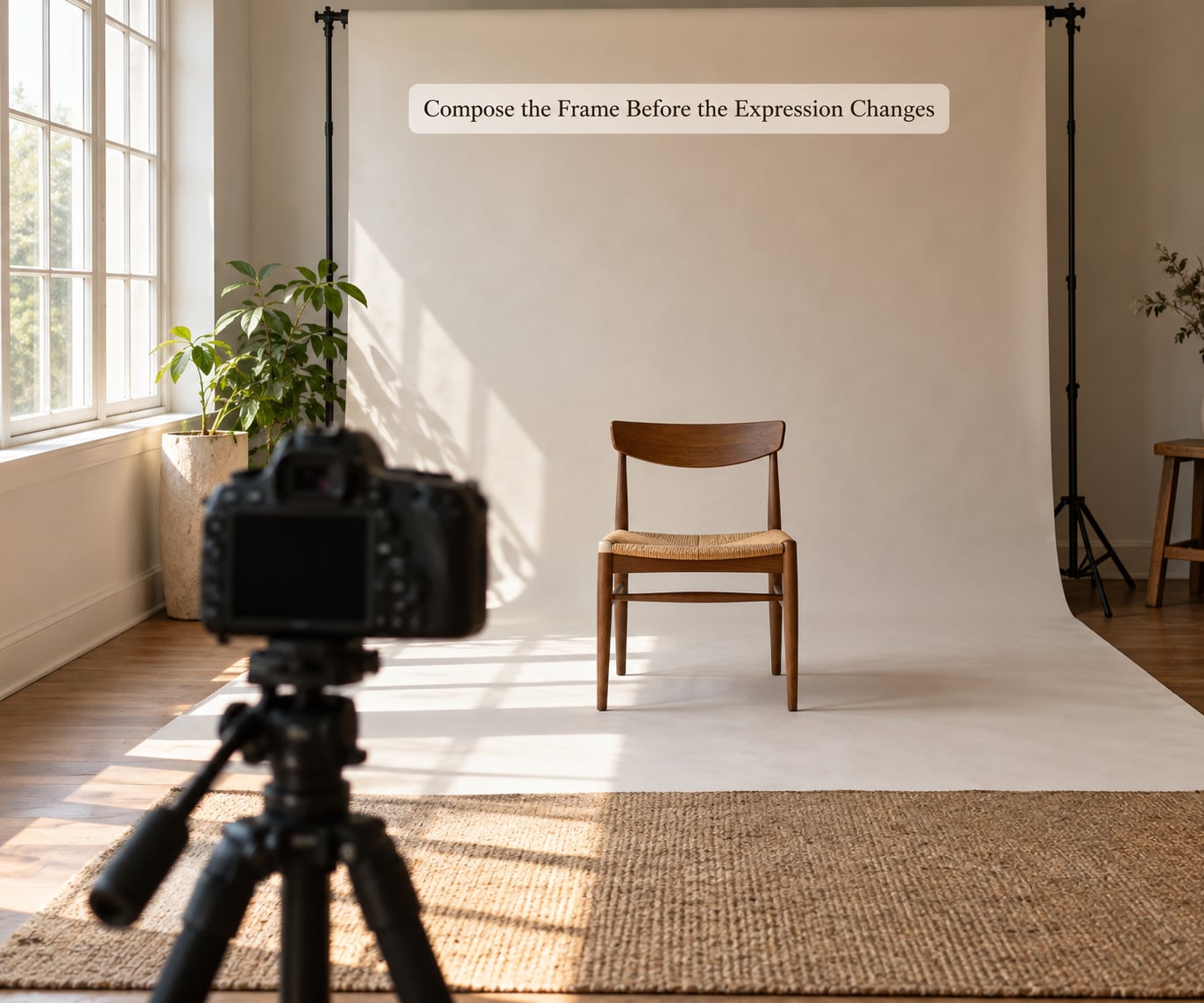
Composition is decided before the burst starts, because the frames inside a burst share the same framing. If the composition is wrong, you have recorded eight copies of the wrong picture.
- Shoot at eye level or slightly below. Faces read as more open when the camera is not looking down at them.
- Leave room in the frame for movement. A subject who leans or turns toward your open space stays inside the composition.
- Clean the background of anything that competes with a face, especially bright edges behind the head.
- Lock focus and confirm exposure with your subject in place before you start directing anything.
- Keep your feet planted. You will be leaning in for two seconds at a time, and you cannot lean if you have to find a position first.
Leave the space. When people laugh, they fold forward and inward, and a tight head-and-shoulders crop that looked composed in the setup shot cuts off the chin of the very frame you wanted.
4. Anticipate the Change: How to Shoot Bursts for Expression Changes
Hold the shutter down continuously and you will get thousands of frames showing the same face. Short bursts fired at the right moment beat a long spray every time.
Watch for the tells: a breath in, a head turning toward you, hands dropping to their sides, the eyes narrowing as a joke lands. Those are the half-second windows where the face is about to change. Fire before the change or immediately after it, then release. The frames inside the group will contain the whole arc.
Counting down helps more than anything else here. Tell the subject something, pause, then count “three, two, one” and fire on one. The burst then catches the anticipation, the transition and the settled result, which is where the good frames live. Group photographers already do this instinctively, counting down before every pose.
On a longer lens, the anticipation is visible before the expression itself arrives. A portrait shooter on the Alpha Universe forum describes shooting three to four frame bursts outdoors specifically to catch the micro-expression or micro-pose, because the peak never sits still long enough to time a single frame.
5. Check the First Burst and Adjust
Review the first group on the back of the camera before you shoot another. Four things to check, in this order:
- Focus. If the eyes are soft, the AF area is probably too large or tracking the wrong thing. Shrink the zone or switch to eye detection.
- Exposure. Check the histogram. Bright skin in a burst means you need negative exposure compensation, and you want to find that out before the tenth group.
- Expression timing. If every frame shows the same flat face, you are firing too early or too late. Move the burst a beat later.
- Motion blur. Soft frames with a fast shutter speed mean the subject moved toward the lens. Shoot at a wider aperture or raise the speed a stop.
Then change one thing, not five. Adjusting drive mode, aperture and framing at the same time tells you nothing about which change fixed the problem.
6. Capture Several Expression Phases in One Session
Do not aim for the smile for the whole hour. Break the shoot into distinct expression phases, and give the subject a few seconds to reset between them. Each phase gives you a separate group with a different character.
- Neutral. Face relaxed, mouth closed. This is where honest portraits hide.
- Smile. The most requested and the hardest to fake convincingly.
- Laugh. Prompt with a story, a joke about the session, or something that happened before you arrived.
- Thoughtful. Look off past the camera, then back. The turn itself produces micro-poses worth several frames.
- Transitional. The half-second between a smile and neutral, which is the frame people usually miss and often the one they end up choosing.
Match the burst length to how many faces are in the frame:
| Subject count | Frames per burst | Reason |
|---|---|---|
| One person | 3 to 5 | Enough to hold the arc, few enough to cull quickly |
| Two or three people | 6 to 10 | Someone blinks or speaks at the wrong moment every time |
| Small group | 10 to 15 | The commonly used rule for a group of about ten, for the same reason |
| Kids | Short and constant, 3 to 4 | Longer groups produce nothing but duplicates once they run off |
Talk to your subject before the shoot. Saying “I am going to take about five frames each time, and we will look at them together” removes the awkwardness of the shutter machine-gun and makes people relax into the rhythm.
7. Cull for Expression, Sharpness, and Timing
The edit is where burst work pays off, and the workflow in Lightroom Classic or Bridge is the same for everyone. Sorting near-identical frames is the most common complaint in r/Lightroom and r/AskPhotography, so it is worth doing it deliberately.
- Import normally and let the camera folder sort itself by capture time. Never rename during a session.
- Set the stack shortcut to a single key in the Develop module grid view. Default stacking keys do not work the way you want on a burst folder.
- Read the first and last frame of each group. In a three-frame burst that is two clicks; in a fifteen-frame group it is still two.
- Hold down the stacking key to collapse the group into one thumbnail.
- Work through the stack thumbnails only. A face reads at 150 percent on a grid thumbnail, and that is enough to judge expression.
- Open the two or three real candidates full size and check the eyes, the catchlight and the moment between the smile starting and finishing.
When a group looks flat, check the frames either side of it before you delete it. The real expression is often sitting just outside the burst you fired.
Common Mistakes
Holding the shutter down for the whole session. You fill the buffer, the card fills up, and the frames become hard to sort. Fix: bursts of three to five, then release and reset.
Leaving the drive mode on High continuous. High rates waste buffer and produce 20 near-identical frames of one blink. Fix: drop to Low continuous for solo portraits and raise it only for groups and running children.
Shooting with Single autofocus. Focus locks on the half-press and the rest of the burst drifts soft. Fix: Servo AF or AF-C, and set AF-ON to start tracking.
Bursting under hard overhead light. Everyone squints, and you record the squint instead of the expression. Fix: move the subject to a window or turn the subject toward a large soft source.
Firing on the count instead of watching the face. A countdown synced to the shutter catches a performed smile on the beat, not the real one. Fix: use the countdown to prepare the subject, then watch the eyes and fire.
Choosing the technically perfect but emotionally flat frame. The sharpest image is often the one where nothing happened. Fix: judge sharpness first, then pick between the sharp frames on expression alone.
Ignoring blinking subjects. Short bursts are more likely to catch an eyelid mid-blink. Fix: ask for a short blink on a count, then fire the burst slightly after the blink rather than during it.
One more worth naming: bursting with flash or a tripod on a slow shutter. Stacked neutral density filters and long exposures do not benefit from frames per second, and a flash strobe firing 15 times in a row drains the recycling capacitor faster than it recovers.
Quick Tips for Better Bursts
- Fire three frames before a change and three after it. The transition frames are usually better than the settled one.
- Keep the camera on your chest between bursts. Your eye on the viewfinder makes subjects perform; your eye off it makes them talk.
- Vary your framing between groups rather than between frames inside a group. One burst, one composition.
- Check the buffer and card indicator after each set. A stalled buffer is the reason you missed the peak.
- Shoot wide open for the burst sequence and stop down for the settled frames. Wide open is where people stop posing.
- Give the subject a two-second reset between prompts. The frame you want usually appears after they think the moment is over.
- Say the frame count out loud: “five frames, then I will show you.” People relax when they know when it ends.
Frequently Asked Questions
What shutter speed should I use when shooting bursts for expression changes?
Start at 1/250 second for a seated or standing portrait, and go to 1/500 second when the subject is a child, moving toward you, or turning quickly. Faster than that only costs you light and forces a wider aperture or higher ISO. Blur from a small head turn is the most common reason a burst group is unusable, and 1/250 second removes most of it without pushing your ISO somewhere ugly.
Is high-speed burst mode better for capturing facial expressions?
No, not for most portraits. Low continuous, at roughly 3 to 5 frames per second, gives you the three to five frames you need around one expression change and keeps the buffer open for the next one. High continuous earns its place with groups, running children and fast gestures, where you cannot predict the timing. Used on a solo portrait it mostly produces extra frames showing the same blink.
Should I use continuous autofocus or single autofocus for burst portraits?
Use continuous autofocus, called Servo AF on Canon and Nikon and AF-C on Sony and Fujifilm. Single autofocus locks the distance when you half-press the shutter, so the frames after the first are shot at whatever distance the subject has already left. Continuous autofocus keeps tracking through the whole group. If your camera has AF-ON, assign that to the button and keep focus under your thumb.
How many frames should I capture during one expression change?
Three to five frames for one person, six to ten for two or three people, and ten to fifteen for a group of about ten. The numbers rise because blinks multiply with every face in the frame, and one blink ruins the group. If your camera lets you set the burst length, set it rather than relying on your finger, because a held button always records more than you intended.
Why do my burst images look soft even when the camera fires quickly?
Three usual causes. Single autofocus locked the distance on the half-press, so only the first frame is sharp. The aperture was narrow enough that the subject moved out of the focal plane between frames. Or the camera was struggling to write files, so the later frames in the group were taken while the buffer was still clearing. Check one full-size frame at 100 percent and you will usually see which one it is.
How do I choose the best frame from a burst sequence?
Judge in two passes. First sort on sharpness, since a soft frame cannot be rescued no matter how good the expression is. Then look only at the sharp frames and pick on expression alone, ignoring composition details you already know are fine. The frame that wins is usually the one just before the smile fully settles, not the one where the smile is widest.
Conclusion
Start by putting the camera into Low continuous, setting Servo AF with eye detection, and fixing your composition before your subject arrives. Then fire short groups of three to five frames at the moments you see a face about to change, review the first group, and adjust one thing at a time. That is how to shoot bursts for expression changes without spraying frames at random.