Knowing how to raise your photography prices comes down to a process, not a leap of faith. Work out what a job actually costs you, pick a rate you can defend, apply it to new inquiries first, then hold for 90 days and watch your booking rate.
The usual first step is a 20% increase, with a healthy booking rate sitting somewhere between 40% and 60% of qualified inquiries. If inquiries keep converting above 70% after the change, you have room to raise again.
That method matters because most photographers raise prices for the wrong reason and in the wrong order. They quote a competitor’s number, or they react to a slow month, and then they discount the moment anyone pushes back. The sequence below fixes both habits.
All figures in this guide are in US dollars and are worked examples you can substitute your own numbers into.
Table of Contents
- What You Need
- Step-by-Step: How to Raise Your Photography Prices
- 1. Review Your Costs, Time, and Profitability
- 2. Define the Photography Service You Are Pricing
- 3. Research Comparable Local Photography Rates
- 4. How Much to Raise Photography Prices
- 5. Update Your Pricing and Booking Policies
- 6. Tell Existing Clients What Is Changing
- 7. Handle Objections Without Discounting Immediately
- Common Mistakes
- Frequently Asked Questions
- How much should I raise my photography prices?
- How do I tell existing clients about a photography price increase?
- Will I lose clients if I raise my photography prices?
- How often should photographers raise rates?
- What is a good booking rate for a photographer?
- Should I raise prices or improve my portfolio when bookings are down?
- Conclusion
What You Need
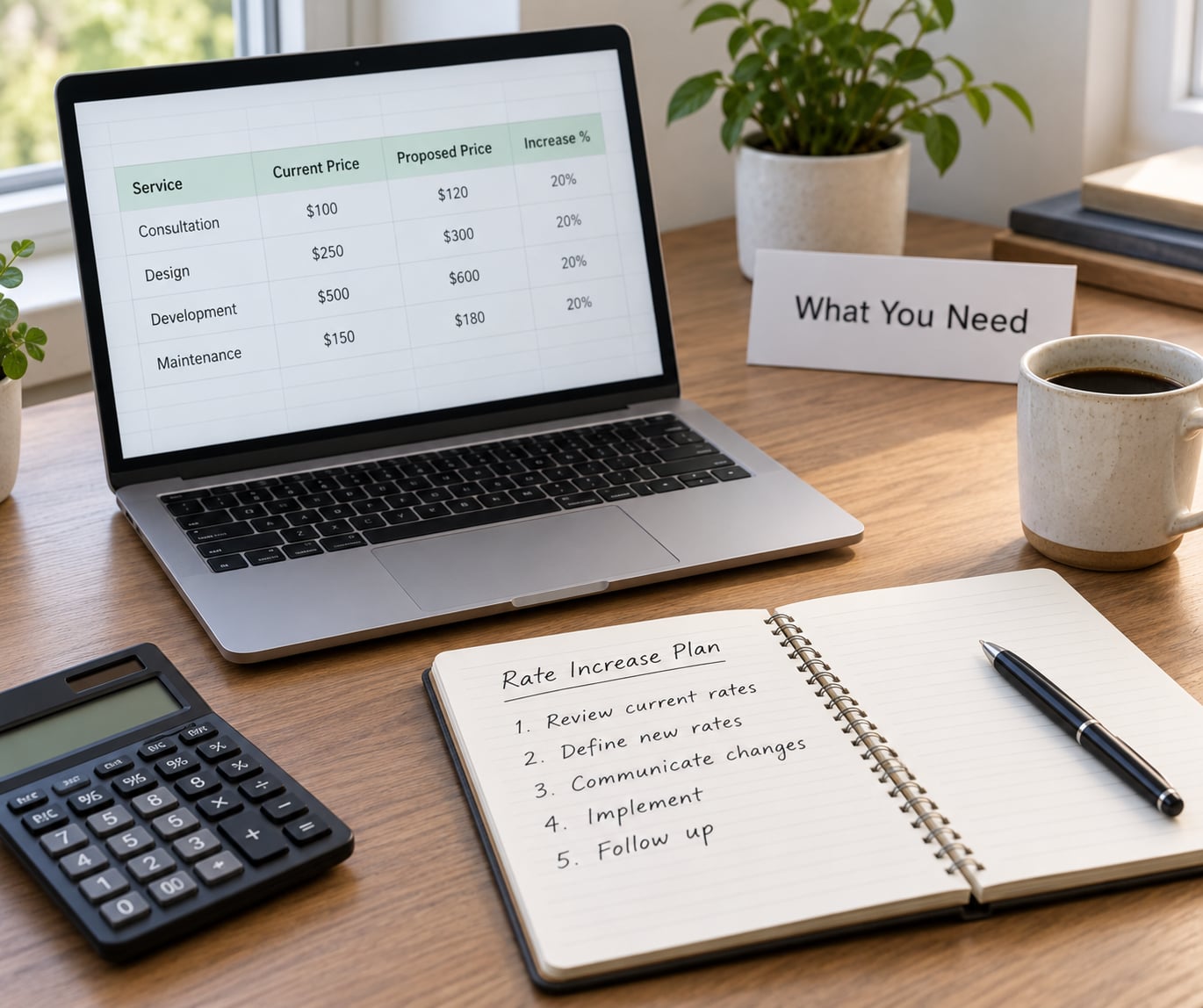
You need five things before you touch a single number. Anything less and the raise turns into a guess you have to defend in a conversation you would rather not have.
- Twelve months of actual expenses. Bank statements, software invoices, insurance renewal, equipment finance, mileage, and the fuel card. Pull the real numbers, not last year’s memory of them.
- A booking log. Every inquiry, the date it arrived, what it was worth, and whether it booked. Twelve months of this gives you the one number the whole process depends on.
- A realistic billable-days count. How many jobs or shoot days you actually work in a year once you subtract admin, travel, marketing, editing days off and slow weeks.
- Your current deliverables, written down. Hours on site, number of images, turnaround time, album or print inclusions, usage rights, and what travel costs you.
- A way to announce it. A pricing page, an inquiry form, a contract template, a payment-schedule clause, and a list of clients already booked at the old rate.
If you only do one of these, do the booking log. Without it you cannot tell whether a raise worked or whether you simply got quieter.
Step-by-Step: How to Raise Your Photography Prices
Seven steps, in this order. Skipping ahead to the number is what produces the anxiety that makes photographers negotiate their own rate down.
1. Review Your Costs, Time, and Profitability
Start with the cost of doing business, because everything else in this guide is downstream of it. Divide your total annual business costs by your realistic billable days, and you get the number every single job has to carry before you make anything.
The easiest mistake here is leaving out your own unpaid time. Editing, culling, admin, invoicing, contract prep, gallery delivery, marketing — that is real labour and it belongs in the calculation. Assign it a rate you would happily charge a stranger, even if only for this exercise.
Here is the arithmetic in practice, for a wedding photographer taking 25 jobs a year:
- Annual business costs, including equipment, insurance, software, marketing, vehicle and admin time valued at an hourly rate: 41,400
- Overhead per job: 41,400 divided by 25 = 1,656
- Target net income per job: 1,200
- Minimum sustainable rate: 1,656 + 1,200 = 2,856
At a 2,500 rate, every wedding that photographer shoots loses 356 before tax. Now the raise stops being a leap of faith and becomes a correction.
A note on hourly thinking: a tidy figure like 100 an hour looks reassuring on an invoice, but it quietly prices your admin time at nothing and your equipment at zero. It is a cost-recovery number, not a business rate.
2. Define the Photography Service You Are Pricing
Before comparing rates, write the service down as a defined package. Session length, number of delivered images, turnaround, travel beyond a set radius, second shooter, album or print credits, rush delivery, and usage rights all change the job, and each one changes the price.
Most photographers end up undercharging for the same reason: they raise the headline number but keep every deliverable exactly as generous as before. That is a pay cut wearing a raise’s clothes.
Pick one structure and hold it. Three tiers built as good, better and best is the most common, and the middle tier does most of the work because most clients pick the middle. A cheaper tier that is genuinely smaller, not a stripped version of the same day, keeps your entry point without giving away your main package.
Add-ons earn their keep here too. Extra hours, travel past the radius, a second shooter, same-day previews and extended usage each get a line item with a number attached.
3. Research Comparable Local Photography Rates
Compare against photographers doing the same work, at the same career stage, in the same market. A fifteen-minute scan of local pricing pages, association benchmark reports and a handful of photographer directories gets you a range.
Treat that range as a sanity check, not an anchor. Competitor prices tell you almost nothing about their costs, their capacity, or how many unpaid hours sit behind a 1,200 session fee. A photographer working two jobs a week and one working Saturdays can quote the same number and mean completely different things by it.
Two real signals matter more than any published list. If clients consistently book your most expensive package, your packages are too close together or your rate is too low. And if you are fully booked months out, capacity, not price, is your constraint.
Forums disagree on how hard to push here. One thread on r/WeddingPhotography argues for raising very slowly and watching how bookings respond, while photographers on r/photography describe standing firm on a base rate and never negotiating. Both are workable — the slow path suits a couple-facing niche where clients shop by number, the firm path suits a referral-driven book.
4. How Much to Raise Photography Prices
A first raise of 20% is the most common recommendation, because it is large enough to be meaningful and small enough to explain. If your rates have not moved in three or more years, or your numbers say you are losing money on jobs, a 30% to 50% move is correction rather than ambition.
After that, plan 10% to 15% a year as your costs rise. That pace matches what equipment, insurance, software and subcontractor rates actually do to your margin, and it keeps you in a habit of repricing instead of one lurch every three years.
Use the worksheet before you commit to a figure. Fill in the blanks and the defensible rate does the talking for you.
| Raise planning worksheet | Your number |
|---|---|
| Current published rate | ____________ |
| Annual cost of doing business | ____________ |
| Jobs or shoot days per year | ____________ |
| Overhead per job (costs divided by jobs) | ____________ |
| Break-even rate (overhead plus target net income) | ____________ |
| Proposed new rate | ____________ |
| Booking rate now (bookings divided by qualified inquiries) | ____________% |
| Booking rate target | 40–60% |
Back to the worked example. At 2,500 for 25 jobs, gross revenue is 62,500 against 41,400 of costs, leaving 21,100 before tax. Raise 20% to 3,000 and the same 25 jobs produce 75,000, or 33,600 — about 59% more income for the identical workload.
Raise your subcontractor rates in the same pass. A second shooter, assistant or retoucher still cost you what they cost you, and if you raise one side of a two-person job and not the other, your margin quietly shrinks.
Prints and albums deserve their own numbers too. Your vendors quote you a cost, and your client should be paying that cost plus a margin on top. Products sold after delivery are the cheapest revenue you will ever add.
5. Update Your Pricing and Booking Policies
Give the new rates one effective date and write that date into everything: the pricing page, the inquiry form, the PDF guide you email, the contract template, the deposit schedule, the cancellation terms, and any add-on list.
Decide the grandfathering rule before you publish, not in the moment a loyal client emails you. The common approach is to honour the rate for anyone already booked and paid a deposit, and apply the new rate to every new inquiry from the effective date forward. That is the approach one photographer on r/photography describes using: mention the increase the next time a returning client gets in touch, rather than blasting the whole list.
A second option is to offer booked clients an upgrade — more hours, an album, an extra shooter — at the difference in price. Some take it, and it raises average order value without a confrontation.
Also write down what happens when a client negotiates. A published policy that says rates are firm and scope is flexible gives you something to point at, so the conversation is about deliverables rather than your worth.
6. Tell Existing Clients What Is Changing
Keep it short, warm and specific. Thank them, name the new rate and the date, give one honest reason, and stop talking. Over-explaining reads as asking permission.
Subject: A note about my 2026 pricing
Hi [name],
I wanted to let you know that my session rate is moving from [old rate] to [new rate], effective [date]. I have kept the same package — same hours, same edited gallery, same turnaround — and I will continue booking your family’s dates first, as always.
The change reflects what it now costs me to run a business well, from insurance and equipment to editing time and the support I pay for after the shoot.
If you would like to book before the new rate takes effect, just reply and I will hold the current pricing for you.
Thanks for trusting me with your photos,
[your name]
Offer the old rate to anyone booking before the effective date. That gives the reply-to-email reader a clear action without discounting your published price for anyone else.
Send it to clients who have rebooked before. Do not send it to every name you have ever quoted; an inquiry who never booked is not a client and does not need the news.
7. Handle Objections Without Discounting Immediately
Two objections cover almost everything you will hear. “It’s out of budget” and “another photographer quoted me less.” Neither one is answered with a lower rate.
For the budget objection, move scope rather than price. Offer a smaller package with fewer hours or a digital gallery only, priced honestly, and keep your full rate intact. On r/photography, photographers who describe dropping a base rate say it signalled they were open to bargaining permanently. The number you concede once becomes the number you are asked for again.
For the comparison objection, ask what is included. Scope differences are usually the real answer, and a client comparing a five-hour day with an album to an hour of coverage learns something useful. If the competitor genuinely offers more for less, that is a packaging problem for you to fix, not a reason to cut your rate.
Then wait. Silence after a quote is uncomfortable and it is also just a person thinking. Send one polite follow-up, then move on.
After 90 days, run the review. Booking rate above 70% means raise again by another 10% to 15%. Between 40% and 60% means hold. Below 30% means stop and diagnose, because that is usually lead generation or portfolio work, not the rate.
A booking drop is not automatically a pricing failure. Separate the causes: are inquiries down (a marketing problem), or are inquiries the same and bookings down (a trust or fit problem)? If inquiries fell, the raise did not cause it. Only when volume holds and conversion falls has the price actually moved out of your market.
Common Mistakes
Most pricing mistakes repeat a handful of patterns. Each one has a straightforward correction.
- Anchoring on a competitor’s number. Correction: price from your own cost structure and use market rates only as a range check.
- Raising because you feel busy rather than because the numbers moved. A busy season is not evidence. Correction: recalculate your cost of doing business annually and let that set the floor.
- Changing prices with no notice. Correction: one effective date, stated everywhere, applied to new inquiries first.
- Discounting right after announcing a raise. Correction: reduce scope or add value instead. A discount reverses the message you just sent.
- Renegotiating with clients already booked. Correction: publish a grandfathering rule and stick to it. Chasing a difference you were never owed costs more in trust than the money is worth.
- Ignoring unpaid admin time. Correction: value your editing, admin and marketing hours at a real rate in the calculation.
- Raising only your own rate. Correction: raise second shooters, assistants and retouchers in the same pass.
- Deciding before measuring. Correction: hold the new rate for a full 90 days before you judge it. Two slow weeks mean nothing.
Two habits keep this from drifting. Check your margin monthly and your competitor scan quarterly, then recalculate your cost of doing business once a year. And put a full re-pricing on a three-year cycle, because your package, your gear and your market will all have moved.
Frequently Asked Questions
How much should I raise my photography prices?
Most photographers should raise 20% on the first pass, then 10% to 15% a year as costs rise. If your rates have not moved in three or more years, or your own cost math shows you losing money on jobs, 30% to 50% is a correction rather than an overreach. Check the result against your booking rate 90 days later before deciding on the next move.
How do I tell existing clients about a photography price increase?
Keep it to four sentences: thank them, name the new rate and its effective date, give one honest reason tied to real business costs, and stop. Offer the old rate to anyone who books before the effective date so they have a reason to reply now. Do not ask for permission and do not list every cost line, because over-explaining weakens the message.
Will I lose clients if I raise my photography prices?
You will lose some, and that is usually a good sign. The price-sensitive clients who leave were never a profitable fit, and the ones who stay because they value the work are the ones worth building a business around. Photographers who raise rates report that booking volume often barely moves. Watch your booking rate over 90 days rather than reacting to the first quiet week.
How often should photographers raise rates?
Plan a 10% to 15% increase annually to track rising costs, with a full recalculation of your cost of doing business once a year and a complete re-pricing every three years. Review your margin monthly and scan local competitors quarterly so you notice the market moving before your rates are obviously stale. Small annual moves are far easier to explain than one large jump.
What is a good booking rate for a photographer?
A healthy booking rate is 40% to 60% of qualified inquiries. Above 70% you are turning work away or working too hard for too little, and that is a clear signal to raise. Below 30% usually points at lead generation, portfolio or a mismatch between your rate and your positioning rather than the rate itself. Count only inquiries you could genuinely have served.
Should I raise prices or improve my portfolio when bookings are down?
Check where the drop came from before you change anything. If inquiry volume fell, your marketing or referrals changed and the rate is not the cause. If inquiries held steady and conversion fell, work on the portfolio, your inquiry response time and the clarity of your packages before touching prices. Raising into a lead-generation problem rarely fixes it.
Conclusion
Open your expense spreadsheet tonight and divide it by the number of jobs you actually shoot each year. That gives you a floor, the floor gives you a rate, and publishing one rate with one effective date is the whole first move.