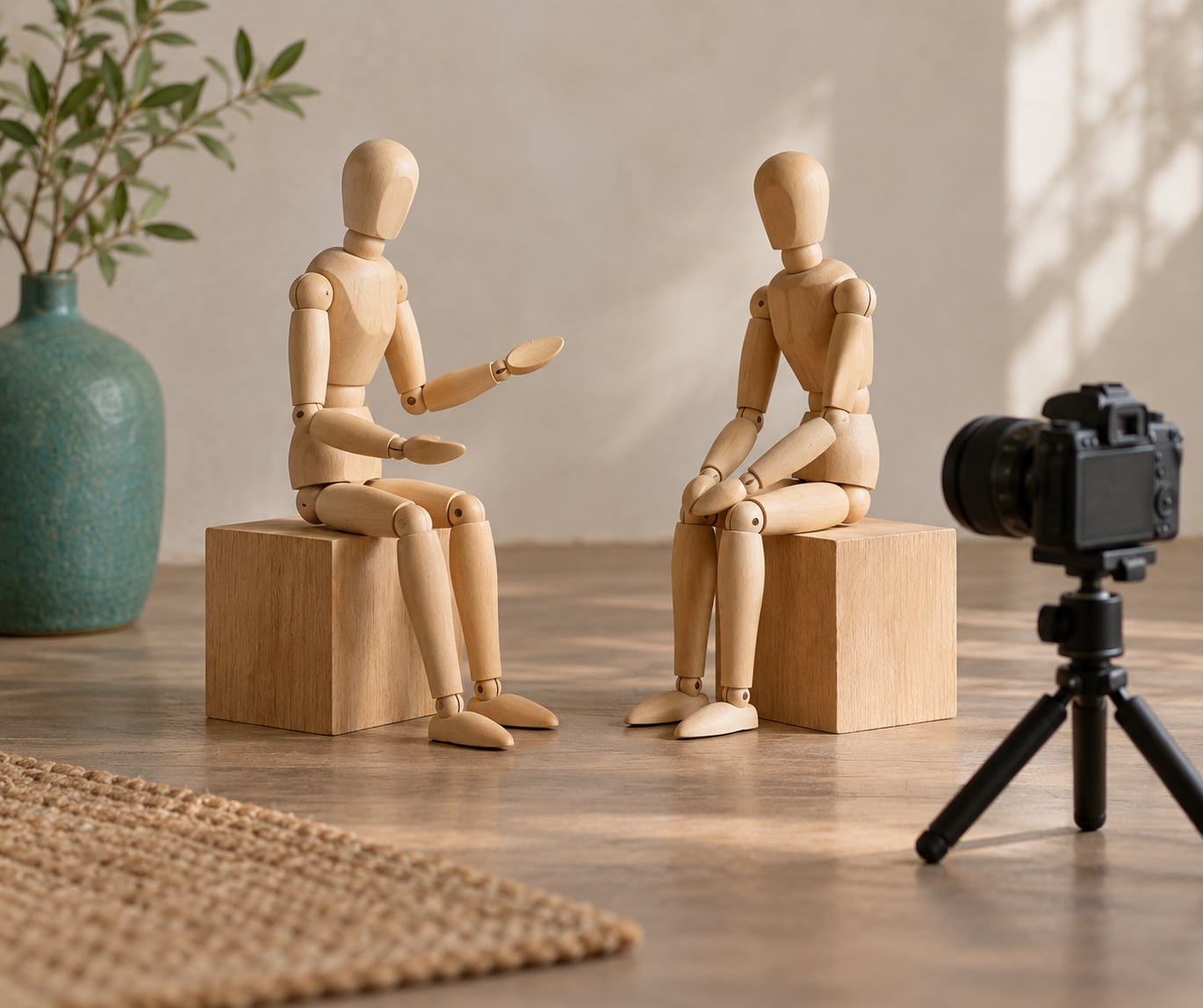
To pose couples naturally, you stop arranging bodies and start directing people. Give the couple one simple base position, then hand them an action or a sentence to react to, and keep the camera firing while they play it out. Most of the stiff, awkward results photographers worry about come from holding a pose still and waiting for the shutter, not from the pose itself.
Here is how to pose couples naturally using a repeatable workflow you can run in about twenty minutes. It works for engagement sessions, wedding day portraits, and the couple who just wants better photos of themselves on a walk.
Table of Contents
What You Need
Everything you need is small: a base shape, a handful of words, and room to move. Before you arrange anyone, gather the following.
- A base pose the couple can hold for a few seconds without thinking — staggered feet, weight on the back foot, one shoulder slightly forward.
- Three or four action prompts you can say word for word, such as “walk toward me slowly” or “whisper something to each other.”
- A simple background with a few feet of clear space so they can walk toward you.
- Two contrasting clothing tones that separate from the background. Matching clothes merge into the wall and make a silhouette look flat.
- Music on a small speaker. It covers the silence that makes people self-conscious.
No gear list here. A 35mm or 50mm lens works; an 85mm is flattering but narrower, so you will walk more.
Run a Two-Minute Warm-Up Before the First Pose
Anything you direct will land better if the couple has already moved once. Ask them to walk arm in arm across the space and back, twice, while you shoot. It warms them up physically, gives you a look at how they hold hands, and produces a few usable frames before you have arranged a single thing.
During the walk, ask two questions you actually want to hear the answer to later: what made them choose each other, and what are they planning this year. If a memory comes up while they are still talking about it, that is your frame.
Pick a Time That Works for Them
Golden hour and the hour after sunset are the easy choices, because the light is soft and low and forgiving. Midday is workable if the couple is comfortable being out in public — otherwise shoot near a building edge, a porch or an open doorway where the wall throws shade across their faces.
Wind matters more than the clock. If it is blowing hard, hair and fabric are going to move in every frame, so shoot closer and slightly faster rather than fighting it with distance.
Have a Backup Plan for Restlessness
Some couples genuinely cannot stand still, and asking them to is a losing instruction. Give them a prop or a task instead: a coffee cup, a book, a jacket over the shoulder, a bouquet to hand over. A prop creates movement and gives hands something to do without you having to direct either.
Step-by-Step: How to Pose Couples Naturally
Start With a Relaxed Connection
Do not touch anyone in the first two minutes. Ask them how they met, ask what they are arguing about this month, and walk them slowly toward the camera while you talk. The frame you take while they are mid-sentence is usually better than anything you could arrange.
Photographers on photography forums describe this as a directing problem rather than a posing problem — some couples are simply more comfortable being photographed, and prompts work better than a pose list for everyone else.
Create Space Between the Bodies
Most unflattering couple photos have their torsos welded together. Ask one partner to take a small step back or to the side, and rotate both hips about thirty degrees away from the lens. That gap catches light between them and gives each person a visible shoulder line instead of one wide, shapeless block.
Check the silhouette. If you squint and cannot tell where one person ends and the other begins, the bodies are too merged.
Use Movement to Avoid Stiff Poses
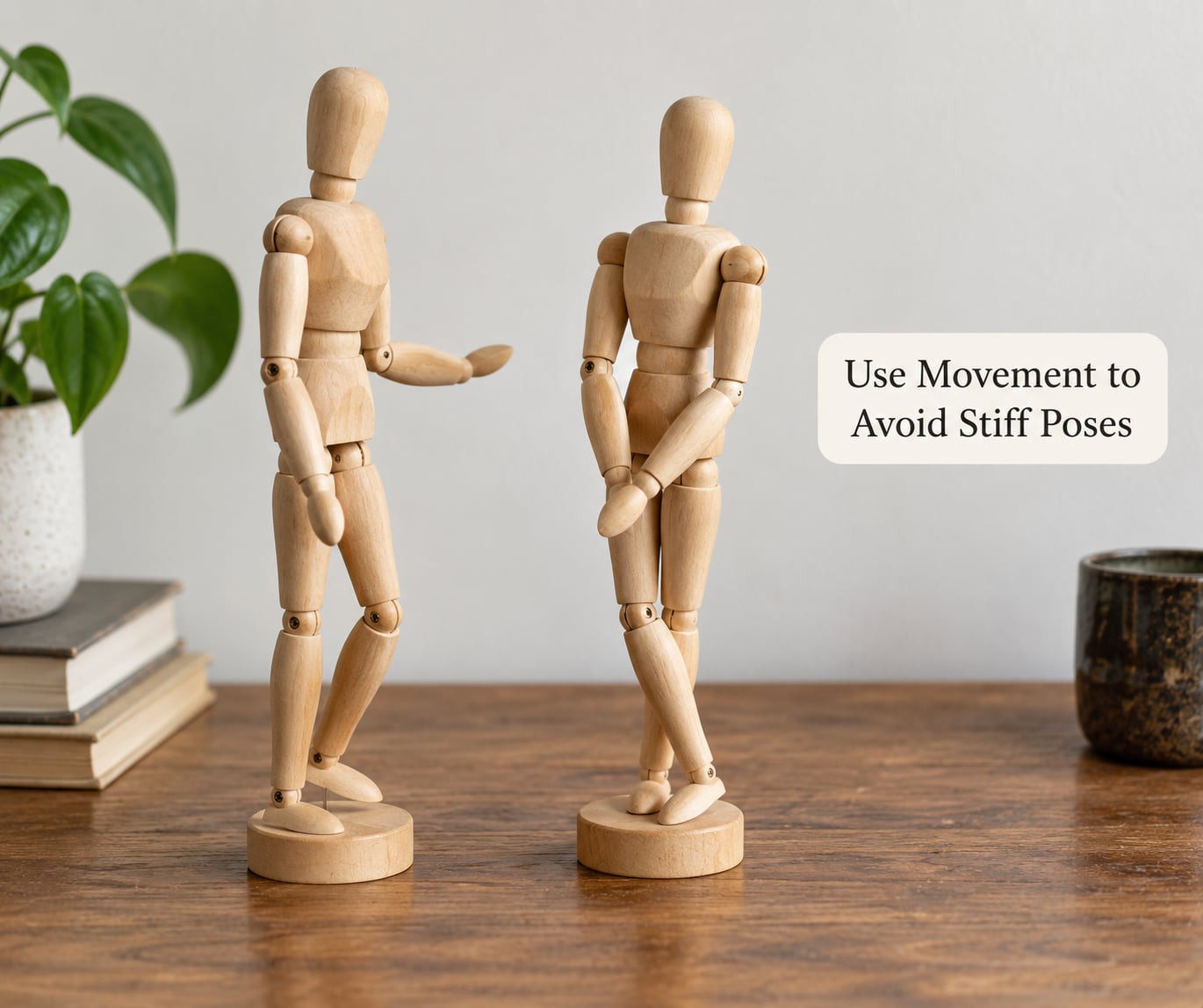
Movement breaks stiffness faster than any instruction. Ask them to walk slowly toward you, to turn toward each other mid-step, to adjust a sleeve, or to rest a hand on a shoulder while they laugh about something you just said. Keep the camera up and shoot continuously rather than arranging, stepping back, and firing once.
For a twirl, ask one partner to spin the other and catch them. That single prompt produces a dozen usable frames because the motion keeps changing the shape.
Build a Simple Three-Point Shape
Heads, torsos and legs should each point somewhere slightly different. Heads turned toward each other, torsos angled to the light, feet pointing off to the side. That mismatch creates a relaxed diagonal instead of a flat line, and it looks natural even when nobody is moving.
You can apply this to the whole body or to a single part. If the pose feels static, change one group — usually the feet — and leave the rest alone.
Build from the bottom up, the way experienced shooters do it. Weight settles onto one back foot first, knees stay soft rather than locked, then the shoulders drop and the hands find somewhere to rest. Add the connection — a hand, a lean, a look — last. Starting at the faces puts people into a performance mindset, and starting at the feet does not.
A quick check you can run on any frame: shoulders down and away from the ears, chin slightly forward and down, weight visibly on one leg. Fixing those three in that order fixes most of what makes a standing couple look tense.
Choose a Comfortable Supporting Pose
Contact only works when the couple already likes it. Offer choices and let them decline without comment. A hand on the shoulder suits shy couples. Hands held loosely in front suits older couples who are comfortable but not performative. A full side embrace or a forehead touch suits couples who ask for something warmer. Leaning together with no arms involved works for anyone.
Never ask for a kiss in a public place. Community advice on wedding photography forums is consistent on this: forcing public affection produces closed shoulders and fixed smiles, not intimacy.
Direct With Actions, Not Pose Names
“Pose more naturally” is not an instruction anyone can follow. Replace it with something concrete: “put both hands in one pocket,” “look at each other for three seconds,” “lean your head on their shoulder,” or “walk to the fence and turn around slowly.”
Give one direction at a time. Two instructions at once splits attention and both get half-heard.
How to Pose Couples Naturally From More Angles
When you run out of poses, move yourself. Drop the camera to waist height and shoot upward to make a couple look stronger. Step closer with a wider lens for intimacy, or back off to put them in the landscape. Walk around them for a full circle — every angle gives a different frame from the same comfortable body language.
Photography communities rarely agree on more than this: starting from a comfortable position and letting the couple move within it beats trying to set a complicated shape from scratch.
Capture Small Moments Between Poses
The frame right after you set a direction is where the stiffness falls off. Keep shooting through the reset — the laugh that happens when someone lets go, the lean that returns, the glance while the other person is not posing yet. Those in-between seconds are usually the ones couples pick as their favourite.
Watch the background each time you move. A pole growing out of a shoulder or a bright window behind a head ruins a good frame, and moving five steps sideways fixes it without touching the pose.
Common Mistakes and Easy Fixes
Hands that hang or grip too hard. Give hands a job: one in a pocket, one on the partner’s shoulder, fingers loosely laced at waist height. Then relax the fingers and take a few frames. Stiff hands are the fastest way to make a warm pose look cold.
The same fixed smile in every frame. Ask them to look at each other instead of the lens, then at the camera, then back to each other. Changing where they look changes the expression more reliably than asking for a better smile.
Bodies merged or limbs tangled. Ask for a hand’s width of space between torsos, then re-angle the hips. If arms overlap badly, swap which arm goes where, or move the camera instead.
Exaggerated movement. Movement should be slow. Twirls, spins and dramatic gestures produce frames where the subject is blurred mid-pose. Tell them to move like they are crossing a room, not dancing at a party.
Rushed or vague direction. Say one clear thing, then wait two seconds. If you are describing a pose while walking backwards and changing settings, nobody is listening. Slow down and the frames improve on their own.
Ignoring the background. Check behind their heads for bright gaps, tree trunks or horizon lines. Ask them to shift a foot at a time rather than rearranging the whole pose.
One habit worth dropping entirely: showing couples saved reference photos on your phone. It puts them in a performance mindset, and both photographer and couple end up stiff trying to copy something that was lit and framed differently.
The couple who dislikes how they look in pictures. Do not argue with it and do not offer a reassurance they did not ask for. Find out what specifically bothers them — usually it is one thing, a nose, a jaw, a hand — and move the camera to work around it. Shoot slightly higher and use a moderate lens to soften the face, or frame a little wider so that feature sits in context. Once that one thing is dealt with, the rest of the set usually lands fine.
Everyone’s family watching. Shy couples perform worse with an audience, and the onlookers become part of the frame. Walk them somewhere with their backs to the crowd, put them in motion toward a fixed point, or shoot close and shallow so the background dissolves. If you cannot move them, ask the family to step out of frame for twenty seconds.
Two minutes of usable time and five photos needed. Stop designing poses. Shoot the walk toward you, one shoulder-touch, and one circle around the couple at a closer distance. Three setups, dozens of frames, done. Tight timelines are better served by movement than by arrangement.
Frequently Asked Questions
What poses show intimacy in photos?
Intimacy reads through contact and proximity rather than through kissing. Forehead-to-forehead, a hand on the shoulder or chest, hands loosely held at waist height, and one partner leaning into the other all read as close. Keep the eyelines on each other instead of the lens, leave a little space between bodies so both silhouettes stay visible, and shoot at a slightly wider angle to keep the context around them.
How do I direct a couple who is not a model?
Start with a base position they can hold, then add one action per frame. Say things they can act on immediately: walk toward me slowly, look at each other, hold hands, whisper something. Give one instruction at a time and wait a couple of seconds. Most people who describe themselves as awkward freeze because they are given too many things to think about at once.
Why do couples look stiff in photos?
Stiffness usually comes from holding a position on command and waiting for the shutter. The couple is thinking about their hands, their weight and the camera all at once, which flattens the face. Movement fixes it: walking toward you, turning toward each other, laughing at something you said. Shooting continuously during the setup rather than after it gives you far more usable frames.
How do I get variety from a small set of poses?
Keep the bodies where they are and change one thing at a time. Move the hands, then the eyelines, then your own camera height, then the distance and lens. Walk a full circle around a comfortable position for four more distinct frames. That gives you eight to ten images from one arrangement, which is why working photographers lean on three or four base poses instead of a long list.
How do I pose a couple who is not comfortable with public affection?
Ask what they are comfortable with, and never assume. Options that need little or no contact work well: hands in pockets, walking side by side, one partner leaning on the other, sitting together with space between, or a shoulder touch if they offer it. Many couples will happily hold hands in private and freeze in front of a crowd, so let them set that boundary and shoot around it.
How do you pose a couple with a big height difference?
Work with it instead of trying to level it out. Put the shorter partner a step forward on stairs or a slope, or have them stand while the other sits on a low wall. Shoot from the shorter partner’s eye level so both faces stay visible. Avoid straight-on wide framing from far away, which exaggerates the difference, and keep them close enough for a moderate lens.
Conclusion: Start With One Easy Pose
To pose couples naturally, forget memorising poses. Set one comfortable staggered stance, add a single action like a slow walk or a look at each other, and shoot through the moment instead of waiting for it. Then move yourself — lower the camera, step closer, walk a circle — before you change anything about their bodies. Most of what reads as natural in the final frame comes from that sequence, not from a complicated pose.