Last updated October 2026
For paid portrait work, mirrorless wins: you get instant feedback, hundreds of frames per sitting and retouching latitude before the client walks out. Film wins for personal and fine-art portraits, where the slower pace and the look of Kodak Portra 400 or a Fujifilm Pro 400H scan matter more than the deadline. Plenty of working portrait shooters do both, and for this comparison on mirrorless vs film for portraits that is usually the honest answer.
That is the whole argument, honestly. Everything below is the detail behind it: what each format does to skin tones, what it costs per finished portrait, how fast autofocus gets you to a usable frame, and how the medium changes the way you direct a person who is standing in front of you being photographed.
Table of Contents
- Mirrorless vs Film for Portraits at a Glance
- How Image Quality Differs for Portraits
- Which Is Faster and More Reliable?
- Lens and Equipment Options
- The Main Differences in Cost
- How Each Format Handles the Portrait Session
- Which Is Better for Different Types of Portraits?
- Which Should You Choose?
- Frequently Asked Questions
- Conclusion
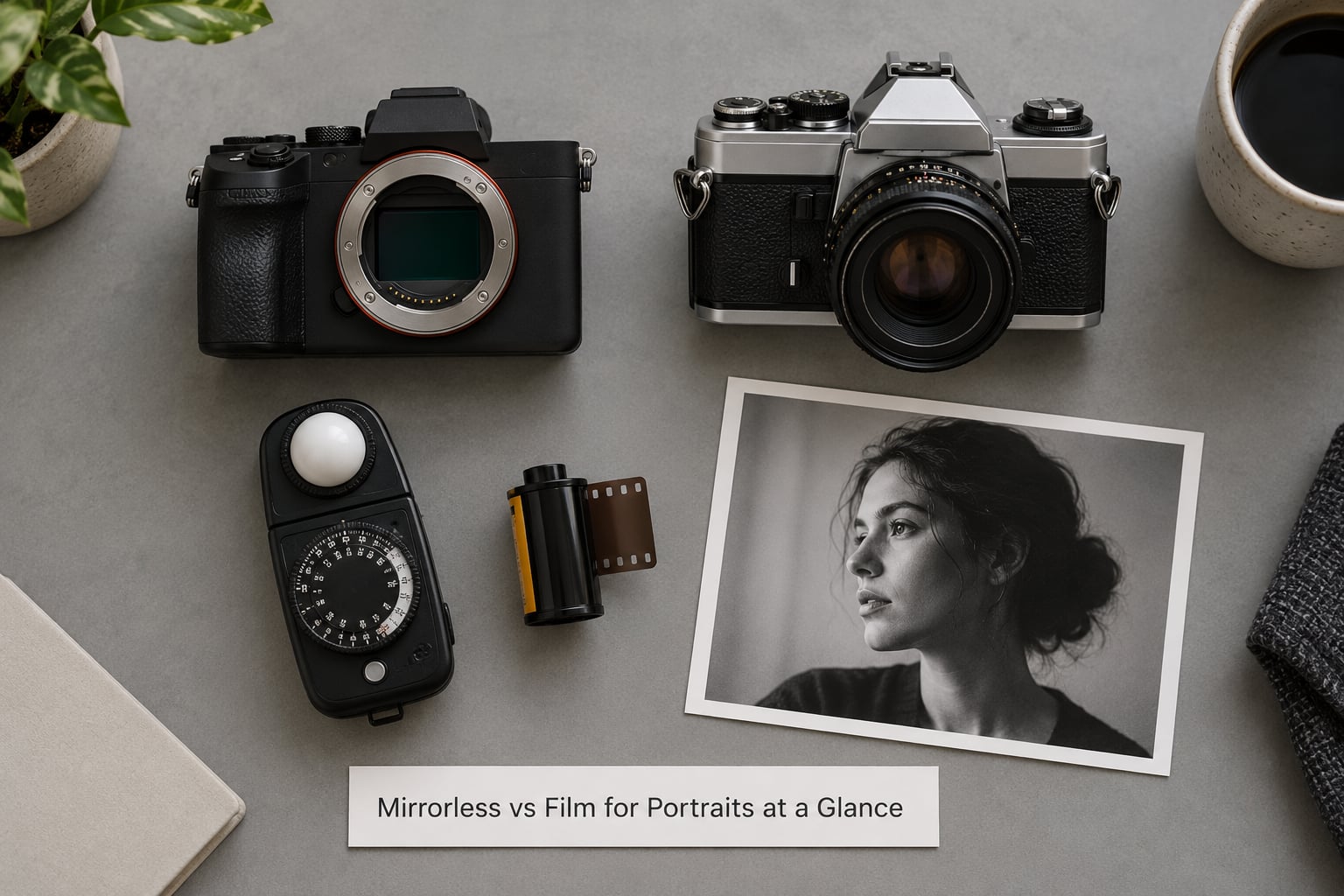
Mirrorless vs Film for Portraits at a Glance
| Factor | Film | Mirrorless | Verdict for portraits |
|---|---|---|---|
| Image character | Grain, gentle highlight roll-off, stock-specific colour | Clean files, film simulations available in body | Film for mood, mirrorless for control |
| Frames per session | 24 to 36 on a 35mm roll | Several hundred per card | Mirrorless, for a live sitter |
| Frames per roll on 120 | Roughly 6 to 8 portrait frames | Not applicable | Film gets expensive fast at medium format |
| Reshoots | Counted against a finite roll | Practically unlimited | Mirrorless, when the subject is paying |
| Feedback loop | None until the negatives come back | Instant, on the back screen | Mirrorless for tight deadlines |
| Running cost | Film, development, scanning, per shoot | Cards and batteries, near zero after the body | Mirrorless over hundreds of sessions |
| Turnaround | Days to weeks, depending on the lab | Same evening | Mirrorless for commercial delivery |
| Retouching latitude | Whatever the negative holds | RAW files, wide latitude | Mirrorless for heavy skin work |
| Low light | Grain climbs fast, focus gets manual | High ISO files that hold up | Mirrorless, indoors at night |
| Master image | The negative, indefinitely | Files that need backups forever | A wash, once you back up properly |
| Best suited for | Personal work, fine art, film-leaning brands | Headshots, weddings, editorial, volume work | Split by who is paying |
Short version of the table: film wins on the qualities that live in the photograph itself, mirrorless wins on everything that happens around the photograph. If your client needs forty headshots, a retouched deliverable on Friday, or a session shot at dusk in a dim venue, the decision is not close.
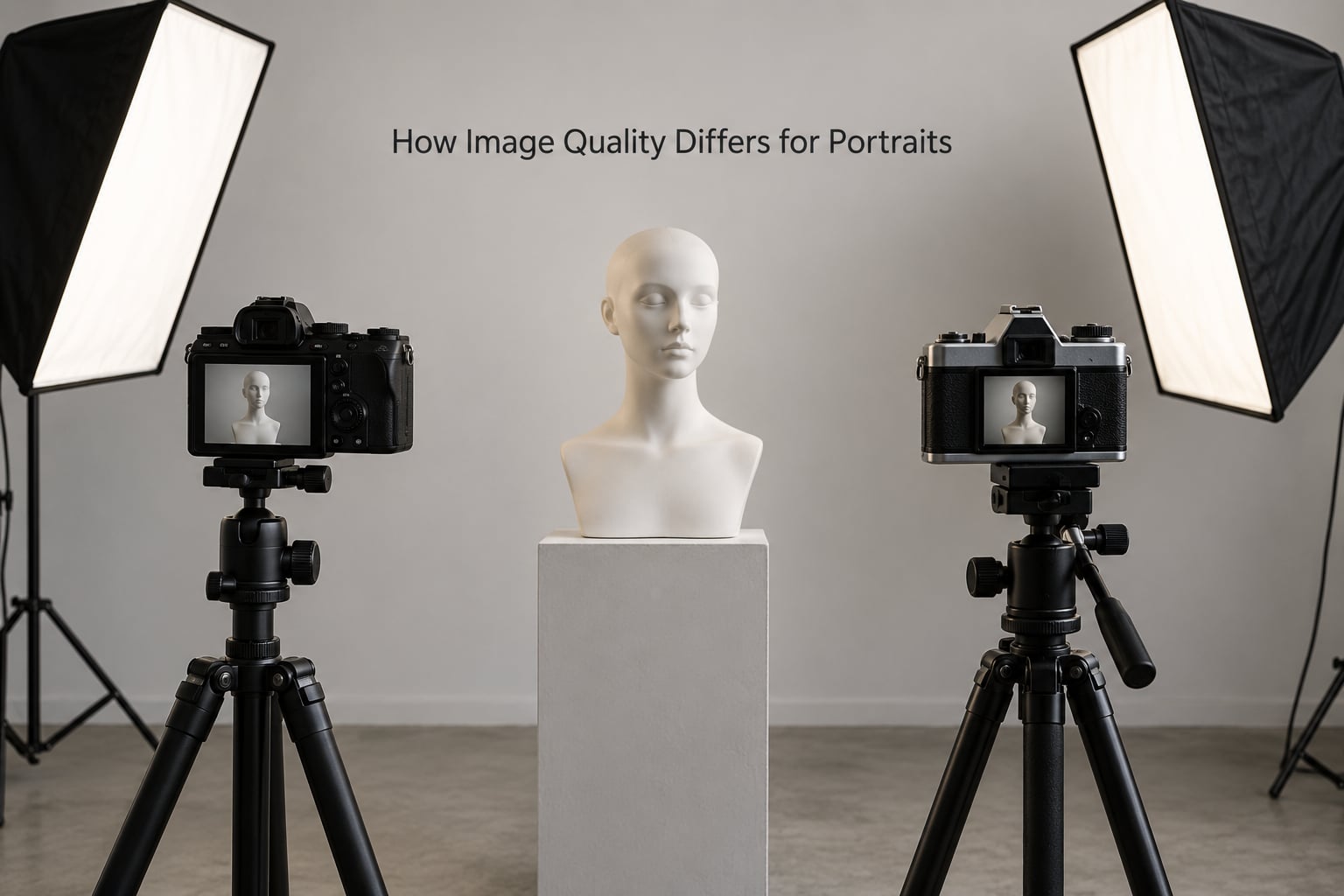
How Image Quality Differs for Portraits
Highlight roll-off and how skin tones render
Portrait light is all about faces. Skin has a wide range of tones packed into a small part of the frame, and that is where the two formats behave differently under pressure.
Film has a broad exposure latitude and a soft shoulder. Overexpose a face on Kodak Portra 400 and the skin tones go creamy rather than going chalk white, and the film keeps some detail into the highlights. A digital sensor holds detail in the shadows beautifully, but once those same highlights clip, they are gone in the file. You can pull a clipped cheek back only so far before it turns blotchy.
The practical effect is that film forgives a meter reading that was slightly off, and digital forgives a badly placed light. Both claims are oversimplifications, but they explain why a lot of portrait shooters describe film highlight roll-off as the reason their skin tones look softer.
Grain versus high ISO noise
Film grain is part of the image and looks like it. High ISO noise on a sensor is generated by the sensor and looks like what it is. Portra 400 at box speed has a fine, even texture that most people read as a look rather than a defect. Push it two stops and the structure gets more visible, which many photographers genuinely prefer.
Digital noise reduction, by contrast, tries to remove the thing that makes a low-light image feel photographic, and it often leaves behind waxy skin. Clean files win for commercial retouching. Grain wins for a portrait that is meant to look like a photograph rather than a rendering.
Depth of field, resolution and retouching latitude
Depth of field is a function of focal length, aperture and sensor size, not of film. That trips people up constantly: nothing about a 6×7 negative automatically gives you a more blurred background than a full-frame sensor at the same framing.
What medium format changes is the plane itself. On a 6×7 back, you can sit at a comfortable working distance from an average-sized subject and still fill the frame, where a 35mm or full-frame portrait of a head from the same distance is uncomfortably close. That is why medium format portrait photographers talk less about blur and more about working distance and how a subject responds when nobody is standing on top of them.
Resolution is the one place digital simply wins and keeps winning. A 60-megapixel file gives a retoucher real room to clean up a flyaway hair, and it prints large enough for a wall. A drum-scanned 120 negative can look extraordinary, but only when the lab does it properly.
Which film is best for portraits?
For most people, Kodak Portra 400 is the first stock to shoot because the skin tone rendering is forgiving and the grain stays fine at portrait densities. The picks after that depend on the job:
- Kodak Portra 400 — the safe default. Warm skin tones, wide exposure latitude, scans well from any decent lab.
- Kodak Gold 200 — more contrast and a cooler-neutral rendering than Portra. Good when you want a brighter, cleaner commercial look on a lower budget.
- CineStill 800T — tungsten stock for portraits shot at night without flash. The halation on highlights around light sources is the whole point.
- Ilford HP5 Plus — the black and white answer, with fine grain that holds up to a large print.
- Fujifilm Pro 400H — cooler pastel rendering, popular for wedding and editorial work in daylight.
Portrait shooters on forums like r/AnalogCommunity keep coming back to the same point: the stock matters less than the scan. A mediocre lab will flatten the roll-off that justified shooting the stock in the first place.
Which Is Faster and More Reliable?
Speed is where mirrorless stops being a preference and becomes the answer. Modern eye autofocus holds a face through a slow head turn at wide apertures, and subject tracking keeps up with a subject who moves during a wide shot. On film, focus is manual, you are checking a ground glass screen or a rangefinder patch, and a missed frame is a missed frame.
Burst shooting changes the arithmetic of a session. With mirrorless you can shoot a whole sequence of expressions and pick the one that works. On a 36-exposure roll you are choosing highlights, and a portrait session with a nervous sitter can eat ten frames while they settle.
Exposure feedback is the second half. A histogram, zebras and instant playback mean you know your file is good before the sitter leaves the chair. Film gives you nothing until the negatives are scanned, so every exposure is a small act of faith based on a meter reading and a stop of estimation.
Reliability runs the same way. A weather-sealed mirrorless body shrugs off a location shoot in bad light; a film body with an aged light seal may fog a roll. Batteries in mirrorless are a solved problem, while film bodies need batteries for the meter anyway, which means carrying two things that can fail.
Film has one reliability advantage worth stating: the negative does not corrupt. A RAW file dies with the drive it sits on if you stop copying it. Negatives survive a decade in a drawer, though that longevity only helps if someone scans them properly, and an unscanned negative prints nothing.
Lens and Equipment Options
Portrait glass is the reason many photographers buy into a format. Modern fast primes cover both worlds well: an 85mm f/1.4 or a 90mm f/2 gives you the shallow depth of field and the working distance that portraits need, and both formats have versions available new today. Fujifilm X-Pro3 and X-T5 bodies, Sony A7R V, Canon EOS R5 Mark II and Nikon Zf all cover portrait work natively.
Film has a large used market of fast primes, and adapters let you mount much of that glass on a mirrorless body. That is a real and cheap way into interesting rendering, with two caveats: adapted manual-focus lenses have no eye autofocus, and with a thin adapter you sometimes need to stop down to get the image plane close enough to focus.
Flash sync speed is worth checking on any setup. Digital can strobe at high sync speeds for shallow depth of field. A flash that syncs at a low speed on a film body constrains your aperture choices in a headshot.
Medium format film versus full-frame mirrorless
Medium format is the most interesting comparison in this whole question, and the one most general film-versus-digital articles skip. A 6×7 negative is roughly 5.4 times the area of a 35mm frame, and 120 film yields about six to eight portrait frames per roll. That is the trade in one line: rendering and working distance on one side, frames and money on the other.
On the digital side, a medium format mirrorless body such as a Fujifilm GFX 100S gives you a comparable sensor size with eye autofocus, instant review and files you can retouch. Shooters coming from a Hasselblad 500C/M, a Mamiya RB67 or a Pentax 67 usually describe the switch as trading the rendering and the slowness for speed and delivery.
Used 120 systems can also be cheaper to enter than medium format digital, but most are fully manual and slow, so the frames per roll problem is real. Six frames is a test shoot, not a sitting.
The Main Differences in Cost
Film and mirrorless have opposite cost structures, which is why every argument about them eventually turns into a spreadsheet.
Mirrorless front-loads the cost. You pay for the body and the lenses up front, and after that a session costs you a card write and a battery charge. Over a few hundred paid sessions the kit pays for itself and the running cost is close to nothing.
Film has a low barrier and an ongoing bill. A roll of 35mm gives you 36 exposures, so a session that takes 200 shots needs six rolls. Add development, scanning and postage on every batch, plus the frames you spent while metering, and the per-portrait number climbs fast. On 120 the jump is dramatic: a 6×7 roll that yields eight portrait frames costs more per finished image than most people expect, which is exactly the shock forum users describe when they run the arithmetic.
The hidden cost on film is the reshoot risk. On mirrorless a mistake costs nothing beyond time. On film a missed focus or a blown frame with a client in front of you is a wasted exposure, and if the shoot has a deadline you may not get the frame back at all. Budget for reshoots on any film commission and the running cost goes up again.
Check current prices on the film and gear you are considering rather than trusting an old forum post. Costs move, and most numbers in this article are about shape, not amount.
How Each Format Handles the Portrait Session
The difference becomes obvious when a person is standing in front of you. With mirrorless, you can shoot, show them the frame, and adjust on the spot. That loop changes how a session goes, because the sitter sees progress and relaxes.
On film, you cannot preview. You meter, you focus, you fire, and you trust the reading. Most film portrait photographers end up building a deliberate rhythm: set the exposure, compose, fire a small burst, then move on. The sitter has no way to know a frame is ruined, which removes the pressure but also removes your ability to react to a specific problem in the frame.
The delivery stage separates them just as sharply. Mirrorless files are edited, retouched, exported and delivered in days. A film negative is sent away, developed, scanned, and comes back with a colour balance you did not choose. You then decide how much of that character to keep. That process is slower and far less predictable, and it is also the reason film portraits rarely look like over-processed digital work.
Archiving splits the same way. Negatives are a physical master you can hand to a lab or a client years later. Files are a master only if you keep two copies in two places, because the format you are shooting now will be unreadable eventually and the drive it sits on will fail.
Which Is Better for Different Types of Portraits?
- Studio headshots and corporate portraits — mirrorless. Tighter schedules, larger deliverables, retouching, same-week delivery.
- Editorial and fashion tests — either, and this is where film still gets picked for its look. Bring mirrorless for the volume of contact sheets you send to a rep.
- Weddings — mirrorless for the ceremony and the reception; film for a quiet hour of portraits in between, if the schedule allows the turnaround.
- Environmental portraits — film, if the light is good. The slower pace suits subjects who need time to settle.
- Fine art and personal projects — film. There is no deadline and no client, so the constraints disappear.
- Low light and indoor evening work — mirrorless. Film grain climbs quickly and manual focus gets hard fast.
- Beginners — mirrorless, mostly because metering and focus feedback remove two walls at once. Film teaches metering faster, but slowly.
- Experimentation and test shoots — mirrorless, since a test costs nothing. Film experimentation is expensive per idea.
Which Should You Choose?
Three profiles cover most people. If someone pays you for portraits and has a deadline, choose mirrorless and put the saved budget into one fast prime lens. If you make portraits for yourself and care about how the image looks rather than how fast it lands, choose film and budget for the turnaround.
If you already own a mirrorless kit, film is the cheapest creative upgrade available to you. Shoot a roll of Portra 400 on a used body, get it scanned well, and compare the result with your usual files rather than with someone else’s. Shooters on r/AskPhotography describe a common split that works well: film in daylight and at well-lit social events, mirrorless at night and for anything experimental.
The decision rule is simple. Ask who the portrait is for and what happens to it afterwards. If it goes to a client, an art director or an employer, choose speed. If it goes on your own wall, choose the image you want to look at in ten years.
Frequently Asked Questions
Which film is best for portraits?
Kodak Portra 400 is the safest starting point because its skin tone rendering is forgiving and the grain stays fine at portrait densities. Kodak Gold 200 gives more contrast for a brighter commercial look. CineStill 800T is for night portraits without flash, Ilford HP5 Plus for black and white, and Fujifilm Pro 400H for cooler daylight editorial work. Whichever you pick, the lab scan matters more than the stock choice.
Is film better than digital for portraits?
Neither is better in the abstract. Film gives you softer highlight roll-off and a stock-specific look, and it rewards a slower, more deliberate session. Mirrorless gives you eye autofocus, instant review, hundreds of frames and files you can retouch heavily. Choose film when the image itself is the goal and mirrorless when the portrait is part of a paid job with a deadline.
What type of camera is best for portrait photography?
A full-frame mirrorless body with a fast prime lens, usually 85mm or 90mm, handles most portrait work: reliable eye autofocus, high sync flash speeds and files that retouch well. A medium format mirrorless body gives you more working distance on a chair. A 35mm film camera with a fast prime is still excellent for personal work, but it is manual focus and you will wait for the scan.
Do professional photographers still use film?
Yes, but usually selectively. Headshot, wedding and editorial photographers depend on mirrorless for speed and delivery. Many of them also shoot film for personal projects, fine-art portraiture and the look of a stock such as Portra. The common pattern described on photography forums is a split rather than a conversion: film for personal work, mirrorless for anything a client is waiting on.
Can you retouch film portraits the same way as digital ones?
Less freely, and that is the point. You can crop, dodge, burn, adjust colour and clean up a scanned negative, but you cannot recover a blown highlight or pull heavy shadow detail out of a frame the film never held. A good scan gives you a usable RAW or TIFF working file, so light retouching is normal. Deep skin cleanups need digital, or a better exposure in the first place.
Is medium format film worth it for portraits?
If your budget covers it, yes, because of the rendering and working distance, not resolution. A 6×7 negative on a Hasselblad gives a large film plane, so you can frame a head without standing on top of your subject. The catch is economics and handling: roughly 6 to 8 portrait frames per roll of 120, and most bodies are manual only. Treat it as a slow personal medium, not a production one.
Conclusion
Before you spend anything, write down who the portraits are for, how fast you need them and what you want the finished image to look like. If a client, an employer or an art director is waiting, choose mirrorless and put your budget into one fast prime lens. If the portraits are for you, film is a legitimate choice in 2026, not a nostalgic one.
Start with the format you already own, and shoot enough frames on the other one to compare honestly. Ten frames from a good scan will tell you more than any article, including this one.