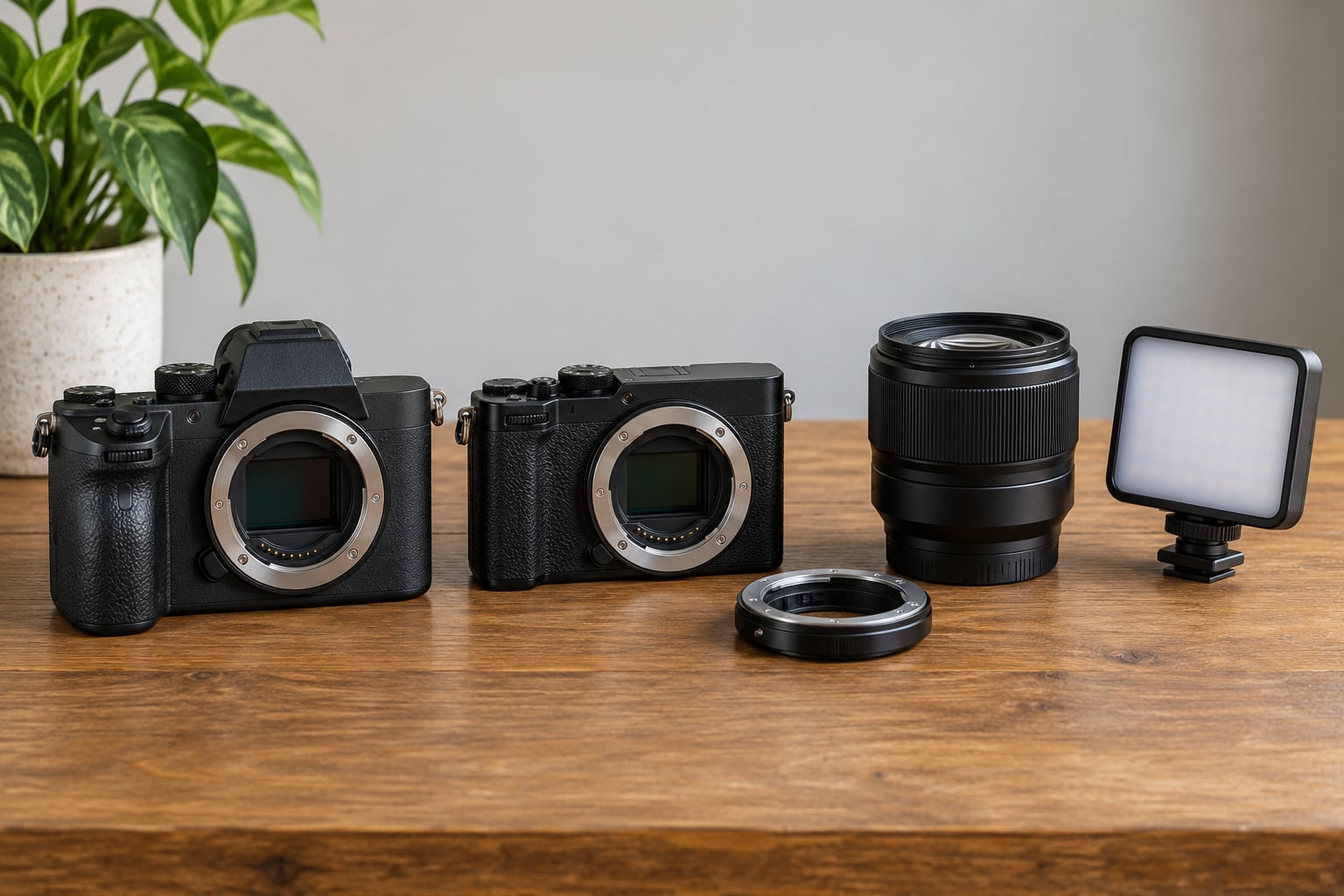
If you shoot people, a mirrorless camera is usually the better tool: eye-detection autofocus holds a subject’s face for you, and the screen shows the exact exposure before you press the shutter. A DSLR still makes more sense if you love an optical viewfinder, shoot long days on one battery, or already own a set of DSLR lenses you do not want to re-buy. The format matters far less than the sensor size and the lens on the front.
That last point is the one most comparisons bury. The most-upvoted answer in the r/AskPhotography thread that still ranks for this question makes exactly that argument: if you are moving from a crop sensor to full frame, your bag gets bulkier whatever body you choose. Format is a secondary decision wearing a very loud jacket.
So let us take the noise off. This guide looks at DSLR vs mirrorless for portraits only, through the things that actually show up in a portrait session: how the camera finds a face, what the viewfinder tells you, what happens in a dim room, what your lenses cost, and what you give up either way.
Updated for 2026 to cover the current generation of bodies on both sides.
Table of Contents
- DSLR vs Mirrorless for Portraits at a Glance
- Autofocus and Subject Tracking
- Image Quality and Portrait Rendering
- Low-Light Portraits and Background Blur
- Lens Choices and Creative Options
- Battery Life, Handling, and Reliability
- Price and Total Cost of Ownership
- Which Should You Choose?
- Frequently Asked Questions
- Is mirrorless better than DSLR for portrait photography?
- Are DSLR lenses compatible with mirrorless cameras?
- Do mirrorless cameras produce better portraits than DSLRs?
- Is a DSLR better for portraits in low light?
- Should a beginner buy a DSLR or mirrorless camera for portraits?
- Is it worth upgrading from a DSLR to mirrorless for portrait work?
- Conclusion
DSLR vs Mirrorless for Portraits at a Glance
| Category | DSLR | Mirrorless | Better for portraits |
|---|---|---|---|
| Image quality | Excellent, sensor-dependent | Excellent, sensor-dependent | Tie |
| Eye-detection autofocus | Not available in the optical viewfinder | Human, animal and vehicle detection, edge to edge | Mirrorless |
| Viewfinder | Optical, no lag, no exposure preview | Electronic, exact exposure, exposure simulation | Depends on your preference |
| Focus point coverage | Concentrated in the centre | Nearly the whole frame | Mirrorless |
| Flash AF-assist beam in dim rooms | Works on many bodies | Usually does not fire | DSLR |
| Battery life per charge | Hundreds more shots on many pairs | One to two extra batteries on a long day | DSLR |
| Silent shooting | Silent mode only, mechanically limited | Fully electronic shutter, truly silent | Mirrorless |
| Shutter sound for a nervous subject | Mechanical, some vibration | Can be completely silent | Mirrorless |
| Weight for equivalent tiers | Heavier | 100 to 300 grams lighter in most pairings | Mirrorless |
| Cost of a good used body | Low, deep second-hand market | Higher, thinner used market | DSLR |
| Legacy lens reuse | Native | Adapter needed on most older glass | DSLR |
| Video | Basic, autofocus is limited | 4K, phase-detect video AF, log profiles | Mirrorless |
Read that table as a set of tendencies, not laws. A modern pro DSLR and a modern mirrorless body of the same tier produce the same files. The differences that stay consistent are the ones about how the camera behaves while you shoot, not what it records afterwards.
Autofocus and Subject Tracking
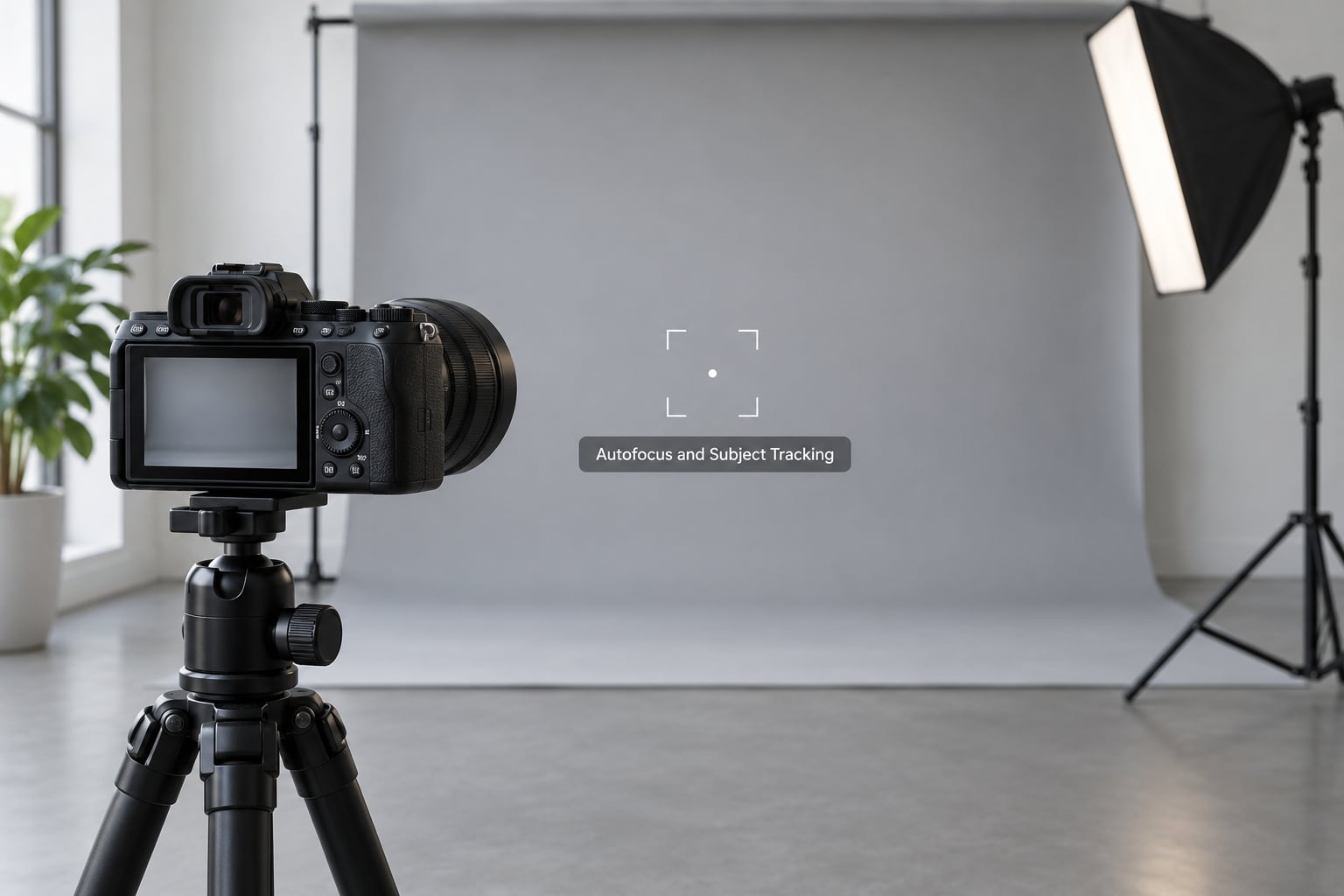
Autofocus is the single biggest reason portrait photographers moved to mirrorless, and it is not close.
Eye detection is the feature that changes portrait work most
A DSLR decides where to focus using a dedicated phase-detection module built into the body. That module sits behind the mirror and covers a small patch of the frame, which is why DSLR focus points cluster in the middle. A mirrorless camera computes phase detection from the sensor itself, so detection points can cover nearly every pixel.
That coverage is what makes eye detection usable. The camera finds a face anywhere in the frame, then switches to tracking the nearest eye and holds it while the subject turns, leans or walks toward you. For a headshot session, a family shoot or a wedding, that means you are framing and talking instead of hunting for an AF point.
Reliability has improved a lot, but the honest answer to “can I trust it on a paid shoot” is that you still verify focus. Subject detection can latch onto a wrong thing. A wedding photographer writing up her year with a Canon R5 and R6 reported eye AF holding lock on people while occasionally getting confused by a horse’s eyes and nostrils. Treat it as a very fast first assistant, not an autopilot.
Where DSLR autofocus still does the job
A DSLR with a decent centre-point module and an 85mm prime will focus accurately and repeatably. Portrait photographers who shoot on a tripod, pre-focus on a mark and fire bursts have never needed subject tracking at all.
Back-button focus and a thumb on the control ring still give you precise manual control that some people prefer to any algorithm. Nothing about an optical viewfinder prevents good portraits. The gap is in speed and in how much attention the camera demands, not in the final result.
Moving subjects, children and the electronic shutter
Children and pets are where the comparison turns sharp. Fast, continuous autofocus with wide coverage is the whole job, and that is mirrorless territory.
One caveat: the fully electronic shutter that gives mirrorless its silent shooting can bend fast-moving subjects if the shutter speed drops below about 1/2000 second. Plenty of current bodies fire an electronic first curtain and a mechanical second, which keeps rolling-shutter distortion low. If you shoot a lot of fast panning portraits at wide apertures, check that specific behaviour before you commit.
Image Quality and Portrait Rendering
There is no image quality gap between a current pro DSLR and a mirrorless body of the same tier. That is close to universal agreement among working photographers, including the ones who prefer DSLRs. Comparing them on a spec sheet is a waste of your afternoon.
Sensor size matters more than the format
DSLR vs mirrorless for portraits is the wrong axis to measure. Sensor size is the right one. Full frame gives you a wider dynamic range for recovering shadow detail in skin, and shallow depth of field at equivalent framing, which is the classic portrait look.
APS-C is not a compromise to apologise for. A crop-sensor body paired with an 85mm f/1.8 frames like a 135mm on full frame, and that longer working distance is flattering for head and shoulder work. You trade background blur and high-ISO latitude for a smaller, lighter kit. Many working portrait photographers shoot crop bodies for exactly that reason.
Match the body to the lens you want to shoot. An 85mm f/1.4 on full frame gives you a working distance and a background that dissolves completely. A 50mm f/1.8 on crop gives you roughly the same angle with half the glass and a fraction of the cost. Neither is the format’s fault.
Skin tones, colour and the retouching workflow
Skin rendering is a body colour-science question, not a format question. Some photographers who shot both report a slightly richer, more saturated look from their DSLR files, and others report the opposite after changing profiles. What actually changes your workflow is the preview.
Mirrorless exposure simulation shows you the final exposure live, including a deliberately pushed-down view in bright light so you can judge highlights. Several portrait and wedding photographers credit it with cutting editing time, because they can walk away from a take knowing it is right instead of checking the histogram on a screen afterwards. On a DSLR, live view gives you most of this on the rear screen, but the optical viewfinder does not show it.
Low-Light Portraits and Background Blur
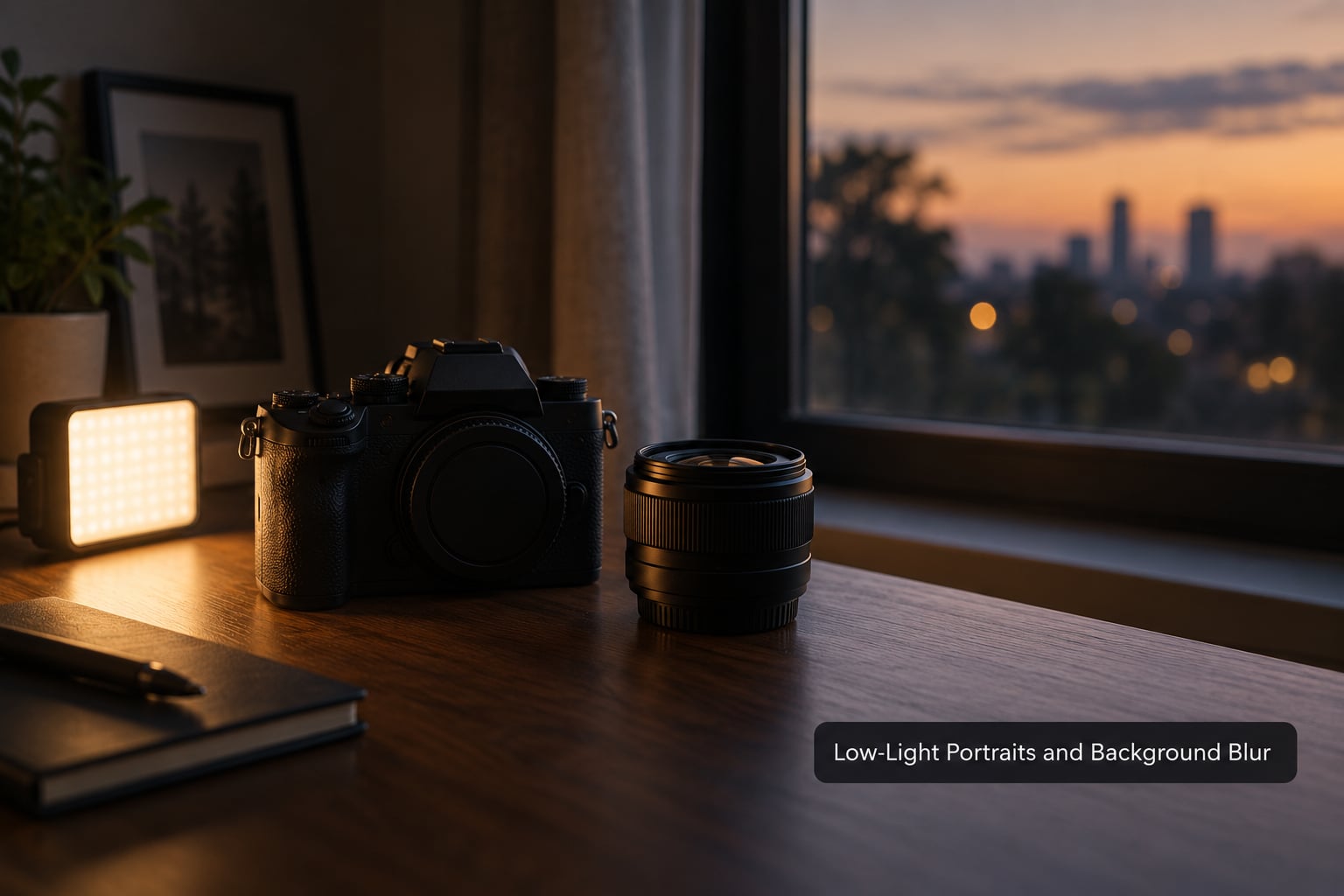
Evening location work, a dark church, a restaurant with one window. This is where people worry most that mirrorless cameras are inferior, and the concern is more nuanced than it looks.
High ISO, stabilization and focus in the dark
Both formats now produce clean files at high ISO, and the difference between them has largely closed. In-body stabilization helps hand-held framing on either format; it does not freeze a moving subject, so a stabilizer stabilizes the frame, not the person.
Where the formats part company is battery draw. A screen-based system with an electronic viewfinder and continuous subject tracking eats power, so a long dim-room session may cost you two or three extra batteries where a DSLR would finish on one. Photographers shooting weddings on mirrorless usually just carry the spare cells.
The flash AF-assist beam problem
Many DSLRs project an infrared or strobe-assisted beam from the built-in flash to help focus in dim conditions before the main flash fires. Most mirrorless bodies do not.
If you work in a dark room on a bare strobe, a speedlight or an off-camera flash at low power, the AF-assist beam is a real convenience you give up. It is one of the most cited practical objections from people who shoot dim venue portraits on mirrorless, and it is why some studio and event photographers keep a DSLR body in the bag alongside their mirrorless one. Check your specific body and flash combination before assuming it applies to you.
Why red dot patterns show up on mirrorless
You will see this complaint repeatedly in forums: bright specks, red dots, or a dappled flare in the background of a mirrorless portrait. It has a mechanical explanation.
Mirrorless mounts have a short flange distance, which is what allows lenses to be designed faster and smaller than the old reflex era. That same short distance means the rear element of some wide-aperture lenses sits very close to the sensor, and at f/1.2 to f/1.4 internal reflections can bounce between the sensor and the glass. Optical vignetting, high ISO noise reduction and aggressive sharpening can all amplify it into visible dots.
It is not a defect and it is not fixable by firmware. Practical mitigations include stopping down a third of a stop, keeping the lens hood on, and being careful when you light a backlit subject with a bare reflector. Plenty of photographers never see it. Plenty of others decide it costs them more than they want to pay for the eye AF, and that is a legitimate call on expensive client work.
Lens Choices and Creative Options
A camera body is a mount with a computer attached. The lens decides what you can photograph.
Can you use your DSLR lenses on a mirrorless camera?
Usually yes, through an adapter, and usually well. Canon EF lenses mount to Canon RF bodies with the official adapter, Nikon F lenses mount to Z bodies with Nikon’s FTZ adapter, and third-party options exist for most other combinations.
Adapters are thin rings, so the weight advantage of a smaller body partly disappears once your existing glass is on the front. A commenter on r/AskPhotography running a Nikon D780 made exactly this point: the size and weight savings felt compelling until the adapters for his older lenses went on, and the difference nearly vanished. Budget for that when you compare packages rather than bodies.
Autofocus through an adapter is usually a little slower than native, though recent mirrorless bodies with in-body stabilization have narrowed the gap dramatically. Wedding and portrait photographers who switched to an R5 and R6 report their adapted EF lenses performing at least as well as they did on the DSLRs, sometimes better.
What adapters actually cost you
The real switching cost is not the adapter. It is the lenses you do not have.
Every mirrorless system has a short list of fast, sharp, lightweight primes in its native mount, and the widest selection of affordable fast glass still sits with the older DSLR mounts. If you are starting fresh, buying the body and the portrait lens you actually want as a set usually costs less and wastes nothing. If you already own three good DSLR lenses, adapters are close to free compared with replacing them.
Worth checking the full package: a body, a fast prime, a zoom for environmental work, a spare battery, a card reader, and a decent tripod for low-light sessions. The body is a small share of that total.
Battery Life, Handling, and Reliability
The numbers on paper are lopsided. CIPA ratings put bodies like the Canon 5D Mark IV at around 900 shots per charge and the R5 at roughly 320, with the Nikon D850 rated near 1840 against about 420 for the Z7. Real-world results vary with how much you use the screen and how hard the autofocus is working, but the gap is real enough that serious mirrorless shooters carry spares as standard practice.
Size tells a similar story. Compared tier for tier, the common pairings save roughly 150 grams on a full-frame Canon comparison, close to 300 grams on a crop-sensor comparison, and about 300 grams for a Nikon full-frame pairing. One retired professional who sold a 5D IV and EF glass for an R6 said the deciding factor was not image quality at all, it was that a twenty-pound bag on one shoulder had become unbearable. That is the argument for mirrorless in a sentence.
Why some photographers still choose a DSLR in 2026
There is a genuine counter-current, and it deserves a straight answer rather than a polite dismissal.
People come back to DSLRs because the optical viewfinder has no lag, no pixels and no refresh rate, and many photographers simply find shooting through it more enjoyable. Because one battery can cover a long day. Because used bodies and legacy glass are genuinely cheap right now, and a working camera you already own beats an expensive upgrade. Because flash AF-assist still helps in dark rooms. And because there is no rule that says you must switch formats while the camera still works.
One photographer described it neatly: mirrorless is the better camera to learn on because of exposure simulation, but a DSLR is more fun, because you read the light yourself instead of letting the viewfinder decide. That is a preference, not a defect, and it deserves respect.
Do professional portrait photographers use mirrorless?
Overwhelmingly mirrorless for new work, with a meaningful minority still running DSLRs as a primary or a backup body. A great many professionals carry both.
Manufacturers have stopped investing in new DSLR bodies, so buying new today usually means buying mirrorless. But the used market keeps pro DSLR bodies and fast primes in circulation for years, and working photographers who value optical viewing or long battery life keep shooting them. If you are starting out and want to learn the craft, the honest answer is that the format matters less than getting out and shooting people.
Price and Total Cost of Ownership
Prices move constantly, so treat this section as a shape, not a figure, and check current listings before you buy.
The used DSLR market is the cheapest place to enter photography. Full-frame bodies with a fast prime show up for a fraction of what an equivalent new mirrorless setup costs, and the glass is the same glass. For a beginner shooting headshots on a budget, that math is hard to argue with.
New mirrorless bodies sit at higher starting points, but they compress downward quickly, and the used market for last generation models drops fast once a successor lands. A two-year-old full-frame mirrorless body plus a native prime is often the cheapest route to current autofocus and low-light performance.
Long-term costs follow the lens ecosystem. Stay inside one mount and you amortize glass across several bodies. Switch mounts and you may end up owning two full lens sets, which is usually the most expensive mistake in photography and has nothing to do with the format. Add batteries, cards, filters, a colour card for skin-tone consistency, and a decent tripod for dim rooms, and the body is a small part of the real number.
Which Should You Choose?
Match the camera to the work.
Choose mirrorless if you shoot people who move
Weddings, families, children, street-style environmental portraits, anyone candid. Eye detection and edge-to-edge coverage let you keep your attention on the interaction, and the electronic shutter means you can shoot in genuine silence, which matters with shy subjects. Add exposure simulation and you spend less time in post checking exposures.
Choose a DSLR if your sessions are deliberate and dim
Studio work on a tripod with off-camera strobes in a dark room, where the AF-assist beam earns its keep. Long documentary or event days on a single battery. If you love optical viewing, or you already own a kit that does the job, the argument for switching is thin.
Stay with what you have until it stops working
A working DSLR that shoots sharp portraits is still a working portrait camera. Upgrade when a specific limit hits you: focus you cannot get fast enough, a viewfinder you cannot trust in dim light, a body that will not survive the weather, or glass that cannot get you the look you want. Buy for the limit, not for the format.
Pick the sensor first
Decide full frame versus APS-C, then pick a body that suits the way you shoot. A 50mm f/1.8 on a crop body covers most head-and-shoulder work at a fraction of the weight. Full frame plus an 85mm gives you the background separation and highlight latitude that high-end client work usually asks for. The body comes after that decision.
Frequently Asked Questions
Is mirrorless better than DSLR for portrait photography?
For most portrait work, yes, mainly because of eye-detection autofocus that holds a subject’s face and an electronic viewfinder that shows the exact exposure before you shoot. A DSLR still wins for long days on one battery, optical viewing, dim rooms where the flash AF-assist beam helps, and for photographers who already own a good DSLR lens kit. The sensor size and the lens matter more than the format.
Are DSLR lenses compatible with mirrorless cameras?
Usually, through an adapter. Canon EF lenses fit Canon RF bodies, Nikon F lenses fit Z bodies, and third-party adapters cover most other combinations. Autofocus is slightly slower than native but close, and in-body stabilization has narrowed the gap further. The catch is weight: adapters add bulk, which can cancel out the smaller body. Check the adapter list for your specific lenses before switching.
Do mirrorless cameras produce better portraits than DSLRs?
No, not inherently. A current pro DSLR and a mirrorless body at the same tier produce very similar files from the same sensor. Where mirrorless changes portraits is during the shoot: exposure simulation shows you the final exposure live, autofocus covers the whole frame, and silent shooting keeps a nervous subject relaxed. Those workflow differences affect how many usable frames you get, not the quality of each one.
Is a DSLR better for portraits in low light?
It can be, in specific situations. A DSLR may project an AF-assist beam from the built-in flash to help focus in a dark room, and its battery life means far fewer spares on a long evening shoot. A hybrid body with live view and an optical viewfinder sits in the middle. For most low-light portrait work, a fast prime lens and careful high-ISO settings matter more than the format.
Should a beginner buy a DSLR or mirrorless camera for portraits?
Buy a current mirrorless body, because that is where manufacturers develop autofocus and where native fast primes are heading. Keep the first kit simple: a body, an 85mm f/1.8 or 50mm f/1.8, a spare battery, and a card. If your budget is tight, a used DSLR with the same lens teaches you everything that matters. The camera teaches you nothing on its own.
Is it worth upgrading from a DSLR to mirrorless for portrait work?
It is worth it when a specific limit is costing you frames: focus you cannot acquire fast enough on moving subjects, a viewfinder you cannot trust in dim light, a body too heavy for location work, or a video requirement. If your DSLR still focuses accurately and your sessions are short and deliberate, the upgrade buys comfort rather than images. Base the decision on your hardest shoot, not on the format debate.
Conclusion
DSLR vs mirrorless for portraits comes down to your hardest shoot, not to a spec sheet. Mirrorless wins on focus that finds a face by itself, exposure you can see before you shoot, and silence. A DSLR wins on battery life, optical viewing, the flash AF-assist beam in dark rooms, and the cheapest way into the craft.
Before you compare bodies, write down three things: who you photograph most, the worst lighting you expect to work in, and which lens you actually want on the front. Pick your sensor size, then buy the body that fits those answers. If your current camera still does all three, keep shooting with it.