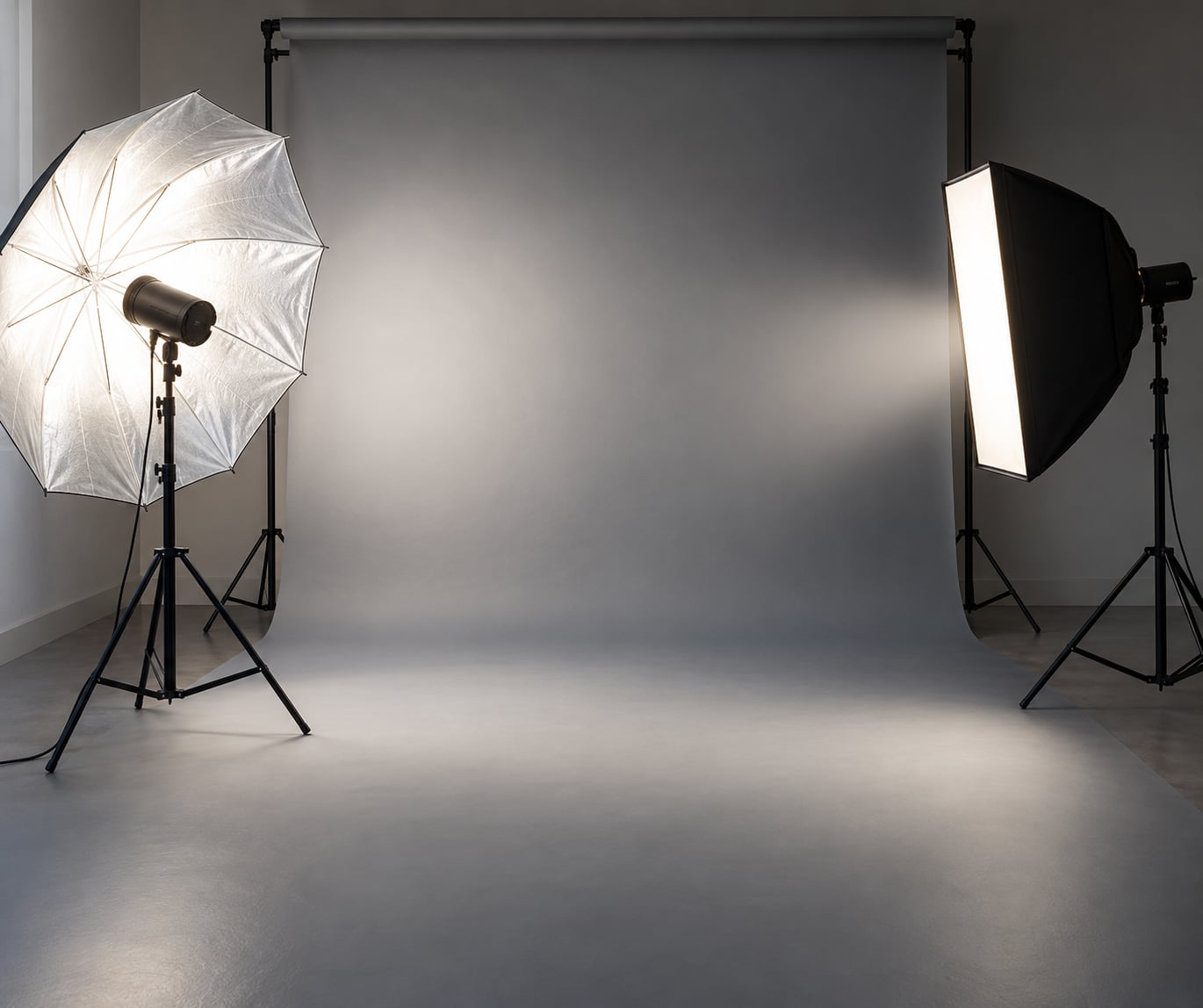
An umbrella is faster to deploy and spreads light wider; a softbox costs more effort to set up but keeps the light aimed where you point it. For a first modifier in a small room, that trade usually decides it.
Here is the part most guides skip. Softness is not decided by the modifier’s name. It comes from how large the source looks to your subject compared with the subject’s size, and from how far away you put the light. Everything below is built around that, because a softbox vs umbrella for portraits debate turns into an argument about labels instead of light.
Table of Contents
Softbox vs Umbrella for Portraits at a Glance
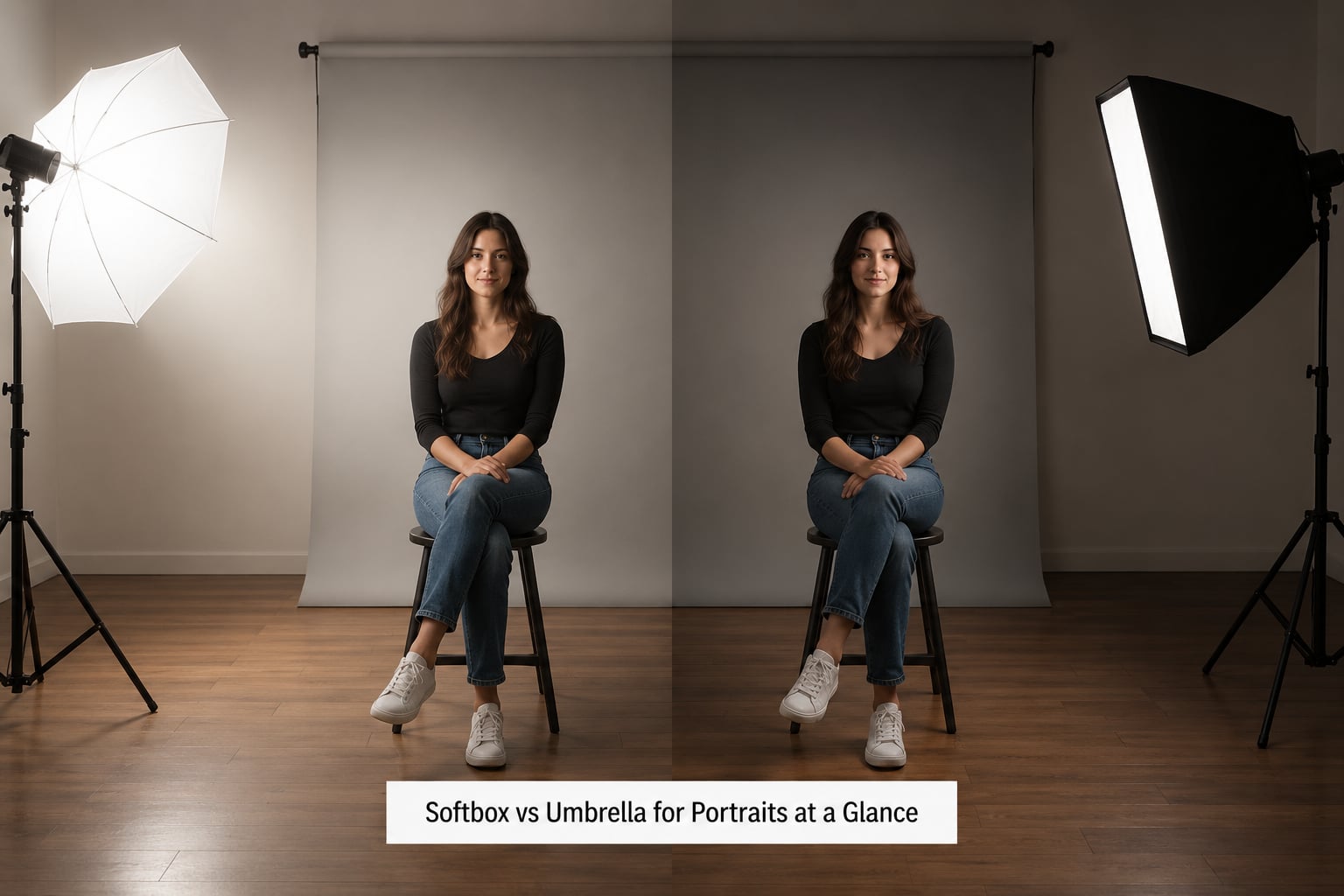
| Criterion | Umbrella | Softbox |
|---|---|---|
| Light spread | Very wide, fires past the subject in every direction | Narrower, feathered toward the front |
| Light spill | High, needs flags or distance to control | Low, the shell contains the beam |
| Softness | Very soft on shoot-through, slightly harder on silver lining | Soft, even across the front panel |
| Contrast | Lower with the shoot-through, higher with the silver lining | Controlled by distance and panel size |
| Catchlight shape | Round | Rectangular, window-like |
| Setup speed | Under a minute once you know the mount | Two to five minutes with rods and speedring |
| Portability | Folds to a thin bundle, one piece | Bulkier, reverses into a compact disc |
| Durability | Ribs and fabric take the punishment | Seams and rods on cheaper models take it |
| Grid compatibility | Not with most models | Standard accessory on most models |
| Working space | Needs room behind and beside the subject | Works in a corner |
| Best portrait styles | Location work, groups, quick sessions | Headshots, beauty, moody backgrounds |
How Light Size and Softness Change Portraits
The apparent size of the light source is the whole story. Softness depends on the ratio between how wide the source looks from where your subject sits, and how wide your subject looks. Light that wraps around the side of a face comes from a large source. Light that stops at the cheek comes from a small one.
Distance changes that ratio without changing any equipment. Take a 36-inch modifier and walk it six feet closer to your subject and it reads twice as large as it did at twelve feet. That is why the same umbrella produces noticeably softer portraits than the same softbox at equal distance in a cramped bedroom.
This is where the softbox vs umbrella myth comes from. A shoot-through umbrella looks, on paper, like a light source that throws light everywhere. It wraps light around a face so gently that skin texture almost disappears. A similarly sized softbox, sitting flat-faced, produces a harder transition on the same face at the same distance, because a flat diffusion panel aims its output straight forward instead of back toward the subject.
That does not make the softbox worse. It makes it different. The softbox trades wrap for direction, and you buy that trade deliberately when you need a dark background or a shaped edge on the light.
Softbox vs Umbrella for Portraits: The Key Difference
An umbrella throws a wide, forgiving wash and reaches full brightness almost immediately. A softbox throws a narrower, more consistent beam that keeps working after you dial in grids, flags and distances. One spreads, the other aims.
Neither is the softer light by default. Both are soft when you place them close and large relative to the face in front of them.
Light Control and Spill
Spill is the reason this argument exists. A shoot-through umbrella fires light behind you, out to the sides and onto your background, because there is nothing stopping it. In a room with white walls, that stray light bounces everywhere and lifts your blacks until your backdrop looks grey.
A softbox handles this structurally. Its fabric shell is opaque and shaped like a shallow box, so light can only escape through the front panel. The recessed edges keep the beam from leaking sideways. Add a grid and you narrow the coverage further, which is why grids bolt onto softboxes and not onto umbrellas.
But a softbox is not the only way to control spill, and buying one for that reason alone is a common early mistake.
- Flags and cutters. Black foam board on a stand, placed just outside the beam, eats the spill from an umbrella cheaply and instantly.
- Move the subject away from the wall. More distance means less light reaches the background and a stronger falloff gradient behind your subject.
- Undershoot the umbrella. Aim slightly past your subject’s head so the centre of the beam is empty space, not the backdrop.
- Kill ambient light. Close the curtains. Spill you cannot block is small compared with a window washing out the exposure.
- Go dark in post. Shoot a clean background plate or a darker exposure, then composite. Plenty of working portraits are lit with an umbrella.
Photographers on r/AskPhotography put it plainly: the umbrella is the most convenient and cheapest option, and it gives you the least control over spill. That is an accurate summary rather than a put-down.
Setup Speed and Ease of Use
An umbrella is one piece on a shaft. You slide it onto the stand, open it, clip the diffusion fabric if you want one, and you are working. Packing up takes about as long, which matters more than the setup time when you are shooting a reception in a hotel ballroom.
A softbox takes longer. Speedrings have to line up with the rods, the rods seat into the speedring one at a time, and the diffusion panel snaps into the frame in whichever orientation you need. Expect a couple of minutes on the first attempt of the day and much less after that.
Two details separate good setups from frustrating ones. Sandbag the base of the stand on both modifier types, because a wide umbrella catches wind like a sail. On a softbox, build it with the rods pointing away from you, then rotate the speedring on the head rather than twisting the whole frame.
Working photographers on r/AskPhotography who shoot events often say umbrellas are their go-to for exactly this reason, and that a large softbox ends up in the way when a big family group needs covering.
Flash or Continuous Light
A speedlight mounts to an umbrella with a small bracket or a mini softbox shoe. Studio strobes usually need an umbrella shaft and, for a softbox, the matching speedring, so check mount compatibility before you buy a modifier for the light you already own.
Continuous LED panels are a different case. A panel gives you a flat, unchanging brightness with no recycle time and no colour shift, which makes the exposure consistent for a whole sitting. It also gives off real heat, so give it airflow and do not drape fabric over it.
Neither light source forces a modifier choice on you. A modifier is chosen by the look you want on the face and by what your room can tolerate, and you can mount either kind of modifier to either kind of light as long as the mount fits.
Portability, Durability, and Cost
Portability is where the umbrella wins cleanly. It collapses to a thin, light bundle that fits in a bag with the rest of your kit. A softbox folds in on itself into a fat disc that takes real space in a car, and the rods can end up bent if you force it into a tight bag.
Durability runs both ways. On r/productphotography, photographers comparing price tiers make the point that light quality is broadly comparable between cheap and expensive softboxes, while construction is not: cheaper models rip at the seams, bend their rods and tear their fabric. Umbrellas fail in their own way, with bent ribs and fabric that yellows and goes thin over years of use.
On cost, the umbrella is one purchase. The softbox number usually understates the total, because you also need a speedring, often a grid, and a stand sturdy enough to hold the weight. Neither of those makes you buy the wrong thing. They just belong in the budget before you compare anything.
Which Portrait Styles Suit Each Modifier?
- Headshots and corporate portraits. A softbox with a grid gives the dark, clean separation behind the head that office walls never provide.
- Beauty and close work. An octabox or a shoot-through umbrella placed low and close smooths skin and lines.
- Business portraits in a small room. A softbox, because you can put it in a corner and keep light off the walls.
- Family and group shots. An umbrella or octabox, since the wide spread covers several people at once without extra heads.
- On-location and travel. An umbrella. It packs small, sets up on a pavement, and survives the car journey.
- Environmental portraits. Whichever gets you out of the way fastest, since the light is doing less work than the location.
- Low light and window light indoors. A shoot-through umbrella to lift and soften what little light you have.
- Moody commercial images. A softbox with a grid or egg crate to shape the beam and let the background fall away.
A 36-inch modifier covers one or two people, a 42-inch handles two or three, and a 48-inch or larger suits three or more. Check that against your actual subject distance, since a large modifier further away shrinks in the subject’s view.
Which Should You Choose?
Start with an umbrella if you shoot on location, in homes, at events, or anywhere the session is a 15-minute window. Start with a softbox if you work indoors in a small room, need dark backgrounds, or shoot the same headshot setup repeatedly.
If you shoot in both places, the middle option is a collapsible umbrella-style softbox. It collapses like an umbrella, throws light like a softbox, and forum threads on r/AskPhotography keep recommending exactly that shape for anyone who resents the rod-and-speedring ritual.
Three questions settle most cases. Are you indoors in a tight room? If so, choose the softbox. Are you moving between locations with one bag? Choose the umbrella. Is your background dark or evenly lit? If you need it dark, choose the softbox and add a grid; if an even, bright look suits the shot, the umbrella is faster and fine.
Owning both is reasonable once you are shooting regularly, because they answer different problems rather than competing. Until then, one modifier done well beats two used badly.
Frequently Asked Questions
Are umbrellas better than softboxes for portraits?
Neither is better in general. An umbrella is better when speed, portability and wide coverage matter, such as location work, events and family groups. A softbox is better when you need control over spill, shape and background darkness in a small room. Softness is not the deciding factor, since both can produce very soft light when placed close to the subject.
Which modifier produces the softest portrait light?
Whichever looks largest to your subject, and that is a ratio, not a label. A 36-inch shoot-through umbrella six feet away can wrap softer than a 36-inch softbox ten feet away. Distance matters as much as diameter, so move the modifier closer before you spend money on a bigger one.
Do I need a softbox or umbrella to use continuous lighting?
You do not. A continuous LED panel already provides a broad, soft, even source at a fixed brightness, which is why many beginners skip a modifier entirely. If you want more control, an umbrella or softbox mounted to the panel adds diffusion and direction. Leave airflow around any panel, since continuous lights run hot.
What size softbox or umbrella should I buy first?
For a single portrait subject, a 36-inch softbox or a 36-inch umbrella is the sensible first purchase. Move to 42 inches for two or three people and 48 inches or larger for groups. Check the mount fits your light before buying, since umbrellas and softboxes use different speedrings and brackets.
Can I use an umbrella without a flash or softbox stand?
You need something to hold the shaft, and that means a light stand with a 7/8-inch mounting stud or a small umbrella holder that clamps to a table. A speedlight alone has no boom and will point wherever you hand-aim it, which makes softness and angle inconsistent. Budget for the stand as part of either system.
Conclusion
Beginners usually get the most out of a shoot-through umbrella paired with a proper light stand, because it teaches them how light behaves without slowing every session down. Move to a softbox with a grid once you are working indoors against a background you need to keep dark.
Before buying either, run one test. Photograph a friend at arm’s length using a sheet of white paper held over your flash, then compare the result with the same setup and a 36-inch modifier at the same distance. Seeing the two frames side by side settles the question faster than any spec sheet.